Shark PatternHarmonic Trading
A newer harmonic pattern discovered by Scott Carney featuring a unique 0/5 point structure and the distinctive 88.6% and 113% Fibonacci ratios.
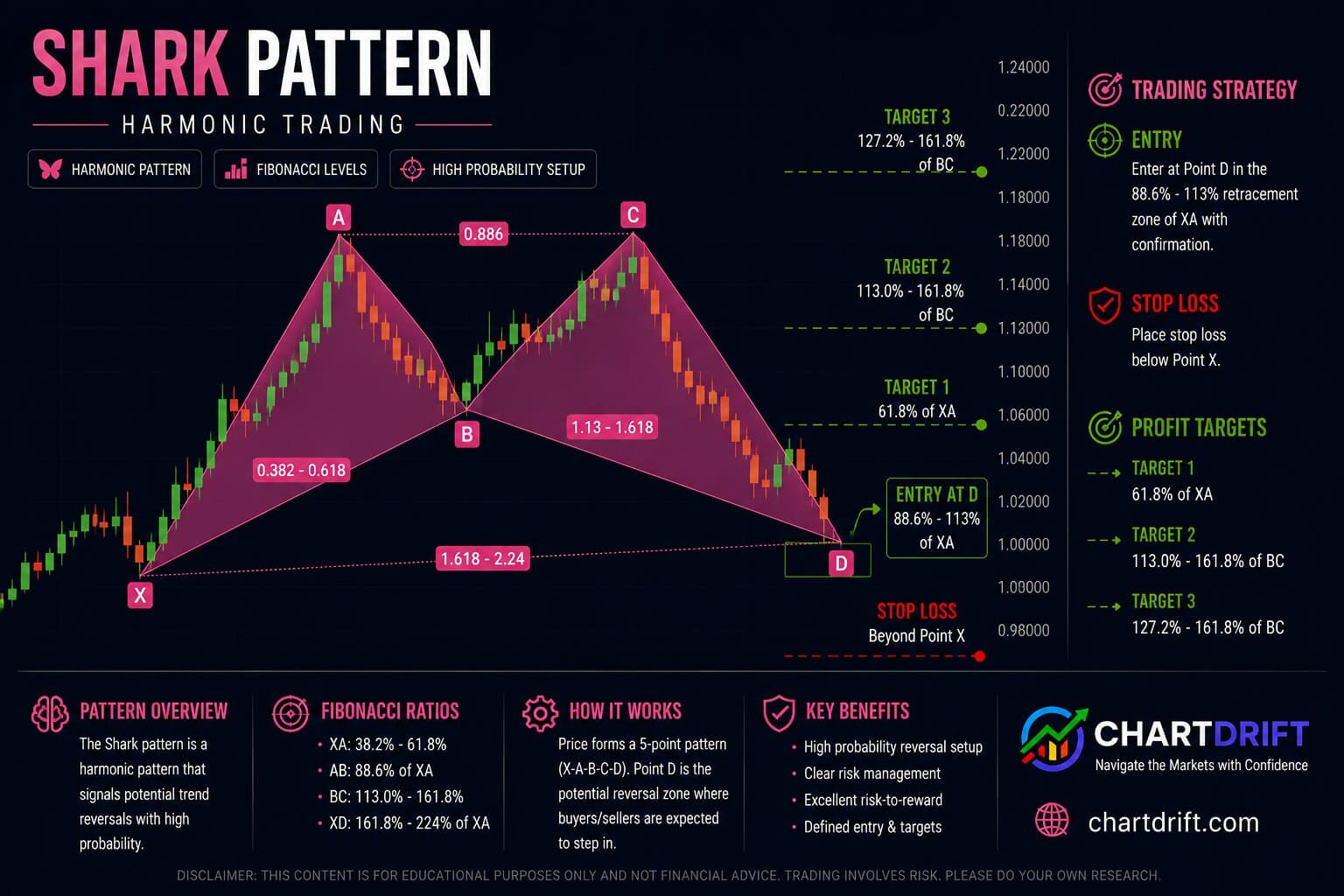
Key Characteristics
The Shark pattern uses a unique labeling system and specific Fibonacci ratios.
0/5 Structure
Unlike other patterns, Shark uses 0, X, A, B, C labeling. Point 0 starts the pattern instead of X.
113% Extension
The B point extends to 113% of the 0X leg—a unique ratio that defines the Shark.
88.6% Completion
Point C completes at 88.6% retracement of the 0B range, creating the PRZ.
What is the Shark Pattern?
The Shark Pattern is a relatively new harmonic structure discovered by Scott Carney. It uses a different labeling system (0, X, A, B, C instead of X, A, B, C, D) and features the unique 113% Fibonacci extension at point B.
Key Insight
The Shark can transform into a 5-0 pattern upon completion, offering a second trading opportunity. This dual nature makes it unique among harmonic patterns.
How to Identify the Pattern
Fibonacci Requirements
XA Leg
The initial move from X to A. No specific ratio required—establishes the base structure.
AB Leg (113% - 161.8% of 0X)
Point B extends beyond X, reaching 113% to 161.8% of the 0X leg.
BC Leg (88.6% of 0B)
Point C retraces 88.6% to 113% of the entire 0B range—the PRZ.
| Leg | Fibonacci Ratio |
|---|---|
| AB | 113% – 161.8% of 0X |
| BC (PRZ) | 88.6% – 113% of 0B |
Trading Strategy
Entry at Point C
PRZ Entry: Enter when price reaches the 88.6% retracement of 0B with confirmation candles. The extreme nature of the pattern requires patience.
Stop Loss
Beyond 113%: Place stop loss beyond the 113% extension of the 0B range. If price breaks this level, the pattern is invalid.
Profit Targets
Fibonacci Targets: Target 1: 50% retracement of BC. Target 2: Point B. Target 3: 88.6% of BC for aggressive targets.
5-0 Transition
After a Shark pattern completes at C, it can evolve into a 5-0 pattern. The reversal from C often creates a new structure that offers a second trading opportunity at the 50% retracement of the BC leg.
Risk Management
Defined PRZ
The 88.6% to 113% zone provides a clear area for entries and stop placement.
Two-Pattern Opportunity
The Shark can lead to a 5-0 pattern, giving you two potential trades from one formation.
Tips for Successful Trading
Confirm 113% Extension
The B point must extend beyond X. If it doesn't reach 113%, it's not a valid Shark.
Watch for 5-0 Setup
After entering at C, monitor for the 5-0 pattern that often follows for a second trade.
Respect the Unique Structure
Don't confuse Shark with Butterfly. The labeling and ratios are distinct.
Example Trade Setup
Identify Point 0
Pattern begins at $100 (point 0). Price moves to $150 (X).
Confirm XA Leg
Price drops to $120 (A), a standard retracement.
Validate B Extension
Price rallies to $156.50 (B)—113% of the 0X range. This confirms the Shark.
Enter at Point C
Price drops to $106 (88.6% of 0B). Bullish reversal forms. Enter long.
Manage Trade
Stop at $93. Target 1: $130, Target 2: $150, Target 3: $156.
Conclusion
The Shark Pattern offers a unique approach to harmonic trading with its 0/5 structure and potential evolution into a 5-0 pattern. While newer than classic harmonics, it provides distinct trading opportunities when properly identified.
Happy trading!
Frequently Asked Questions
What is the Shark harmonic pattern?
The Shark is a harmonic pattern with a 0/5 structure (points 0, 1, 2, 3) where the potential reversal zone is defined by extensions rather than a traditional five-point XABCD structure. It can evolve into a 5-0 pattern and is known for offering distinct entry zones at extreme price levels.
How is the Shark pattern different from Gartley or Butterfly?
The Shark uses a different structure: it relies on specific extension levels (e.g., 88.6% or 113% of the 0-2 leg) for the PRZ, rather than a D point that retraces XA. It is a more modern harmonic pattern and is often used when price shows an extended move that doesn't fit classic five-point patterns.
What are the key levels for the Shark pattern?
The Shark pattern uses the 0-2 leg and its extensions. The potential reversal zone (PRZ) is typically at 88.6% or 113% extension of the 0-2 move, depending on the variant. Point 3 (the entry zone) is where price is expected to reverse.
Is the Shark pattern bullish or bearish?
Both. A bullish Shark forms in a downtrend with the PRZ below; you look to buy at the completion of the pattern. A bearish Shark forms in an uptrend with the PRZ above; you look to sell. The structure is the same; only the direction and placement of the PRZ change.
Should I use confirmation with the Shark pattern?
Yes. Always wait for price to reach the PRZ and then show confirmation—such as a reversal candlestick, divergence, or rejection—before entering. The Shark can produce sharp reversals but is best traded with clear confirmation to avoid false signals.