Crab PatternHarmonic Trading
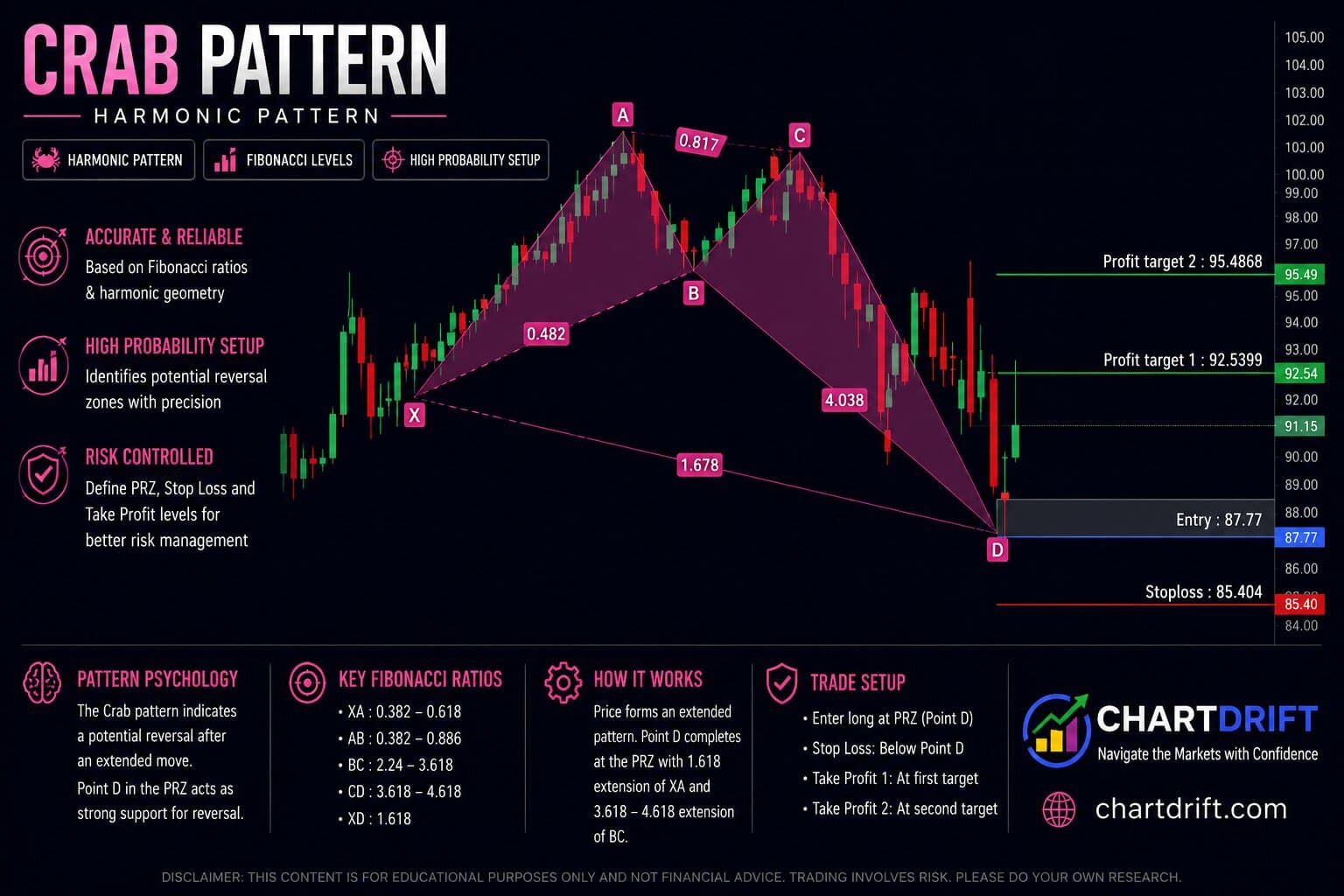
The most extended harmonic pattern with D at 161.8% of XA. Known for its extreme reversal potential and considered the most accurate harmonic pattern by Scott Carney.
Key Characteristics
The Crab extends beyond X to create extreme reversal zones with high accuracy.
161.8% Extension
Point D extends to 161.8% of XA—the golden ratio extension that defines extreme reversals.
Highest Accuracy
Scott Carney considers the Crab the most accurate harmonic pattern when properly identified.
Strong Reversals
The extreme extension often represents final exhaustion, leading to powerful reversals.
What is the Crab Pattern?
The Crab Pattern, discovered by Scott Carney in 2000, is characterized by its extreme 161.8% extension at point D. Unlike other harmonic patterns, D extends significantly beyond the starting point X, often catching traders in extended moves before reversing sharply.
Key Insight
The Crab often appears when markets are in extreme conditions. The 161.8% extension represents maximum extension before exhaustion, making it ideal for catching major reversals.
How to Identify the Pattern
Fibonacci Requirements
AB Leg (38.2% - 61.8% of XA)
A moderate retracement between 38.2% and 61.8% of the XA leg.
BC Leg (38.2% - 88.6% of AB)
Similar to other harmonic patterns, BC retraces between 38.2% and 88.6% of AB.
CD Leg (161.8% of XA)
The defining characteristic—D extends to 161.8% of XA, far beyond point X.
| Leg | Fibonacci Ratio |
|---|---|
| AB | 38.2% – 61.8% of XA |
| BC | 38.2% – 88.6% of AB |
| CD | 161.8% of XA |
Trading Strategy
Entry at 161.8%
Extreme Extension Entry: Enter when price reaches 161.8% of XA with strong reversal confirmation. Look for exhaustion candles and divergences.
Stop Loss
Beyond the 161.8%: Place stop loss slightly beyond the 161.8% level or use 224% as the invalidation point.
Profit Targets
Aggressive Targets: Due to the extreme extension, targets can be aggressive: 38.2%, 61.8%, and 100% retracement of the CD leg.
Example Calculation
If the Crab pattern has:
- X at:
$100 - A at:
$150(bullish)
D = X - (XA × 61.8%)
D = $100 - ($50 × 0.618) = $69.10
(161.8% extension below X)
Risk Management
Tight PRZ Stops
The PRZ at 161.8% is precise. If price moves beyond 200%, the pattern is likely invalid.
Scale In
Consider scaling into the position as price approaches and confirms at the 161.8% level.
Tips for Successful Trading
Look for Exhaustion
The 161.8% level often represents exhaustion. Look for volume spikes and reversal patterns.
Use Multiple Confirmations
Combine with RSI divergence, Bollinger Band extremes, or support/resistance for higher probability.
Don't Chase Extended Moves
If price blows through 161.8% without hesitation, the pattern may be invalid. Wait for confirmation.
Example Trade Setup
Identify XA Leg
Price rallies from $100 (X) to $150 (A), establishing a $50 range.
Confirm AB
Price retraces to $125 (B), a 50% retracement of XA—within valid range.
Validate BC
Price rallies to $145 (C), retracing 80% of AB.
Enter at D (161.8%)
Price drops to $69.10 (161.8% of XA beyond X). Bullish engulfing forms. Enter long.
Manage Trade
Stop at $60 (beyond 200%). Target 1: $95, Target 2: $115, Target 3: $145.
Conclusion
The Crab Pattern is the most extended harmonic pattern and offers exceptional reversal opportunities. The 161.8% extension creates precise entry points at extreme price levels, making it a favorite among experienced harmonic traders.
Happy trading!
Frequently Asked Questions
What is the Crab harmonic pattern?
The Crab is a five-point (X-A-B-C-D) harmonic pattern with an extreme 161.8% extension at point D. It often produces the sharpest reversals because D extends far beyond X, creating a clear exhaustion zone. The Crab is favored for its high risk-reward and precise PRZ.
What are the Fibonacci ratios for the Crab pattern?
The Crab uses: B retracement of XA at 38.2% or 61.8%; C retracement of AB at 38.2% or 88.6%; and XD extension where D is at 161.8% of XA. The 161.8% extension is the key level that defines the Potential Reversal Zone at D.
How is the Crab different from the Butterfly?
Both extend beyond X, but the Crab uses a 161.8% extension for D, while the Butterfly often uses 127% or 161.8%. The Crab is considered the most extreme harmonic pattern and often appears at the end of very extended moves. The structure (B and C ratios) also differs slightly.
Why is the Crab pattern popular with harmonic traders?
The Crab offers one of the best risk-reward profiles: the 161.8% extension creates a clear exhaustion zone, and reversals from D can be sharp. When combined with confirmation, the Crab can produce high-probability entries with a stop that is relatively well-defined (just beyond D).
Should I wait for confirmation before entering a Crab trade?
Yes. Always wait for price to reach the PRZ at D and then show confirmation—such as a reversal candlestick, RSI divergence, or rejection from a key level. Entering early (before D is complete) increases the risk of a failed trade because the pattern may not complete.