MACD Indicator
Moving Average Convergence Divergence, the go-to momentum oscillator for identifying trend changes, measuring momentum strength, and generating reliable buy/sell signals.
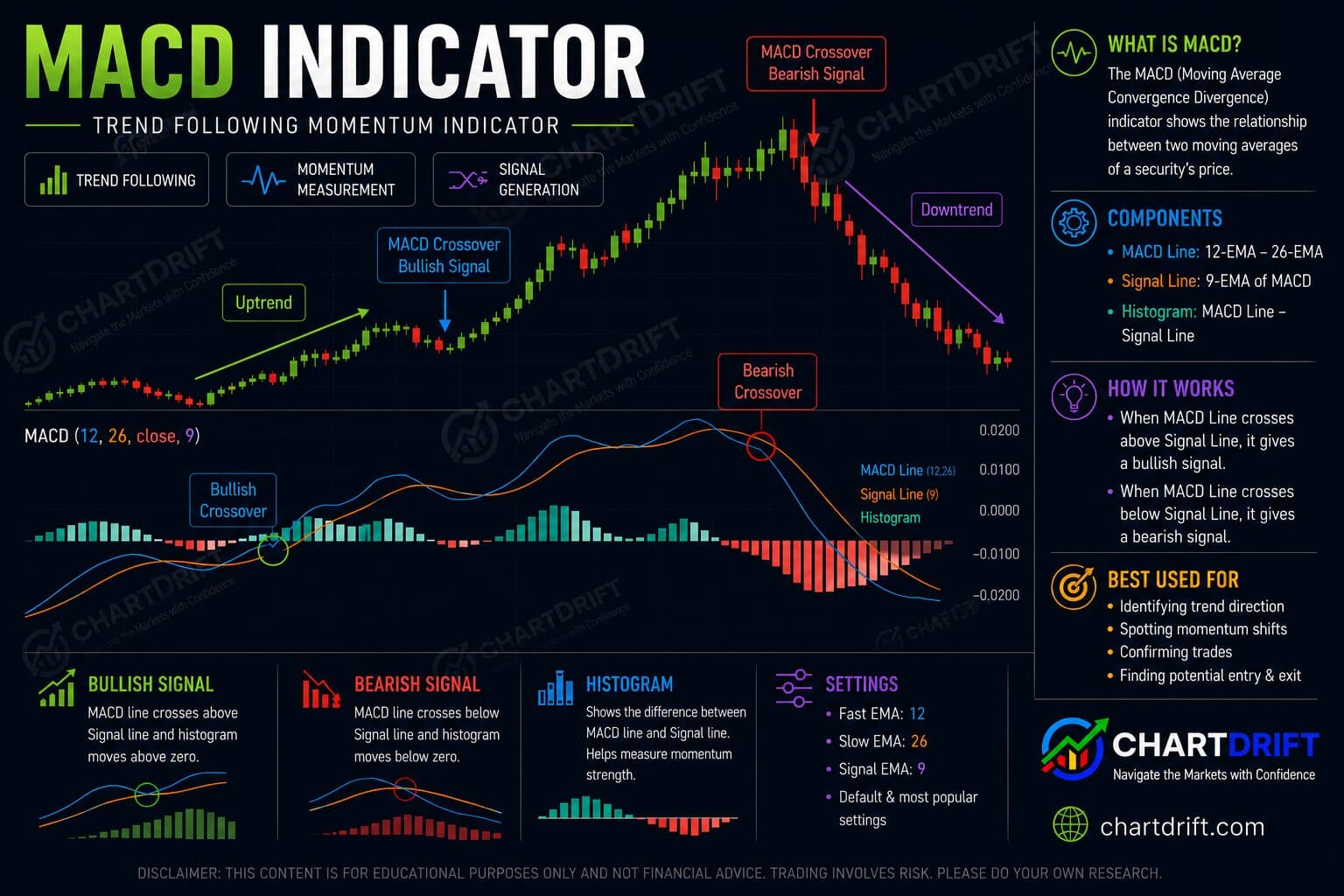
MACD Line
12-period EMA minus 26-period EMA. Shows momentum direction and strength.
Signal Line
9-period EMA of MACD line. Crossovers generate trading signals.
Histogram
Visual difference between MACD and Signal line. Shows momentum acceleration.
Zero Line
Center reference point. Crossovers indicate trend direction changes.
Understanding the MACD
The MACD was developed by Gerald Appel in the late 1970s and has become one of the most popular technical indicators among traders. It reveals changes in strength, direction, momentum, and duration of a trend.
Unlike simple moving averages, the MACD uses exponential moving averages (EMAs) which give more weight to recent prices. This makes it more responsive to current price action while still providing reliable trend information.
MACD Calculation
MACD Line = 12-period EMA − 26-period EMA
Signal Line = 9-period EMA of MACD Line
Histogram = MACD Line − Signal Line
Trading Signals
Bullish Signal Line Crossover
When the MACD line crosses above the signal line, it suggests upward momentum is increasing. This is a potential buy signal, especially when occurring below the zero line.
Bearish Signal Line Crossover
When the MACD line crosses below the signal line, downward momentum is building. Consider this a sell signal, particularly when it happens above the zero line.
Zero Line Crossover
MACD crossing above zero confirms bullish trend; crossing below confirms bearish. These signals are slower but more reliable than signal line crossovers.
Histogram Momentum
Rising histogram bars indicate strengthening momentum. Shrinking bars suggest momentum is fading — often preceding a crossover signal.
MACD Divergence
Divergence occurs when price moves in the opposite direction of the MACD indicator. This powerful signal often precedes significant trend reversals.
Bullish Divergence
Price makes lower lows while MACD makes higher lows. This suggests selling pressure is weakening and a reversal to the upside may be imminent.
Bearish Divergence
Price makes higher highs while MACD makes lower highs. This indicates buying momentum is fading despite rising prices — a warning of potential reversal.
Best Practices
Use Multiple Timeframes
Confirm signals on higher timeframes before trading on lower ones. A bullish crossover on the daily chart adds weight to a 4-hour signal.
Combine with Price Action
Look for MACD signals at key support/resistance levels. A bullish crossover at major support is more significant than one in the middle of a range.
Beware of False Signals
MACD can produce whipsaws in ranging markets. Wait for histogram confirmation or use additional filters like volume or other indicators.
Optimal Settings
While the default 12, 26, 9 settings work well for most markets, you can adjust them based on your trading style and the asset you're analyzing.
| Trading Style | Fast EMA | Slow EMA | Signal | Use Case |
|---|---|---|---|---|
| Standard | 12 | 26 | 9 | Most markets, swing trading |
| Fast | 5 | 13 | 1 | Day trading, scalping |
| Slow | 19 | 39 | 9 | Position trading, less noise |
Frequently Asked Questions
What is MACD and how does it work?
MACD (Moving Average Convergence Divergence) is a momentum indicator that shows the relationship between two moving averages of price. It consists of a MACD line (fast EMA minus slow EMA), a signal line (EMA of the MACD line), and a histogram. Crossovers and divergence help identify trend changes and momentum.
What do MACD crossovers mean?
When the MACD line crosses above the signal line, it generates a bullish signal; when it crosses below, a bearish signal. Zero-line crossovers indicate a shift in the short-term average relative to the long-term average and can confirm trend direction.
What are the best MACD settings?
The default 12, 26, 9 (fast, slow, signal) works well for daily charts. For faster signals use 5, 13, 1; for smoother, less noise use 19, 39, 9. Choose based on your timeframe and trading style.
What is MACD divergence?
Bullish divergence: price makes a lower low while MACD makes a higher low, suggesting weakening downtrend. Bearish divergence: price makes a higher high while MACD makes a lower high, suggesting weakening uptrend. Divergence often precedes reversals but should be confirmed with price action.
Can MACD be used for all timeframes?
Yes. MACD works on intraday, daily, and weekly charts. Shorter timeframes produce more signals and noise; longer timeframes give fewer but often stronger signals. Many traders use MACD on higher timeframes to confirm trend and on lower timeframes for entries.