Bollinger Bands
Bollinger Bands measure volatility by plotting bands above and below a moving average. The bands expand during high volatility and contract during low volatility, helping traders anticipate breakouts and reversals.
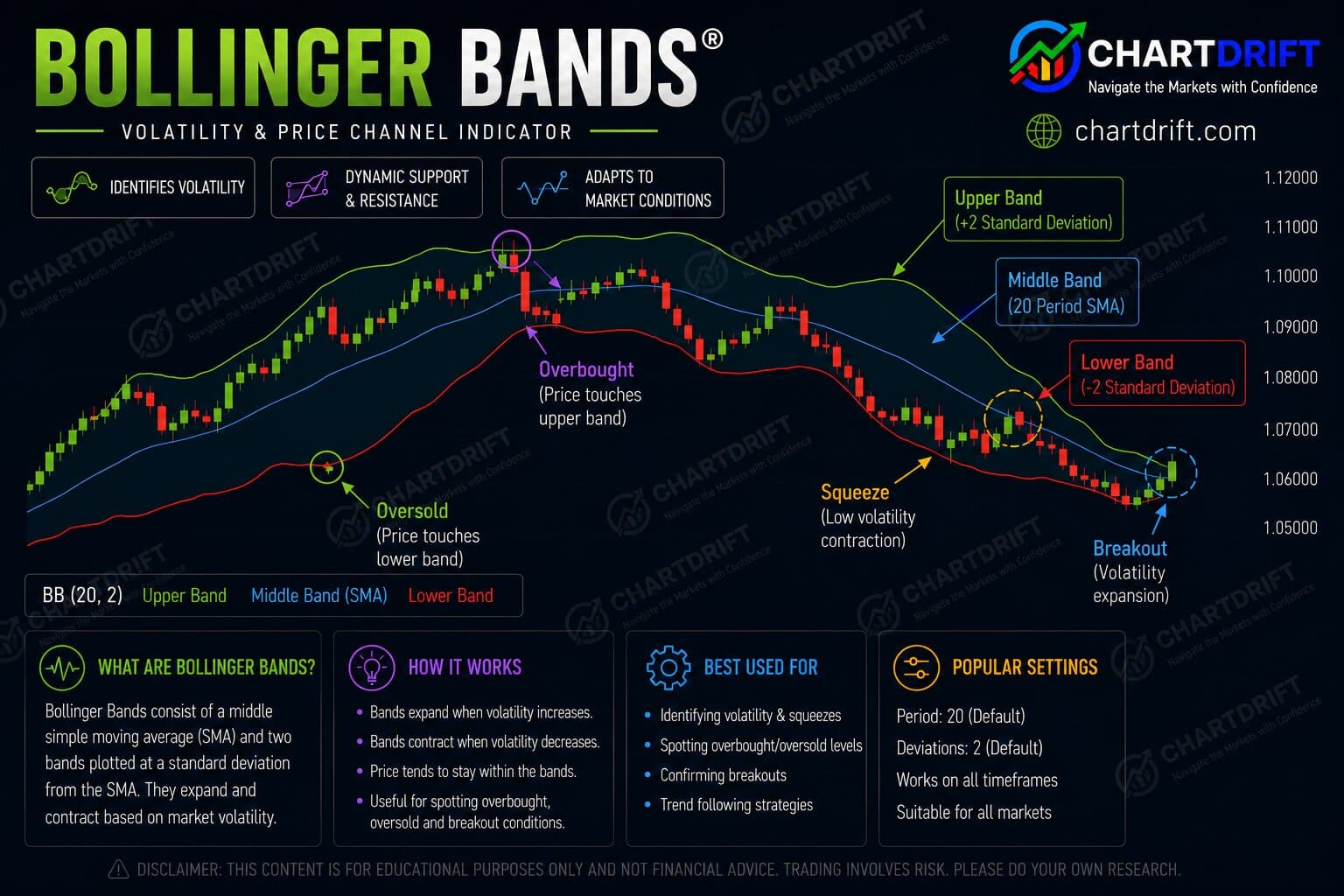
What are Bollinger Bands?
Created by John Bollinger in the 1980s, Bollinger Bands consist of a middle band (usually a 20-period SMA) with upper and lower bands set at a specified number of standard deviations away (typically 2).
The key insight: about 95% of price action occurs within 2 standard deviations of the mean. When price touches or exceeds the bands, it may be extended and due for a reversal — or signaling a strong trend continuation.
Understanding the Components
Middle Band (SMA)
The 20-period Simple Moving Average acts as the baseline. It shows the intermediate-term trend and serves as dynamic support/resistance.
Standard Deviation Bands
The upper and lower bands are calculated using standard deviation, which measures price volatility. Higher volatility = wider bands; lower volatility = narrower bands.
Band Width
The distance between upper and lower bands. Narrow width indicates low volatility (potential breakout setup); wide width indicates high volatility (trend in progress).
The Bollinger Squeeze
The "squeeze" is one of the most powerful Bollinger Band setups. It occurs when the bands narrow significantly, indicating low volatility. Low volatility periods often precede explosive moves.
Identifying the Squeeze
Look for the bands to contract to their narrowest point in recent history. This compression signals that a big move is likely coming.
- • Bands at 6-month narrow point
- • Price consolidating in tight range
- • Volume typically declining
Trading the Breakout
When price breaks out of the squeeze, it often leads to a sustained move in the breakout direction. The first candle to close outside the bands signals entry.
- • Wait for close outside the bands
- • Look for volume confirmation
- • Set stop at opposite band
Walking the Bands
During strong trends, price can "walk" along the upper or lower band, repeatedly touching or exceeding it. This is NOT a reversal signal — it indicates trend strength.
Bullish Band Walk
Price repeatedly touches or closes above the upper band while staying above the middle band. The trend is strong — buy dips to the middle band.
Bearish Band Walk
Price repeatedly touches or closes below the lower band while staying below the middle band. The trend is strong — sell rallies to the middle band.
Trading Strategies
Mean Reversion Strategy
In ranging markets, trade bounces off the bands back toward the middle. This works when price is NOT in a strong trend.
- Buy: Price touches lower band + bullish candle
- Sell: Price touches upper band + bearish candle
- Target: Middle band (20 SMA)
- Stop: Beyond the touched band
Breakout Continuation
After a squeeze breakout, price often pulls back to the middle band before continuing. This creates a lower-risk entry opportunity.
- • Wait for squeeze breakout
- • Let price pull back to middle band
- • Enter on bounce from middle band
- • Trail stop using the middle band
Optimal Settings
| Trading Style | Period | StdDev | Notes |
|---|---|---|---|
| Scalping | 10 | 1.5 | Tighter bands, more signals |
| Day Trading | 20 | 2 | Default setting |
| Swing Trading | 20 | 2 | Works across timeframes |
| Position Trading | 50 | 2.5 | Wider bands, fewer signals |
Bollinger %B Indicator
%B shows where price is relative to the bands (0 = lower band, 1 = upper band). This quantified version makes it easier to create systematic trading rules and backtest strategies.
Frequently Asked Questions
What are Bollinger Bands?
Bollinger Bands consist of a middle band (usually a 20-period SMA) and two outer bands set at a number of standard deviations above and below. They help measure volatility and identify overbought/oversold conditions relative to recent price action.
What does a Bollinger Band squeeze mean?
A squeeze occurs when the bands narrow, indicating low volatility. It often precedes a strong move—breakouts from a squeeze can be explosive. Direction is not given by the squeeze alone; use price action or other indicators to confirm.
What does walking the bands mean?
In strong trends, price can 'walk' along the upper band (uptrend) or lower band (downtrend). Touching the band is not necessarily a sell or buy signal; it can indicate continued momentum. Reversals often start when price moves away from the band toward the middle.
What are the default Bollinger Bands settings?
The standard is 20-period SMA with 2 standard deviations. John Bollinger recommends starting there; some use 20, 2.1 to capture about 85–90% of price inside the bands. Adjust period for your timeframe.
Can Bollinger Bands be used with other indicators?
Yes. Combining with RSI or volume can filter signals—e.g. buy when price touches the lower band and RSI is oversold. Using with a trend indicator (e.g. moving average) helps avoid counter-trend trades in strong trends.