Cypher PatternHarmonic Trading
A unique harmonic pattern that uses the 78.6% retracement of the XC leg to define point D. Known for its distinctive structure and reliable reversal signals.
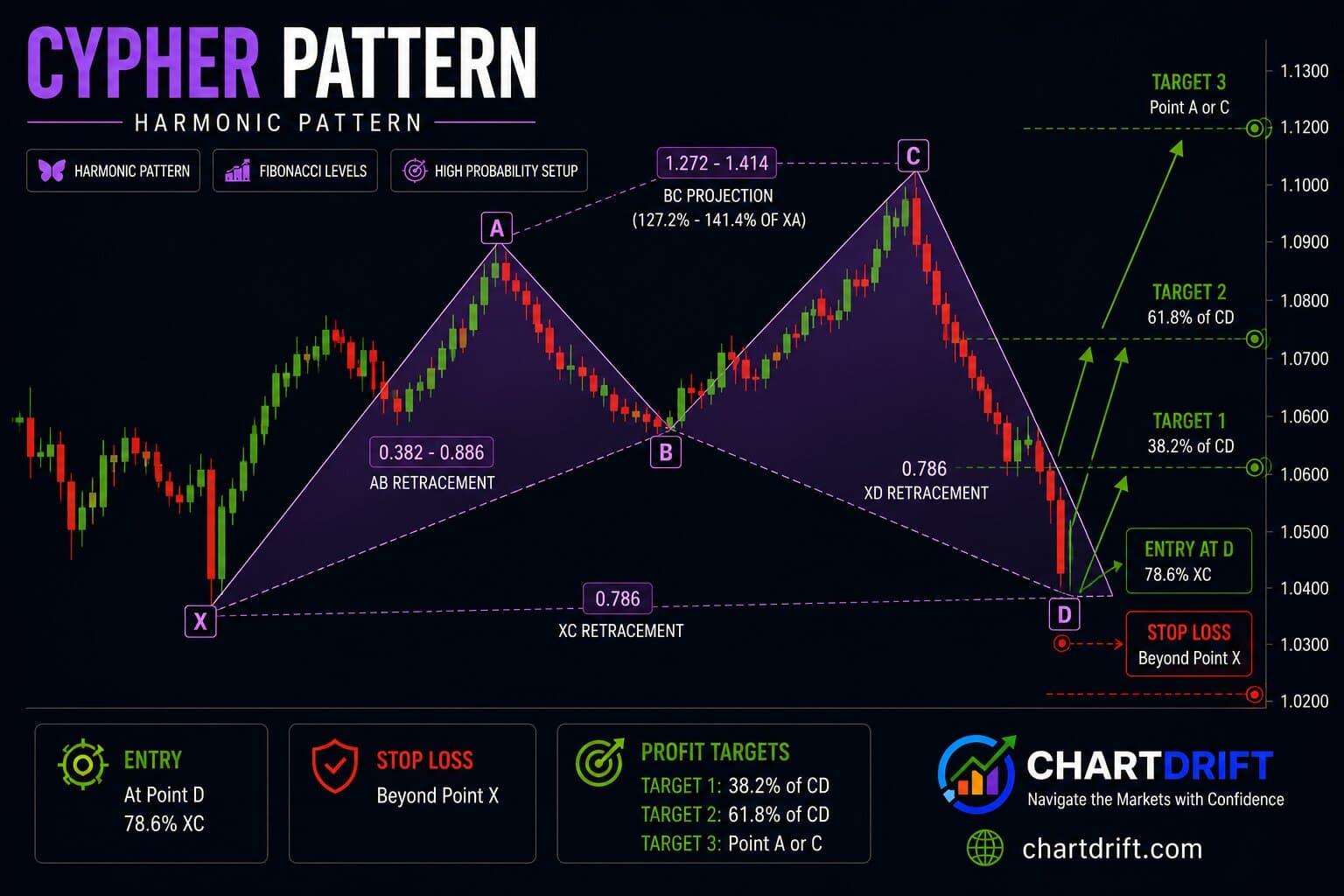
Key Characteristics
The Cypher features a unique measurement method using the XC leg for the final retracement.
XC Retracement
Unlike other patterns, D is measured from the XC leg, not XA. This creates a unique structure.
C Beyond A
Point C must extend beyond point A (between 127.2% and 141.4% of XA).
78.6% Completion
Point D completes at 78.6% retracement of the XC leg—the PRZ.
What is the Cypher Pattern?
The Cypher Pattern is distinct from other harmonic patterns because it measures the completion point D from the XC leg rather than XA. Discovered by Darren Oglesbee, it features an extended C point that goes beyond A before completing.
Key Insight
The Cypher's use of the XC leg for measuring D makes it unique. The extended C creates a more dynamic pattern structure with specific entry and exit points.
How to Identify the Pattern
Fibonacci Requirements
AB Leg (38.2% - 61.8% of XA)
Standard Fibonacci retracement similar to other harmonic patterns.
BC Leg (127.2% - 141.4% of XA)
Point C must extend beyond A—this is what defines the Cypher.
CD Leg (78.6% of XC)
The defining measurement—D retraces 78.6% of the entire XC distance.
| Leg | Fibonacci Ratio |
|---|---|
| AB | 38.2% – 61.8% of XA |
| BC | 127.2% – 141.4% of XA |
| CD | 78.6% of XC |
Trading Strategy
Entry at Point D
78.6% XC Entry: Enter when price reaches the 78.6% retracement of the XC leg with confirmation. Look for reversal candles at this level.
Stop Loss
Beyond Point X: Place stop loss just beyond point X. This provides a clear invalidation level for the pattern.
Profit Targets
Fibonacci Targets: Target 1: 38.2% of CD. Target 2: 61.8% of CD. Target 3: Point A or C for aggressive targets.
Example Calculation
If the Cypher pattern has:
- X at:
$100 - C at:
$180
XC Range = $180 - $100 = $80
D = C - (XC × 78.6%) = $180 - ($80 × 0.786) = $117.12
Risk Management
Clear Invalidation
Point X serves as a clear invalidation level. If D breaks X, the pattern fails.
Multiple Targets
The extended C point provides multiple profit-taking levels at A, B, and C.
Tips for Successful Trading
Confirm C Extension
Point C must exceed point A. If it doesn't, the pattern isn't a valid Cypher.
Use XC for D Measurement
Remember: D is 78.6% of XC, not XA. This is what makes Cypher unique.
Volume Confirmation
Look for volume expansion at point D to confirm the reversal.
Example Trade Setup
Identify XA Leg
Price rallies from $100 (X) to $150 (A), a $50 move.
Confirm AB Retracement
Price retraces to $125 (B), a 50% retracement of XA.
Validate C Extension
Price rallies to $180 (C), which is 160% of XA—exceeding point A.
Enter at Point D
XC range = $80. D = $180 - ($80 × 0.786) = $117.12. Enter long at D.
Manage Trade
Stop at $98 (below X). Target 1: $140, Target 2: $160, Target 3: $175.
Conclusion
The Cypher Pattern offers a unique approach to harmonic trading by measuring the completion point from the XC leg. Its extended C structure and precise 78.6% retracement make it a valuable pattern for traders seeking defined entry and exit points.
Happy trading!
Frequently Asked Questions
What is the Cypher harmonic pattern?
The Cypher is a five-point (X-A-B-C-D) harmonic pattern that measures the completion point (D) from the XC leg. Unlike the Gartley or Bat, the Cypher has an extended C leg, and D is defined as a 78.6% retracement of XC. This creates a distinct PRZ and is popular among harmonic traders.
What are the Fibonacci ratios for the Cypher pattern?
The Cypher uses: B retracement of XA at 38.2% to 61.8%; C extension beyond A (often 127% or 141.4% of XA); and D as a 78.6% retracement of the XC leg. The 78.6% retracement of XC defines the Potential Reversal Zone at D.
How is the Cypher different from the Gartley pattern?
In the Gartley, point D is a 78.6% retracement of XA. In the Cypher, point D is a 78.6% retracement of XC. The Cypher has an extended C leg (C goes beyond A), which changes where D forms. The Cypher often appears in strong trends where price extends further before reversing.
Is the Cypher pattern reliable?
When the structure is clear and you wait for price to reach the PRZ at D with confirmation (reversal candle, RSI, or support/resistance), the Cypher can be very effective. As with all harmonics, avoid forcing the pattern—only trade when the ratios and structure align.
Where do I place my stop loss on a Cypher trade?
Place your stop loss just beyond point D (outside the PRZ). For a bullish Cypher, stop below D; for a bearish Cypher, stop above D. This keeps risk defined while giving the trade room to develop from the reversal zone.