AB=CD PatternThe Building Block
The foundational harmonic pattern where CD leg equals AB in both price and time. Master this pattern first—it's the building block of all advanced harmonic structures.
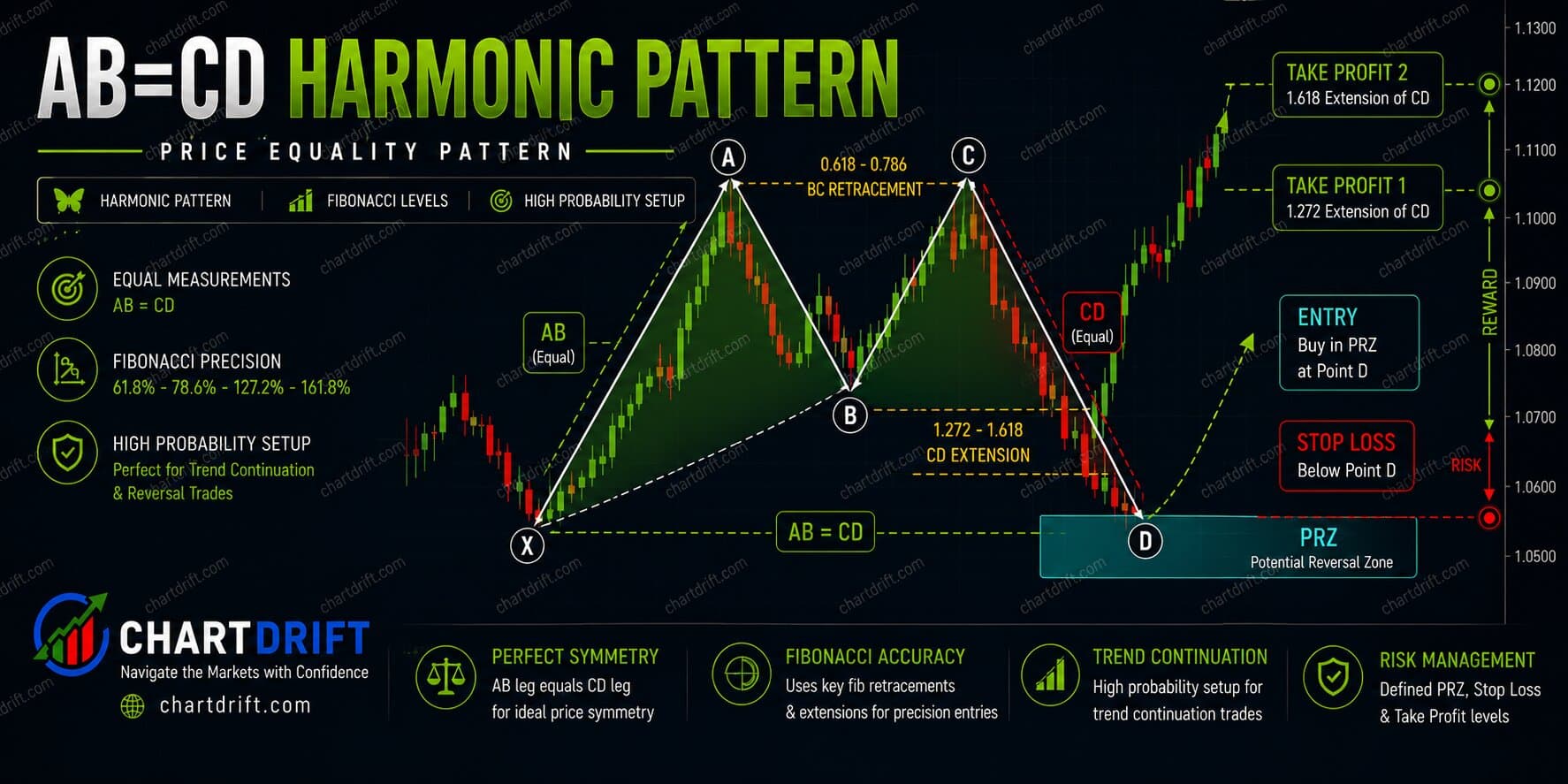
Key Characteristics
The AB=CD is the simplest harmonic pattern and forms the basis of more complex structures.
Symmetrical Legs
The CD leg should equal the AB leg in price distance. This symmetry is the pattern's defining feature.
Time Symmetry
Ideally, the time taken for CD should equal the time for AB, creating a harmonious structure.
61.8% Retracement
Point C typically retraces 61.8% of the AB leg, with CD extending to complete the pattern.
What is the AB=CD Pattern?
The AB=CD pattern is the most basic harmonic structure and serves as the foundation for all other harmonic patterns. It consists of two equivalent price legs (AB and CD) with a corrective wave (BC) between them. When CD equals AB, price often reverses at point D.
Key Insight
Every advanced harmonic pattern (Gartley, Butterfly, Bat, Crab) contains an AB=CD structure within it. Mastering the AB=CD is essential for understanding all harmonic trading.
How to Identify the Pattern
Pattern Structure
AB Leg (Initial Move)
The first price swing from A to B. This establishes the pattern's magnitude.
BC Leg (61.8% - 78.6% of AB)
The corrective wave retracing 61.8% to 78.6% of AB. This is the "pullback" before CD.
CD Leg (Equal to AB)
The final leg should equal AB in price distance. D is where the pattern completes and reverses.
AB=CD Variations
Classic AB=CD
BC retraces 61.8% of AB, and CD extends 161.8% of BC.
Extended AB=CD
BC retraces 78.6% of AB, and CD extends 127.2% of BC.
Trading Strategy
Entry at Point D
Measured Move Entry: Calculate where CD will equal AB and enter when price reaches that level with reversal confirmation.
Stop Loss
Beyond D Extension: Place stop loss beyond the 127.2% extension of AB measured from C. If pattern extends past this, it's likely failed.
Profit Targets
Fibonacci Targets: Target 1: 38.2% of CD. Target 2: 61.8% of CD. Target 3: Point C or full AD retracement.
Example Calculation
If the AB=CD pattern has:
- A at:
$100 - B at:
$150(AB = $50) - C at:
$119(61.8% of AB)
D = C + AB = $119 + $50 = $169
(CD equals AB in price distance)
Risk Management
Defined Risk
The calculated D point provides a precise entry with clear stop-loss placement.
High Frequency
The AB=CD appears frequently across all timeframes and markets, providing many trading opportunities.
Tips for Successful Trading
Check Time Symmetry
The best AB=CD patterns have similar time between AB and CD. This adds to the pattern's reliability.
Look for Confluence
AB=CD at support/resistance levels or with other patterns increases probability significantly.
Allow for Slight Extension
D doesn't have to be exactly equal to AB. Allow for 100% to 127.2% AB extension from C.
Example Trade Setup
Identify AB Leg
Price moves from $100 (A) to $150 (B), establishing a $50 AB leg.
Confirm BC Retracement
Price retraces to $119 (C), a 61.8% retracement of AB.
Calculate Point D
D = C + AB = $119 + $50 = $169. Set alerts for this level.
Enter at Point D
Price reaches $169. Bearish engulfing candle forms. Enter short.
Manage Trade
Stop at $177 (127.2% extension). Target 1: $150, Target 2: $135, Target 3: $119.
Conclusion
The AB=CD pattern is the foundation of harmonic trading. Its simplicity makes it easy to identify, while its frequency provides numerous trading opportunities. Master this pattern first, and you'll have a solid foundation for all advanced harmonic structures.
Happy trading!
Frequently Asked Questions
What is the AB=CD harmonic pattern?
The AB=CD pattern is a four-point (A-B-C-D) harmonic structure where the CD leg is equal in time and price to the AB leg. It is one of the simplest and most common harmonic patterns and forms the building block for more complex patterns like the Gartley and Butterfly.
What are the rules for the AB=CD pattern?
The classic AB=CD requires: (1) CD is equal in length to AB (or a 1.272/1.618 extension); (2) time from C to D is roughly equal to time from A to B; (3) CD often retraces 61.8% or 78.6% of the prior move before completing. The completion of D is the Potential Reversal Zone.
Is the AB=CD pattern bullish or bearish?
Both. A bullish AB=CD forms in a downtrend with D as a buying zone; a bearish AB=CD forms in an uptrend with D as a selling zone. The structure is symmetric—only the direction and context change.
How do I use the AB=CD with other harmonic patterns?
The AB=CD is often embedded in five-point patterns (Gartley, Butterfly, Bat, Crab). The AB and CD legs form part of the XA and XD structure. Many traders learn AB=CD first and then add the X point and Fibonacci rules to trade full harmonic patterns.
Where should I place my stop loss on an AB=CD trade?
Place your stop loss just beyond point D (outside the PRZ). For a bullish AB=CD, stop below D; for a bearish AB=CD, stop above D. Some traders also use a small buffer (e.g., ATR) beyond D to avoid noise.