Bat PatternHarmonic Trading
Discovered by Scott Carney in 2001, the Bat pattern features a deep 88.6% retracement and is known for its high accuracy rate in identifying reversals.
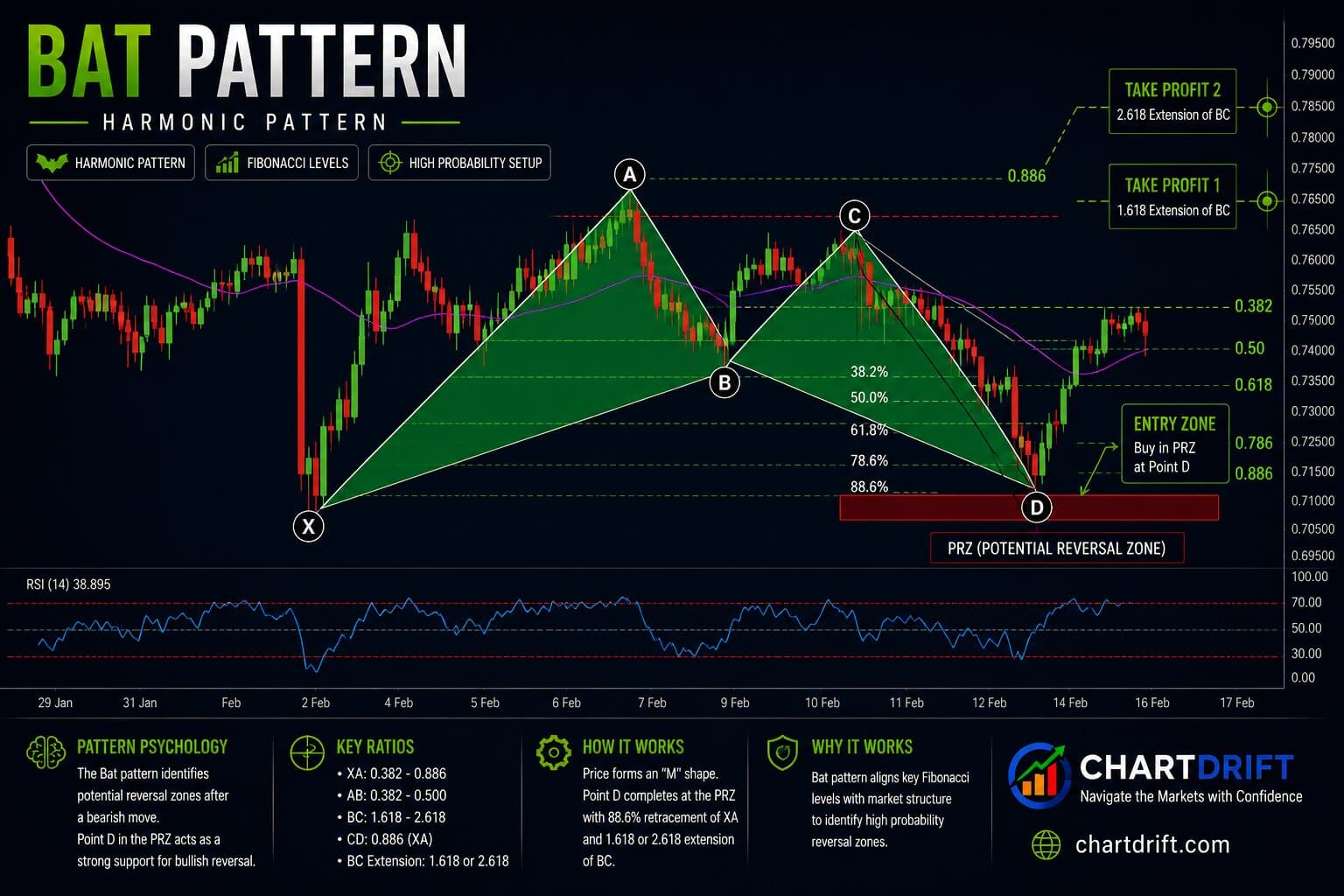
Key Characteristics
The Bat pattern is known for its deep retracement and high accuracy rate.
88.6% Retracement
Point D completes at the deep 88.6% retracement of XA—the pattern's defining characteristic.
Shallow AB Retracement
Unlike Gartley, the AB leg only retraces 38.2% to 50% of XA, creating a shallower initial pullback.
Excellent Risk-Reward
The deep D point retracement allows for tight stops near X with large profit potential.
What is the Bat Pattern?
The Bat Pattern was discovered by Scott Carney in 2001. It's a precise harmonic pattern that uses the 88.6% retracement level at point D—a Fibonacci ratio derived from the square root of 0.786. This deep retracement often marks significant reversal zones.
Key Insight
The Bat pattern is considered one of the most accurate harmonic patterns. The deep 88.6% retracement often represents final capitulation before a reversal.
How to Identify the Pattern
Fibonacci Requirements
AB Leg (38.2% - 50% of XA)
A shallow retracement—key differentiator from the Gartley pattern.
BC Leg (38.2% - 88.6% of AB)
Retraces between 38.2% and 88.6% of the AB leg.
CD Leg (88.6% of XA)
The defining ratio—D completes at 88.6% retracement of XA.
| Leg | Fibonacci Ratio |
|---|---|
| AB | 38.2% – 50% of XA |
| BC | 38.2% – 88.6% of AB |
| CD | 88.6% of XA |
Trading Strategy
Entry at 88.6%
Deep Retracement Entry: Enter when price reaches the 88.6% retracement of XA with confirmation candles. This level often marks final capitulation.
Tight Stop Loss
Just Beyond X: Place stop loss slightly beyond point X. The deep retracement means your stop is very close, improving risk-reward.
Profit Targets
Conservative to Aggressive: Target 1: 38.2% of CD. Target 2: 61.8% of CD. Target 3: Point A for full pattern completion.
Example Calculation
If the Bat pattern has:
- X at:
$100 - A at:
$200
D = A - (XA × 88.6%)
D = $200 - ($100 × 0.886) = $111.40
Risk Management
Superior Risk-Reward
The 88.6% retracement means D is very close to X, allowing for minimal risk with maximum reward.
High Accuracy
When all ratios align, the Bat pattern boasts one of the highest accuracy rates among harmonic patterns.
Tips for Successful Trading
Check AB Ratio First
The 38.2-50% AB retracement is what differentiates Bat from Gartley. Verify this first.
88.6% is Non-Negotiable
The D point must complete at 88.6%. If it's closer to 78.6%, you have a Gartley instead.
Respect the Stop
If price breaks X, the pattern has failed. Don't hold hoping for a reversal.
Example Trade Setup
Identify XA Movement
Price rallies from $100 (X) to $200 (A), a $100 move.
Confirm Shallow AB
Price retraces to $155 (B), only 45% of XA—within the valid 38.2-50% range.
Validate BC
Price rallies to $185 (C), retracing 67% of AB.
Enter at Point D
Price drops to $111.40 (88.6% of XA). Bullish hammer forms. Enter long.
Execute Trade
Stop at $98 (below X). Target 1: $145, Target 2: $170, Target 3: $200.
Conclusion
The Bat Pattern offers exceptional risk-reward ratios due to its deep 88.6% retracement. When combined with price action confirmation, it's one of the most reliable harmonic setups available.
Happy trading!
Frequently Asked Questions
What is the Bat harmonic pattern?
The Bat is a five-point (X-A-B-C-D) harmonic pattern with a deep 88.6% retracement at point D. It is similar to the Gartley but uses a deeper retracement (88.6% instead of 78.6%), which often creates a tighter stop and strong reversal zone. The Bat tends to form in strong trends.
What are the Fibonacci ratios for the Bat pattern?
The Bat uses: B retracement of XA at 38.2% or 50%; C retracement of AB at 38.2% or 88.6%; and D retracement of XA at 88.6%. The 88.6% level at D is the defining feature and forms the Potential Reversal Zone (PRZ).
How does the Bat differ from the Gartley pattern?
The main difference is the D retracement: the Gartley uses 78.6% of XA, while the Bat uses 88.6%. The Bat therefore has a deeper retracement and often appears when price pulls back further before reversing. Both are five-point structures with similar B and C rules.
Is the Bat pattern reliable?
When combined with price action confirmation (reversal candles, RSI divergence, or support/resistance), the Bat can be very reliable due to its precise PRZ. Always wait for price to reach the 88.6% zone and confirm before entering; avoid anticipating the reversal.
Where should I place my stop loss on a Bat trade?
Place your stop loss just beyond point D (outside the PRZ). For a bullish Bat, stop below D; for a bearish Bat, stop above D. The deep retracement often allows for a relatively tight stop while still giving the trade room to develop.