Gartley PatternHarmonic Trading
The original harmonic pattern discovered by H.M. Gartley in 1935. Known as the "222" pattern, it offers high-probability reversals with the classic 78.6% retracement.
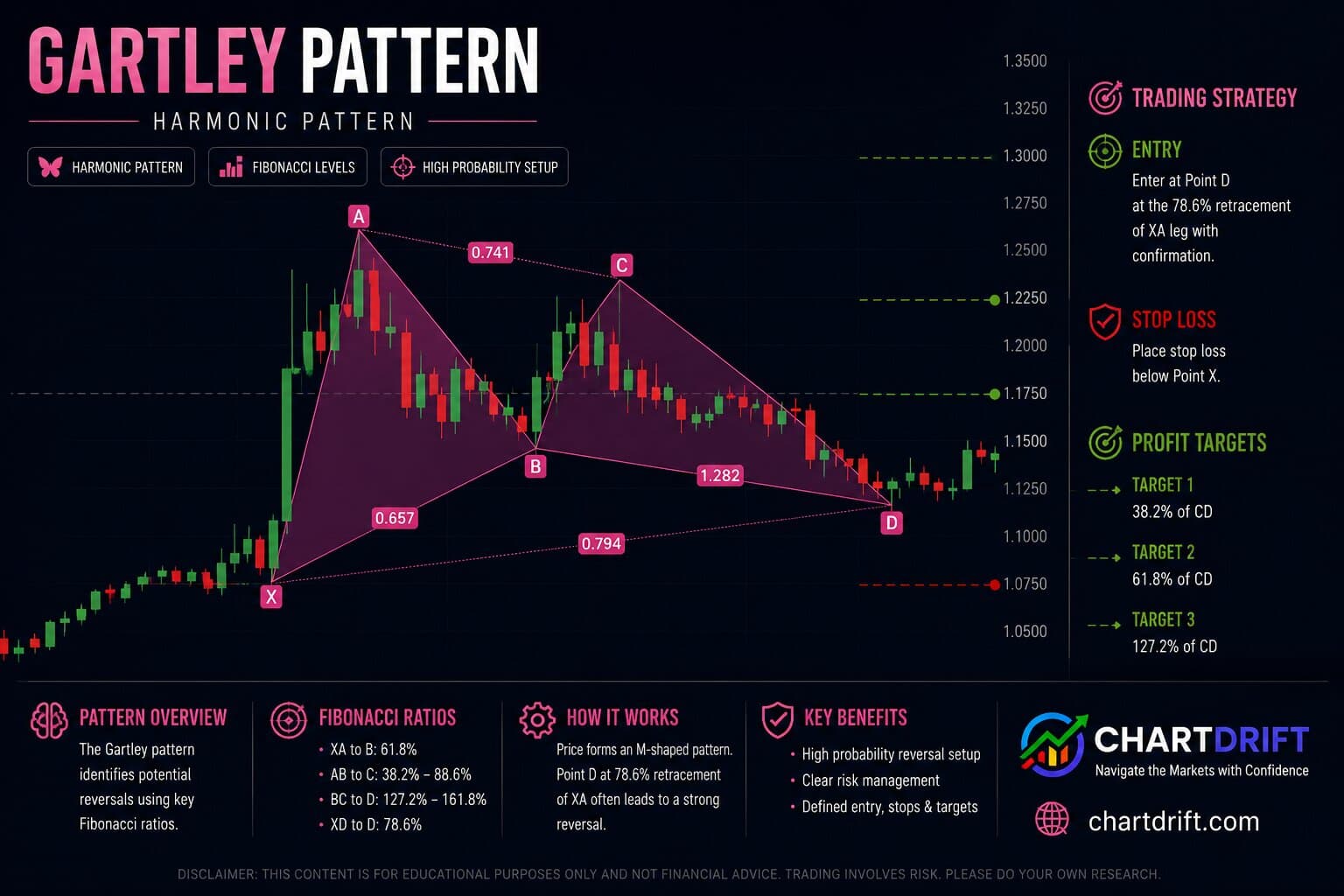
Key Characteristics
The Gartley is the foundation of all harmonic patterns. Understanding it is essential for harmonic trading.
78.6% Retracement
Point D completes at exactly 78.6% retracement of the XA leg—the defining characteristic of the Gartley.
D Within XA Range
Unlike the Butterfly, point D stays within the XA leg range, never extending beyond point X.
High Win Rate
When properly identified with all ratios in alignment, the Gartley offers some of the highest probability setups.
What is the Gartley Pattern?
The Gartley Pattern, also known as "Gartley 222" (from the page number in H.M. Gartley's 1935 book), is the foundational harmonic pattern. It consists of four price legs (XA, AB, BC, CD) that follow specific Fibonacci ratios, creating a potential reversal zone at point D.
Key Insight
The Gartley differs from the Butterfly in that point D stays within the XA range. This makes it a retracement pattern rather than an extension pattern, often providing tighter stop losses and better risk-reward ratios.
How to Identify the Pattern
Fibonacci Requirements
AB Leg (61.8% of XA)
Point B retraces 61.8% of the XA leg. This is the first validation point of the pattern.
BC Leg (38.2% - 88.6% of AB)
The BC leg retraces between 38.2% to 88.6% of AB, with 78.6% being ideal.
CD Leg (78.6% of XA)
Point D completes at 78.6% retracement of XA and 127.2% - 161.8% extension of BC.
| Leg | Fibonacci Ratio |
|---|---|
| AB | 61.8% of XA |
| BC | 38.2% – 88.6% of AB |
| CD | 78.6% of XA |
Trading Strategy
Entry at Point D
Enter at 78.6% Retracement: Wait for price to reach the 78.6% retracement of XA. Look for reversal candlesticks (doji, hammer, engulfing) before entering.
Stop Loss Placement
Below/Above Point X: Place stop loss just beyond point X. If price breaks X, the pattern is invalidated.
Profit Targets
Fibonacci Targets: Target 1: 38.2% of CD. Target 2: 61.8% of CD. Target 3: Point A (full pattern retracement).
Example Calculation
If the Gartley pattern has:
- X at:
$100 - A at:
$150 - XA Range:
$50
D = A - (XA × 78.6%)
D = $150 - ($50 × 0.786) = $110.70
Risk Management
Tight Stop Loss
The Gartley offers tight stops since D is within the XA range. Risk is limited to the distance from D to X.
Position Sizing
Risk 1-2% per trade. The Gartley's defined structure makes position sizing straightforward.
Tips for Successful Trading
Verify All Ratios
Don't force the pattern. All Fibonacci ratios must align for a valid Gartley setup.
Look for Confluence
The best setups occur when point D aligns with other support/resistance levels or trend lines.
Wait for Confirmation
Don't enter blindly at the 78.6% level. Wait for price action confirmation like reversal candles.
Example Trade Setup
Identify XA Leg
Price moves from $100 (X) to $150 (A), establishing a $50 range.
Confirm AB Retracement
Price retraces to $119 (B), which is 61.8% of XA ($50 × 0.618 = $31).
Validate BC Leg
Price rallies to $140 (C), retracing 68% of AB—within the valid range.
Enter at Point D
Price reaches $110.70 (78.6% of XA). A bullish engulfing candle forms. Enter long.
Manage the Trade
Stop loss at $98 (below X). Target 1 at $125, Target 2 at $140, Target 3 at $150.
Conclusion
The Gartley Pattern is the cornerstone of harmonic trading. Its well-defined structure with the 78.6% retracement at point D provides excellent risk-reward opportunities. Master the Gartley first, and other harmonic patterns will become much easier to understand.
Happy trading!
Frequently Asked Questions
What is the Gartley harmonic pattern?
The Gartley pattern is a five-point (X-A-B-C-D) harmonic structure named after H.M. Gartley. Point D retraces to 78.6% of the XA leg, forming the Potential Reversal Zone (PRZ). It is one of the most widely used harmonic patterns and often appears at key support or resistance levels.
What are the Fibonacci ratios for the Gartley pattern?
The classic Gartley uses: B retracement of XA at 61.8%; C retracement of AB at 38.2% or 88.6%; and D retracement of XA at 78.6%. The 78.6% level at D is the critical zone for entry. These ratios can vary slightly depending on the source (e.g., 0.618 for B, 0.786 for D).
How is the Gartley different from the Butterfly pattern?
In the Gartley, point D stays within the range of X (78.6% retracement of XA). In the Butterfly, point D extends beyond X (127% or 161.8% of XA). The Gartley is often considered a tighter, earlier reversal setup; the Butterfly tends to form after more extended moves.
Should I trade both bullish and bearish Gartley patterns?
Yes. A bullish Gartley forms in a downtrend with D as a buying zone; a bearish Gartley forms in an uptrend with D as a selling zone. The structure and ratios are the same; only the market context and direction of the trade change.
Where do I place my stop loss on a Gartley trade?
Place your stop loss just beyond point D (and beyond the PRZ). For a bullish Gartley, stop below D; for a bearish Gartley, stop above D. Some traders also use the extreme of the XA leg or a small buffer beyond D to avoid being stopped out by noise.