Three DrivesHarmonic Pattern
A unique harmonic pattern featuring three consecutive drives with Fibonacci extensions. The completion of the third drive often signals exhaustion and reversal.
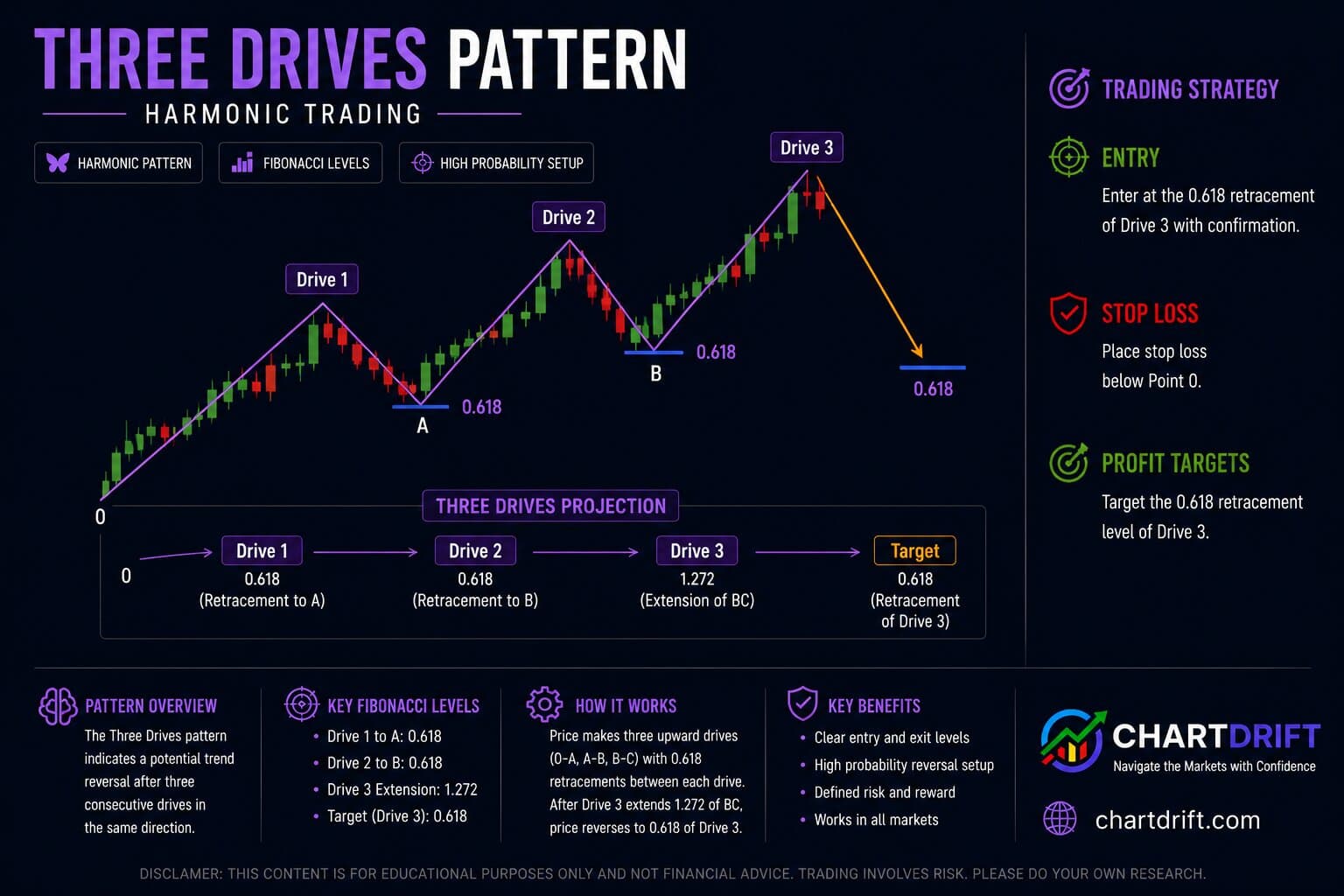
Key Characteristics
The Three Drives pattern features symmetrical drives with consistent Fibonacci relationships.
Three Drives
The pattern consists of three consecutive drives in the same direction, each extending by Fibonacci ratios.
127.2% Extensions
Each drive typically extends 127.2% or 161.8% of the previous correction.
Symmetry in Time
The time between drives should be roughly symmetrical for the pattern to be valid.
What is the Three Drives Pattern?
The Three Drives pattern is a reversal setup consisting of three consecutive pushes (drives) in the same direction, each separated by a retracement. After the third drive completes at a Fibonacci extension level, the pattern often reverses sharply.
Key Insight
The Three Drives represents market exhaustion. After three attempts to push in the same direction, buyers or sellers become exhausted, leading to a reversal.
How to Identify the Pattern
Pattern Structure
Drive 1
The first push in the trend direction. This establishes the pattern's baseline.
Drive 2 (127.2% - 161.8% of Correction 1)
After a 61.8% or 78.6% retracement, the second drive extends to 127.2% or 161.8%.
Drive 3 (127.2% - 161.8% of Correction 2)
The final drive extends similarly. Completion of Drive 3 marks the PRZ for reversal.
| Component | Fibonacci Ratio |
|---|---|
| Corrections | 61.8% – 78.6% retracement |
| Drive 2 | 127.2% – 161.8% of Correction 1 |
| Drive 3 | 127.2% – 161.8% of Correction 2 |
Trading Strategy
Entry at Drive 3
Third Drive Entry: Enter when the third drive completes at the 127.2% or 161.8% extension with reversal confirmation candles.
Stop Loss
Beyond Drive 3: Place stop loss beyond the 161.8% extension of the third drive. Pattern fails if price extends beyond this level.
Profit Targets
Drive Retracements: Target 1: Beginning of Drive 3. Target 2: Beginning of Drive 2. Target 3: Beginning of Drive 1.
Time Symmetry
The strongest Three Drives patterns have similar time durations between drives. If Drive 1 takes 5 days, Drive 2 and 3 should also take approximately 5 days each. This symmetry adds to the pattern's reliability.
Risk Management
Exhaustion
Three drives often represents exhaustion. The reversal can be sharp and profitable.
Clear Structure
The three-drive structure makes it easy to identify entry, stop, and target levels.
Tips for Successful Trading
Check Time Symmetry
The best patterns have equal time between drives. Asymmetrical patterns are less reliable.
Look for Divergence
RSI or MACD divergence at Drive 3 adds significant confirmation to the reversal signal.
Volume Analysis
Declining volume on each successive drive is a sign of exhaustion and increases reversal probability.
Example Trade Setup
Identify Drive 1
Price rallies from $100 to $130 (Drive 1), then retraces 61.8% to $111.40.
Confirm Drive 2
Price extends to $145 (127.2% of Correction 1), then retraces 61.8% to $124.20.
Calculate Drive 3
Drive 3 target = 127.2% of Correction 2 = $150.50.
Enter at Drive 3
Price reaches $150.50. Bearish engulfing with RSI divergence. Enter short.
Manage Trade
Stop at $158. Target 1: $130, Target 2: $115, Target 3: $100.
Conclusion
The Three Drives pattern offers a unique way to identify market exhaustion. With its requirement for three consecutive drives and Fibonacci symmetry, it provides clear entry and exit points for traders looking to catch reversals.
Happy trading!
Frequently Asked Questions
What is the Three Drives harmonic pattern?
The Three Drives pattern is a reversal setup that requires three consecutive drives (legs) in the same direction, each meeting Fibonacci symmetry (e.g., 127% or 161.8% of the previous drive). The third drive often marks exhaustion and a potential reversal. It is one of the older harmonic concepts and is used across timeframes.
What are the Fibonacci rules for the Three Drives pattern?
Typically, each drive is a 127% or 161.8% extension of the previous drive (or the retracement between drives is 61.8% or 78.6%). The third drive completes at a key extension level, forming the Potential Reversal Zone. Symmetry in time and price between the three drives strengthens the pattern.
Is the Three Drives pattern bullish or bearish?
Both. A bullish Three Drives forms after three consecutive down drives; you look to buy at the completion of the third drive. A bearish Three Drives forms after three consecutive up drives; you look to sell at the completion of the third drive.
How is the Three Drives different from AB=CD or Gartley?
The Three Drives uses three symmetric drives in one direction, with Fibonacci extensions between them. The AB=CD is a four-point structure (A-B-C-D); the Gartley is a five-point structure (X-A-B-C-D). The Three Drives focuses on exhaustion after three pushes rather than a retracement to a specific level.
Where do I place my stop loss on a Three Drives trade?
Place your stop loss just beyond the end of the third drive (beyond the PRZ). For a bullish Three Drives, stop below the low of the third drive; for a bearish Three Drives, stop above the high of the third drive. This keeps risk defined while allowing the reversal to develop.