Diamond PatternChart Pattern
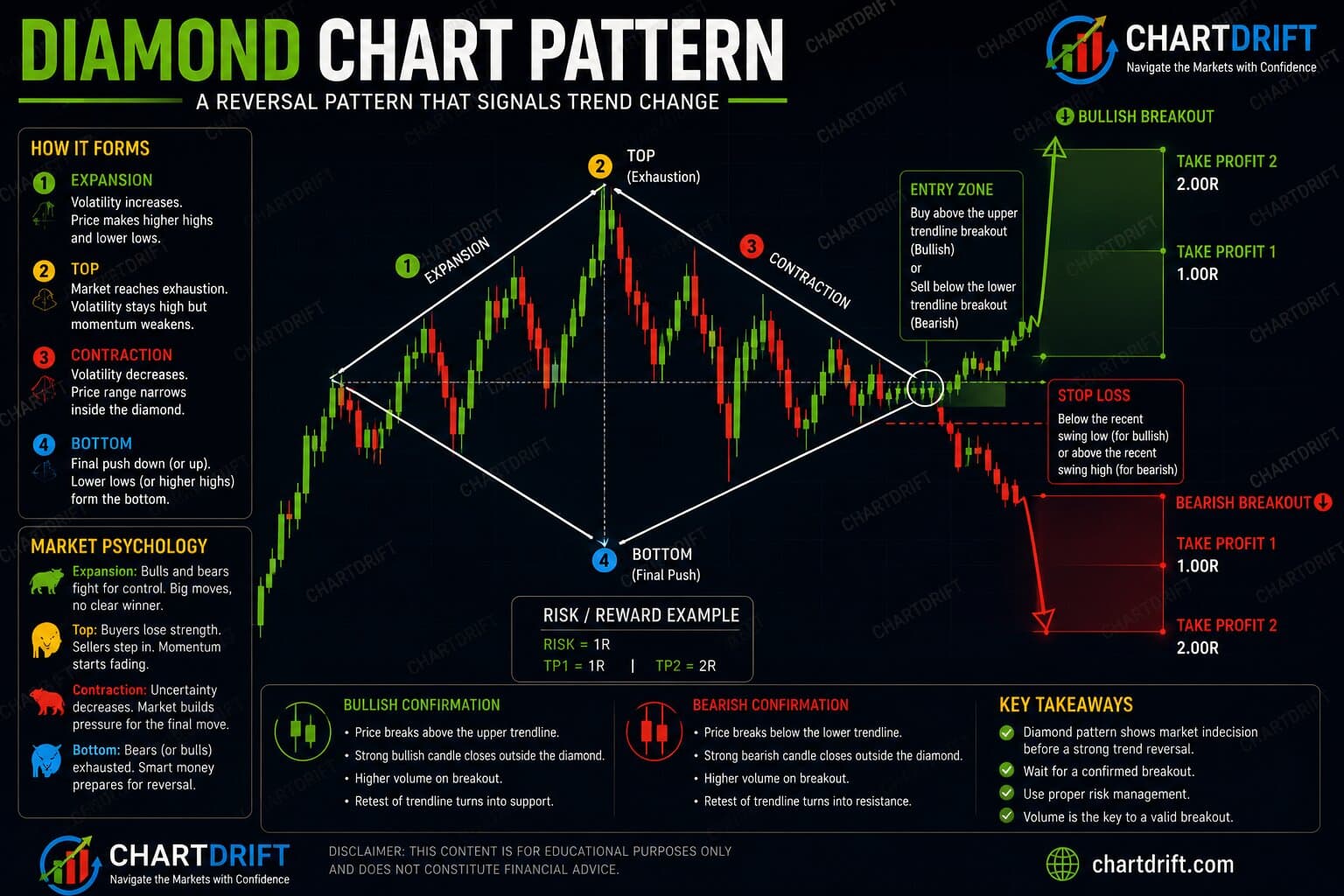
A rare and complex pattern that combines a broadening formation with a symmetrical triangle. When volatility expands then contracts into a diamond shape, major moves follow.
Key Characteristics
Understanding these essential features will help you spot the rare Diamond pattern with confidence.
Diamond Shape
Four trendlines forming a diamond—first diverging (broadening), then converging (narrowing). The result is a distinct four-sided shape.
Volatility Shift
Expanding volatility in the first half as the market is undecided, contracting in the second half as one side gains control.
Multiple Touches
At least 2 touches on each of the four trendlines for valid pattern recognition. More touches increase reliability.
What is the Diamond Pattern?
The Diamond pattern is a rare formation that looks like a four-sided diamond on the chart. It begins with a broadening pattern (expanding volatility) and ends with a symmetrical triangle (contracting volatility). Also known as Diamond Top or Diamond Bottom depending on its location.
Key Insight
The Diamond pattern shows increasing uncertainty (broadening) followed by decreasing uncertainty (narrowing). Initially, market participants are highly divided on direction, causing volatility to expand. As the pattern matures, one side gains control and volatility contracts until a decisive breakout occurs.
How to Identify the Pattern
Structure of Diamond Pattern
Broadening Phase
The first half shows expanding highs and lows, forming the left side of the diamond. Volatility increases as the market struggles for direction.
Contracting Phase
The second half shows converging highs and lows, forming the right side of the diamond. Volatility decreases as one side starts to dominate.
Draw Four Trendlines
Connect the highs and lows to form four trendlines that create the diamond shape. The pattern should be clearly visible.
Wait for Breakout
The breakout direction determines the trade. Diamond Tops break down; Diamond Bottoms break up. Volume should confirm the breakout.
Diamond Top vs Diamond Bottom
Diamond Top
Forms at market peaks after an uptrend. Typically breaks down, signaling a bearish reversal. More common than Diamond Bottom.
Diamond Bottom
Forms at market troughs after a downtrend. Typically breaks up, signaling a bullish reversal. Less common but equally powerful.
Trading Strategy
Diamond Top Entry (Bearish)
Short Entry: When the pattern forms at a peak, enter short on a confirmed break below the lower right trendline. Wait for a close below with volume confirmation.
Diamond Bottom Entry (Bullish)
Long Entry: When the pattern forms at a trough, enter long on a confirmed break above the upper right trendline. Volume should increase on breakout.
Setting Stop Loss
Stop Loss Placement: For shorts, place stop above the pattern high. For longs, place stop below the pattern low. The diamond's extreme provides natural protection.
Determining Target Price
Measuring Technique: Measure the height of the diamond at its widest point. Project this distance from the breakout point in the direction of the break.
Example Calculation (Diamond Top)
If the Diamond Top has:
- Diamond High:
$150 - Diamond Low:
$120 - Breakout Point:
$125
Height = $150 - $120 = $30
Target = $125 (breakout) - $30 = $95
Risk Management
Risk-Reward Ratio
Aim for at least 1:2. The diamond's height provides excellent targets while stops can be placed at pattern extremes.
Pattern Rarity
Diamonds are rare patterns. Don't force the pattern—if it's not clearly visible, it's probably not a diamond. Wait for clear formations.
Tips for Successful Trading
Higher Timeframes Are Better
Diamonds are more reliable on daily and weekly charts. They need time to develop and the psychological impact is greater.
Don't Force the Pattern
Diamonds are rare—if you have to squint to see it, it's probably not a diamond. Look for clearly visible four-sided shapes.
Confirm with Volume
Volume should decrease during formation and surge on breakout. Low volume breakouts often fail.
Example Trade Setup
Identify the Pattern
Spot a Diamond Top forming on a daily chart at market highs. Look for the distinctive broadening then narrowing shape.
Draw Your Trendlines
Connect the expanding highs/lows on the left and converging highs/lows on the right to form the diamond.
Enter the Trade
When price breaks below the lower right trendline at $125 with strong volume, enter a short position.
Set Stop Loss
Place your stop loss at $152, above the diamond's highest point.
Determine Target Price
With a diamond height of $30, set your target at $95 ($125 - $30).
Conclusion
The Diamond pattern is rare but powerful. When you spot one forming at major market turning points, it often signals significant moves ahead. By following a systematic approach—identifying the pattern clearly, waiting for volume-confirmed breakouts, and managing risk properly—you can capitalize on these high-probability setups.
Happy trading!
Frequently Asked Questions
What is the diamond chart pattern?
The diamond is a reversal pattern that starts with expanding volatility (widening range) and then contracts (converging trendlines), forming a diamond shape. When price breaks out of the diamond, it often signals a trend reversal. It’s relatively rare but can appear at major turning points.
Does the diamond have a bullish or bearish bias?
The diamond can break up or down. Context helps: after an uptrend, a break below often leads to a downtrend; after a downtrend, a break above often leads to an uptrend. Volume often increases on the breakout. Wait for the break before entering.
Where should I enter on a diamond pattern?
Enter when price breaks out of the diamond with a decisive close beyond one of the trendlines. Many traders wait for a retest of the broken boundary before entering. Volume confirmation on the breakout improves odds.
Where do I place my stop loss on a diamond trade?
Place your stop loss on the opposite side of the diamond from your entry. For a long (break above), stop below the diamond’s lower boundary. For a short (break below), stop above the diamond’s upper boundary.
Why is the diamond pattern considered rare?
The diamond requires a specific sequence: first expanding range (widening highs and lows), then contracting range (converging trendlines). That combination doesn’t form as often as simpler patterns like triangles or rectangles. When it does form at key levels, it can signal significant moves.