Rectangle PatternChart Pattern
A horizontal consolidation pattern where price bounces between parallel support and resistance levels before breaking out.
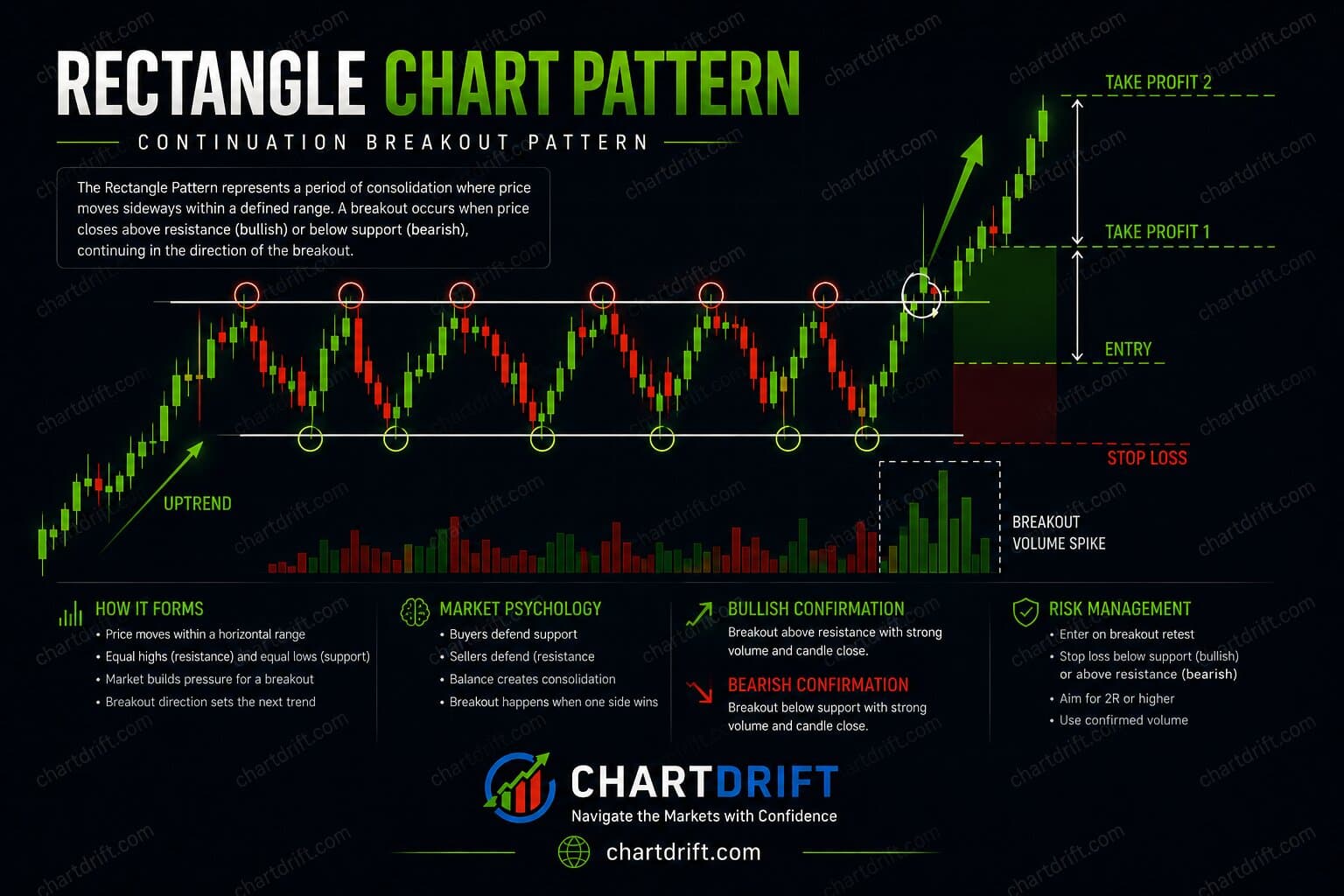
What is a Rectangle Pattern?
The Rectangle is a continuation pattern that forms when price consolidates between horizontal support and resistance levels. Also known as a trading range or consolidation zone, it represents a pause in the trend.
Price oscillates between these levels until one side gives way, typically breaking in the direction of the prior trend.
Market Psychology
Rectangles form when buyers and sellers reach a temporary equilibrium. Buyers step in at support, believing price is too low. Sellers enter at resistance, believing price is too high.
This tug-of-war continues until one side exhausts its resources or new information tips the balance, leading to a breakout.
How to Identify
Horizontal Resistance
Two or more highs at approximately the same level forming a flat ceiling.
Horizontal Support
Two or more lows at approximately the same level forming a flat floor.
Multiple Touches
The more times each level is tested, the more significant the eventual breakout.
Trading Strategies
Breakout Entry (Bullish)
Enter long when price breaks above resistance with increased volume. Stop-loss below the rectangle support.
Breakdown Entry (Bearish)
Enter short when price breaks below support with increased volume. Stop-loss above the rectangle resistance.
Real Examples
Rectangles can last from a few weeks to several months. Longer consolidations often lead to more powerful breakouts as more orders accumulate at the boundaries.
In uptrends, rectangles typically break upward; in downtrends, they typically break downward—but always wait for confirmation.
Common Mistakes
Fading False Breakouts
Price can fake out above/below before reversing—wait for confirmation.
Use Volume Confirmation
Valid breakouts show significant volume expansion.
Frequently Asked Questions
What is the rectangle chart pattern?
The rectangle (or trading range) is a consolidation pattern with horizontal support and resistance. Price moves between the two levels until it breaks out. The breakout can go up or down; context (prior trend) and volume help. It’s one of the most common continuation patterns.
Does the rectangle have a bullish or bearish bias?
By itself, no. The rectangle can break up or down. In an uptrend, breakouts often go up; in a downtrend, breakouts often go down. Volume often increases on the breakout—the direction of the break defines the trade. Wait for the break before entering.
Where should I enter on a rectangle?
Enter when price breaks out of the rectangle with a decisive close beyond support or resistance. Many traders wait for a retest of the broken level before entering. Volume confirmation on the breakout improves odds. Avoid entering before the break.
Where do I place my stop loss on a rectangle trade?
Place your stop loss on the opposite side of the rectangle from your entry. For a long (break above), stop below the rectangle’s support. For a short (break below), stop above the rectangle’s resistance. Some traders use a buffer inside the range.
How do I set a target for a rectangle breakout?
A common method is the measured move: measure the height of the rectangle and project that distance from the breakout point. For a break above, add the height to the resistance; for a break below, subtract the height from the support. That gives a first target.