Cup and HandleChart Pattern
A powerful bullish continuation pattern popularized by William O'Neil, featuring a U-shaped cup followed by a handle consolidation before breakout.
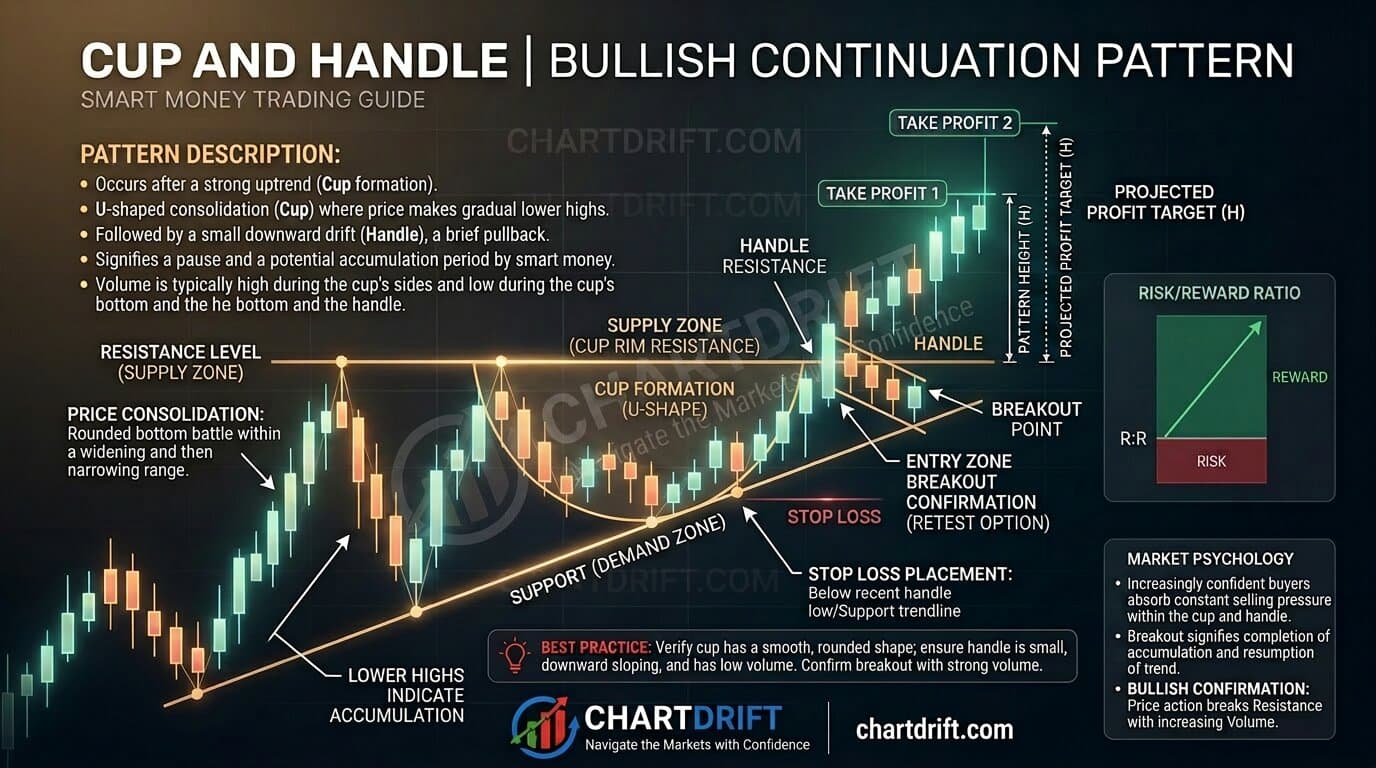
What is Cup and Handle?
The Cup and Handle pattern was popularized by William O'Neil, founder of Investor's Business Daily. It's one of the most reliable bullish continuation patterns, featuring a U-shaped consolidation (cup) followed by a smaller downward drift (handle).
The pattern typically forms over 7-65 weeks and indicates a period of accumulation before prices break out to new highs.
Market Psychology
The cup forms as early buyers take profits and price gradually declines, then bottoms and recovers as smart money accumulates. The rounded bottom shows a smooth transition from selling to buying pressure.
The handle represents a final shakeout of weak hands before the breakout. It drifts lower on decreasing volume as remaining sellers exit before the powerful move higher.
How to Identify
U-Shaped Cup
A rounded bottom, not V-shaped. Depth should be 12-35% from high to low.
Handle Formation
A small pullback in the upper half of the cup, drifting lower on light volume.
Volume Pattern
Volume decreases on the cup's descent, increases on the rise, light in handle, heavy on breakout.
Trading Strategies
Handle Breakout Entry
Enter long when price breaks above the handle's high (the pivot point) with at least 40% above-average volume. Stop-loss below the handle low.
Prior High Entry
More conservative entry: wait for price to break above the cup's left rim high. Lower risk but less profit potential.
Real Examples
Cup and Handle patterns are especially powerful in growth stocks and during bull markets. Many of the biggest stock winners formed this pattern before their major runs.
The pattern works on daily, weekly, and even intraday charts, but the weekly timeframe provides the most reliable signals for position traders.
Common Mistakes
V-Shaped Cups
Sharp V-bottoms don't qualify—the cup should be rounded and gradual.
U-Shaped Recovery
Look for smooth, gradual bottoming showing orderly accumulation.
Deep Handle
Handle shouldn't drop more than 12-15% or below the cup's midpoint.
Tight Handle
Handle should be a minor consolidation with declining volume.
Frequently Asked Questions
What is the cup and handle chart pattern?
The cup and handle is a bullish continuation pattern. It looks like a tea cup: a rounded U-shaped decline (the cup) followed by a short consolidation or shallow pullback (the handle). A breakout above the handle’s resistance signals a resumption of the prior uptrend.
How deep should the cup be in a cup and handle?
The cup typically retraces about one-third to one-half of the prior advance—rarely more than two-thirds. Very deep cups (e.g., 60%+) are less reliable. The handle should be shallow (often 12–15% or less) and not drop below the cup’s midpoint.
Where do I enter and place stops on a cup and handle?
Enter when price breaks above the handle’s resistance with volume. Place your stop loss below the handle’s low (or below the cup’s low for a wider stop). Use the cup’s depth to project a target: measure from the cup low to the rim and add that distance above the breakout.
Does the cup and handle work on all timeframes?
Yes. It appears on daily, weekly, and intraday charts. Weekly patterns are often used for swing or position trading and tend to produce larger moves. Shorter timeframes can be noisier; combine with volume and trend context for better reliability.
What’s the difference between a cup and handle and a double bottom?
Both are bullish, but the cup and handle has a single rounded bottom (U-shape) and then a small handle. A double bottom has two distinct lows at a similar level. The cup and handle is typically a continuation pattern; double bottoms are often reversal patterns.