Falling WedgeChart Pattern
A bullish pattern with downward-sloping converging trendlines that typically breaks upward, signaling a reversal from a downtrend or continuation in an uptrend.
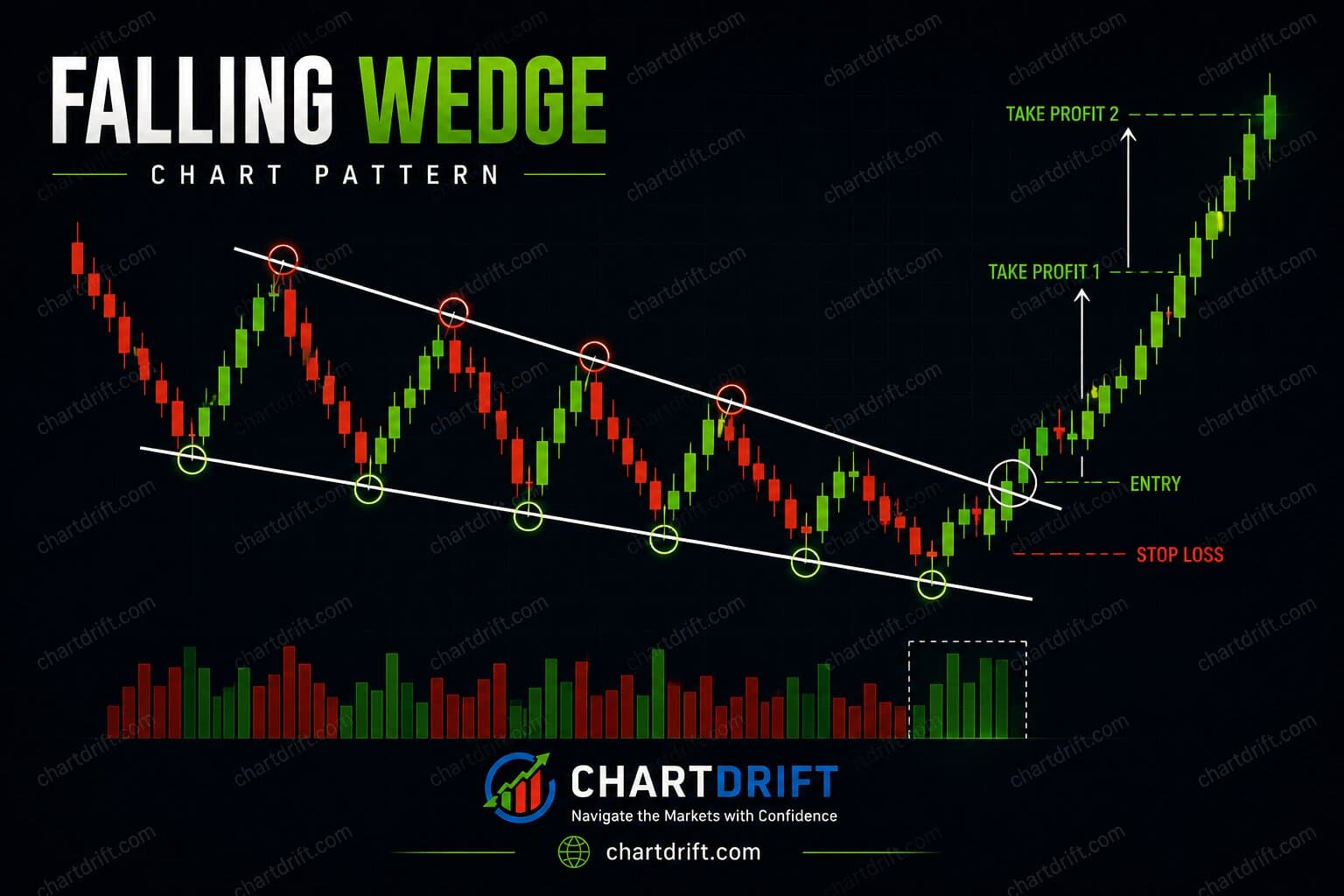
What is a Falling Wedge?
The Falling Wedge is a bullish pattern characterized by two downward-sloping trendlines that converge. The upper line (resistance) slopes more steeply than the lower line (support), creating a wedge shape.
As a reversal pattern, it appears after a downtrend. As a continuation pattern, it appears as a brief consolidation in an uptrend. In both cases, it typically breaks upward.
Market Psychology
Although price is falling, each decline shows less momentum (steeper resistance, flatter support). This indicates sellers are losing conviction while buyers step in at progressively higher relative levels.
The narrowing range shows compression of volatility before an explosive move. When the pattern breaks, buyers typically overwhelm sellers, leading to a strong upward move.
How to Identify
Converging Lines
Both resistance and support slope downward, with resistance steeper than support.
Multiple Touches
At least 2 touches on each trendline for pattern validity.
Declining Volume
Volume typically decreases during formation and spikes on breakout.
Trading Strategies
Breakout Entry
Enter long when price breaks above the upper trendline with volume confirmation. Stop-loss below the most recent swing low inside the wedge.
Real Examples
Falling Wedges have a high success rate (around 68% break upward). They're particularly powerful when appearing after extended downtrends as reversal patterns.
The pattern typically takes 3-4 weeks to form on daily charts, though it can appear on any timeframe.
Common Mistakes
Confusing with Channel
Wedge lines must converge—parallel lines form a channel, not a wedge.
Verify Convergence
Lines should meet at a clear apex point if extended.
Frequently Asked Questions
What is the falling wedge chart pattern?
The falling wedge is a bullish reversal pattern (in a downtrend) or bullish continuation pattern (in an uptrend). Two converging trendlines slope down, with price making lower highs and lower lows. A breakout above the upper line signals a potential move up.
How is the falling wedge different from the rising wedge?
The falling wedge has converging lines sloping down and typically breaks upward (bullish). The rising wedge has converging lines sloping up and typically breaks downward (bearish). Both show narrowing range; direction and breakout side determine the signal.
Where should I enter and place stops on a falling wedge?
Enter when price closes above the upper wedge line with conviction—some wait for a retest of the line as support. Place your stop loss below the wedge or below the most recent swing low inside the pattern. Use the wedge height to project a target above the breakout.
Does the falling wedge need volume confirmation?
Volume often declines as the wedge forms and can increase on the breakout. A breakout with higher volume adds conviction. Low volume breakouts can still work but are sometimes less reliable; combine with support/resistance and trend context.
Can the falling wedge appear in an uptrend?
Yes. In an uptrend, a falling wedge often acts as a continuation pattern—a brief pause or pullback that then breaks up and resumes the trend. In a downtrend, it acts as a reversal pattern, signaling a potential shift from down to up.