Morning StarPattern
Just as the morning star heralds the dawn, this three-candle formation announces the end of bearish darkness. It's one of the most poetic and reliable reversal patterns you'll encounter—a complete story of despair, indecision, and hope.
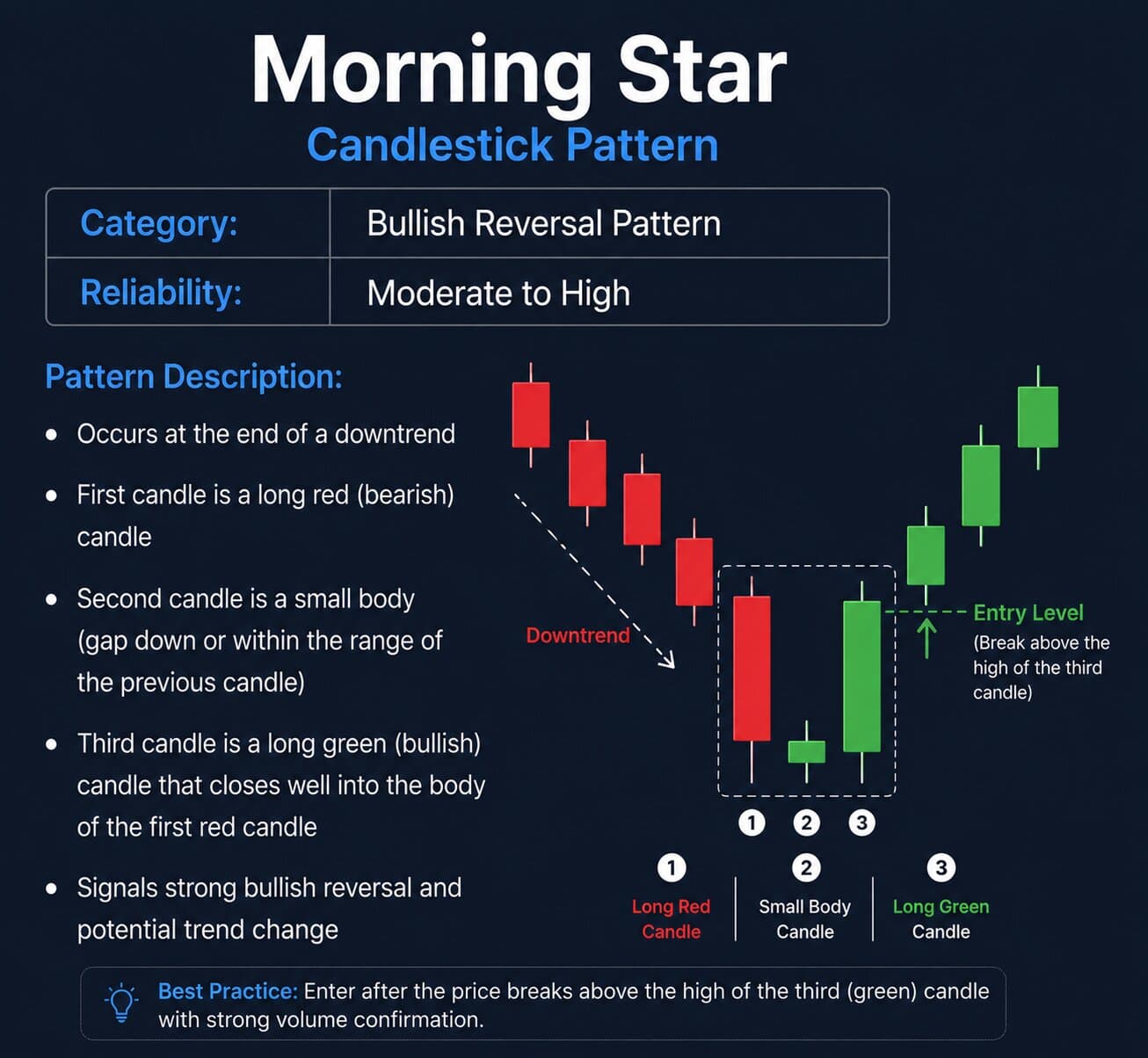
The Three-Act Structure
Each candle in the Morning Star plays a specific role in the reversal narrative.
Day 1: The Bearish Close
A long bearish candle confirms the existing downtrend. Sellers are firmly in control, and bears feel confident. This is the 'darkest hour before dawn.'
Day 2: The Star
A small-bodied candle (often a doji) gaps down from Day 1's close. The small body shows indecision—sellers are exhausted, buyers are testing the waters.
Day 3: The Bullish Surge
A strong bullish candle closes well into Day 1's body. Bulls have taken control. The deeper the close into Day 1's body, the stronger the signal.
The Psychology at Play
The Morning Star captures a complete emotional cycle in just three sessions.
Day 1 represents the peak of bearish conviction. After a sustained decline, this large red candle suggests the trend will continue. Late sellers jump in, thinking they've spotted easy money.
Day 2 is where things get interesting. The market gaps down—initially looking like more bearish momentum. But then, something shifts. The price doesn't collapse further. Instead, it hovers, creating a small body. This is exhaustion. Sellers have thrown everything they have, and the price won't budge lower.
Day 3 delivers the knockout punch. Bulls charge in with conviction, pushing prices up and closing well into Day 1's range. The shorts who piled in are now underwater, forced to cover—adding fuel to the bullish fire.
The Gap's Importance
The gap between Day 1 and Day 2 is crucial. It shows sellers pushing aggressively one last time before running out of steam. When that gap gets filled and exceeded on Day 3, it's a powerful statement.
Identifying Valid Patterns
Established Downtrend
The pattern must form after a clear decline. Without context, it's meaningless.
Strong First Candle
Day 1 should be a substantial bearish candle, confirming selling pressure.
Proper Gaps
Ideally, Day 2 gaps below Day 1, and Day 3 gaps above Day 2. Crypto and forex may not show gaps—look for equivalent separation.
Day 3 Closes Into Day 1
The third candle should close at least 50% into the first candle's body. Deeper is better.
Trading the Morning Star
Entry Strategy
Wait for completion. Enter only after Day 3 closes with a strong bullish candle. Some traders enter at Day 3's close; others wait for a break above Day 3's high.
Stop Loss
Below the star (Day 2) low. This is the pattern's foundation. If price breaks below, the reversal has failed.
Targets
First target: The high of Day 1's body. Second target: Previous swing high or resistance level. Consider the pattern's overall height for projections.
Trade Example
Morning Star forms on AAPL:
- Day 1: Open $180, Close $175 (Large bearish)
- Day 2: Open $174, Close $174.50, Low $173 (Star)
- Day 3: Open $175, Close $179, High $179.50
Entry: $179.60 (above Day 3 high)
Stop: $172.90 (below Day 2 low) = Risk $6.70
Target 1: $186.30 (1:1)
Target 2: $193.00 (1:2)
Pattern Variations
Morning Doji Star
When Day 2 is a perfect doji (open equals close), the signal is even stronger. The doji represents complete indecision—maximum exhaustion.
Evening Star
The bearish opposite. Forms at the top of uptrends with the pattern reversed. Same structure, opposite implications.
Common Mistakes
Jumping the Gun
Entering during Day 2 because you're "predicting" the pattern. Wait for Day 3 to confirm.
Weak Day 3
If Day 3's bullish candle is small or doesn't close into Day 1, the pattern is incomplete.
Frequently Asked Questions
Why is the morning star considered a strong bullish reversal pattern?
The morning star is a three-candle pattern that shows a clear shift: first a bearish candle, then a small-body candle (indecision), then a strong bullish candle that closes well into the first candle’s body. That third candle confirms that buyers have taken control after a downtrend, which is why many traders treat it as a strong signal.
Does the middle candle in a morning star have to be a doji?
Not necessarily. The middle candle can be a doji, a spinning top, or any small-body candle. What matters is that it shows indecision—buyers and sellers in balance—between the first bearish candle and the third bullish one. A doji is common, but the pattern is valid with other small bodies.
Where should I place my stop loss when trading a morning star?
Place your stop loss below the low of the first candle (the bearish one) or below the low of the middle candle. If price breaks below that level, the reversal setup is invalidated. Some traders use the low of the recent swing for a wider stop.
How is the morning star different from the evening star?
The morning star forms after a downtrend and signals a bullish reversal: bearish candle, small body, then strong bullish candle. The evening star forms after an uptrend and signals a bearish reversal: bullish candle, small body, then strong bearish candle. Same structure, opposite direction.
Should I wait for the third candle to close before entering?
Yes. The pattern is only complete when the third candle closes. Entering before the close can lead to false signals if the third candle reverses. Many traders enter on the next candle or at the open of the next period for confirmation.