Bullish Engulfing Pattern
When a large bullish candle completely swallows the previous bearish one, it's one of the most reliable two-candle reversal signals in technical analysis.
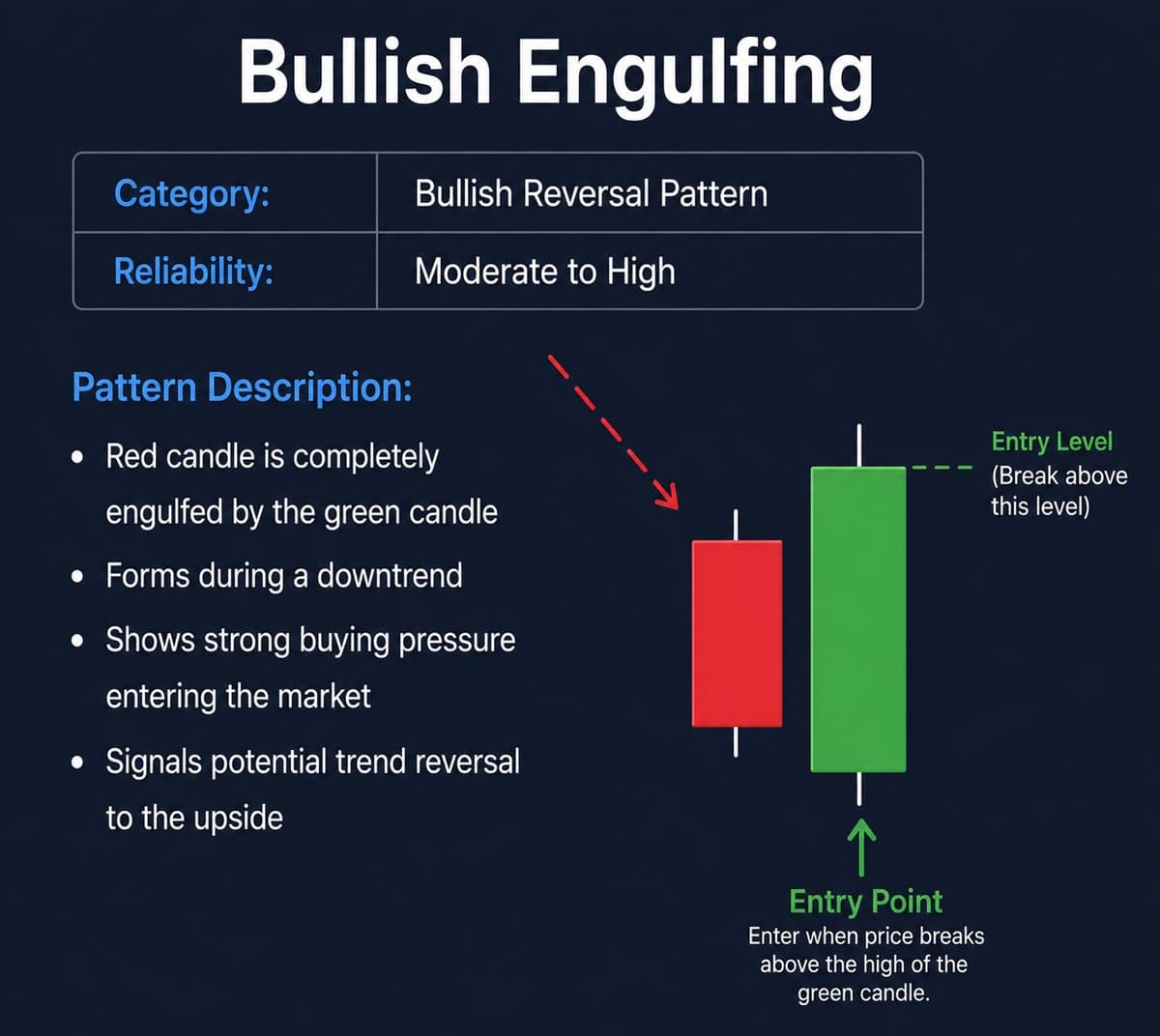
Anatomy of the Pattern
The Bullish Engulfing speaks of a dramatic power shift from sellers to buyers.
Two-Candle Formation
Day one: a smaller bearish candle. Day two: a larger bullish candle opens lower but closes higher than the previous candle's open.
Complete Engulfment
The second candle's body must completely cover the first candle's body. Focus on the real bodies.
Downtrend Context
This pattern carries meaning only when it appears after a decline.
The Story Behind the Pattern
The Bullish Engulfing captures a moment of sudden change. On the first day, sellers appear in control. Then day two: buyers emerge with force and the bullish candle completely consumes the bearish one.
What It Tells You
Buyers overwhelmed. The complete engulfment signals that sentiment has shifted dramatically.
Spotting Valid Patterns
Confirm the Downtrend
Look for at least 4-5 candles of declining price action before the pattern forms.
Size Matters
The bigger the second candle relative to the first, the stronger the signal.
Volume Confirmation
High volume on the engulfing day validates the reversal.
Support Confluence
Patterns at key support, round numbers, or Fibonacci retracements are more reliable.
Trading Strategy
Entry Approach
Conservative: Enter when the next candle closes above the engulfing candle's high. Aggressive: Enter at the close of the engulfing candle if volume is strong.
Stop Loss
Place stops below the engulfing candle's low. If price breaks below, sellers have regained control.
Profit Targets
Target 1: 1:1 risk-to-reward. Target 2: Previous swing high or key resistance. Consider trailing stops.
Common Mistakes
Trading in Uptrends
An engulfing in an uptrend is continuation, not reversal. Confirm downtrend first.
Ignoring Volume
Low volume engulfing patterns fail more often. Wait for conviction.
Frequently Asked Questions
Do I need to wait for the bullish engulfing candle to close?
Yes. Waiting for the candle to close avoids false signals—price can reverse in the last minutes of the period. A closed engulfing candle confirms that buyers took control for the full period. Entering on the next candle (or at the open of the next period) is a common approach.
How strong is a bullish engulfing compared to other reversal patterns?
The bullish engulfing is one of the stronger two-candle reversal signals because the second candle completely engulfs the first, showing a clear shift from sellers to buyers. It’s often ranked alongside the morning star and hammer for reliability when it appears after a clear downtrend.
Should I use volume when trading a bullish engulfing?
Yes. Higher volume on the engulfing candle adds conviction—it suggests real buying pressure, not just a small bounce. If volume is very low, the pattern is less reliable. Many traders look for volume at least equal to the average, or higher.
Where do I put my stop loss on a bullish engulfing trade?
Place your stop loss below the low of the engulfing candle (or below the low of the first candle). If price breaks below that level, the reversal setup is invalidated. Some traders use the low of the recent swing for a wider stop.
Can a bullish engulfing fail?
Yes. No pattern works every time. Failures often happen when the pattern appears in a choppy range (no clear downtrend), when volume is weak, or when a strong resistance level is just above. Always use a stop loss and consider the bigger trend.