PiercingPattern
When bulls pierce through the bears' defenses, they leave this distinctive two-candle signature. The Piercing Pattern shows buyers clawing back more than half of yesterday's losses—a clear sign that momentum may be shifting.
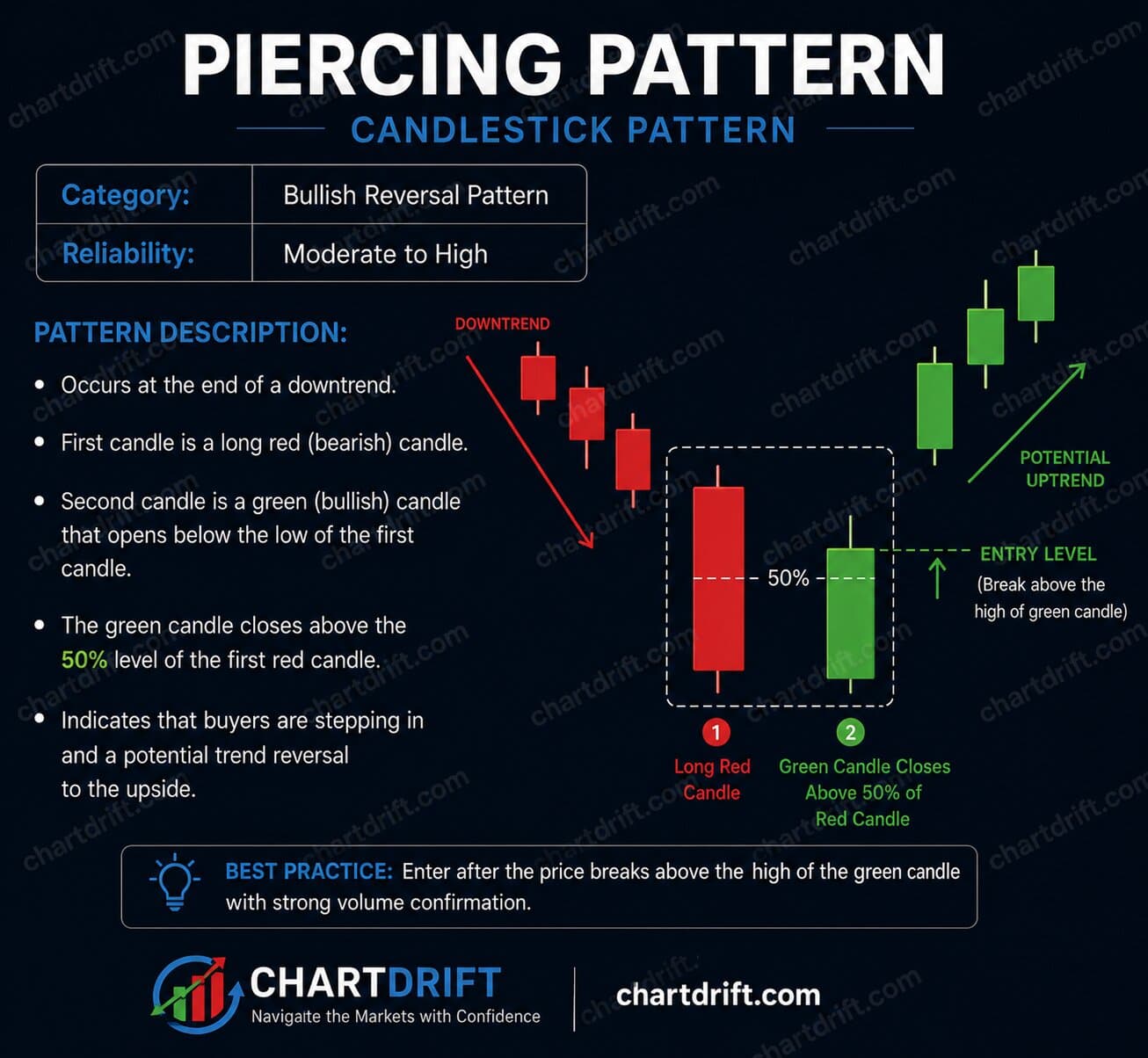
Pattern Requirements
The 50% rule is what makes this pattern unique. Here's what to look for.
Day 1: Strong Bearish Close
A substantial bearish candle confirms the existing downtrend. This represents the bears' last strong push—setting up the battleground for the reversal.
Day 2: Gap Down, Rally Up
The bullish candle opens below Day 1's low (gaps down) but rallies strongly, closing above the midpoint of Day 1's body. This is the 'piercing' action.
The 50% Rule
Day 2 must close above the 50% level of Day 1's body. This is non-negotiable. Closing below 50% doesn't qualify as a Piercing Pattern.
Understanding the Battle
The Piercing Pattern is essentially a failed bearish continuation. Understanding why it fails reveals valuable insights about market psychology.
On Day 1, bears dominate. The large red candle extends the downtrend, and short sellers feel vindicated. Overnight, pessimism peaks—the gap down at Day 2's open seems to confirm more losses ahead.
But that gap down becomes a trap. Instead of continuing lower, buyers emerge at these depressed prices. Maybe it's institutional accumulation, or perhaps short covering begins. Either way, the price reverses course, pushing higher throughout the session.
By Day 2's close, bulls have reclaimed more than half of what was lost the previous day. This isn't just a bounce—it's a statement that sellers couldn't hold their ground.
Why 50% Matters
The midpoint represents a psychological tipping point. Reclaiming more than half signals that buyers aren't just testing—they're taking control.
Trading Execution
Entry Strategy
Conservative entry: Wait for the next candle to close above Day 2's high. Aggressive entry: Enter at Day 2's close if the pattern is textbook and volume is high.
Stop Loss
Below Day 2's low. If price drops back below where Day 2 opened, the piercing has failed and the reversal is invalid.
Price Targets
Target 1: The open of Day 1's bearish candle. Target 2: The previous swing high before the downtrend began. Use 1:2 minimum R/R.
Trade Example
Piercing Pattern on XYZ stock:
- Day 1: Open $50, Close $46 (range = $4)
- Day 2: Open $45, Close $48.50, Low $44.80
- 50% of Day 1 = $48 (Day 2 closes above ✓)
Entry: $48.60 (above Day 2 high)
Stop: $44.70 (below Day 2 low) = Risk $3.90
Target 1: $52.50 (1:1)
Target 2: $56.40 (1:2)
Piercing vs. Engulfing
Piercing Pattern
Bullish candle closes above 50% of bearish body but doesn't engulf it. Strong signal but less powerful than engulfing.
Bullish Engulfing
Bullish candle completely engulfs the bearish body. Stronger signal because bulls didn't just pierce—they dominated.
Common Mistakes
Ignoring the 50% Rule
If Day 2 closes below 50% of Day 1, it's not a Piercing Pattern. Don't force it.
No Gap Down
The best patterns have Day 2 opening below Day 1's low. Without this gap, the signal weakens considerably.
Weak Downtrend
Without a clear downtrend preceding the pattern, there's nothing to reverse. Context is everything.
Low Volume
A piercing move on low volume lacks conviction. Look for above-average volume on Day 2.
Frequently Asked Questions
What’s the difference between piercing pattern and bullish engulfing?
In a piercing pattern, the second candle closes above the midpoint of the first candle’s body but doesn’t fully engulf it. In a bullish engulfing, the second candle completely engulfs the first (body and wicks). Both are bullish reversal signals; the engulfing is typically considered stronger because it shows a more decisive shift.
Does the piercing pattern need to close above the midpoint of the first candle?
Yes. For a valid piercing pattern, the second (bullish) candle must close above the midpoint of the first (bearish) candle’s body. If it closes below the midpoint, the pattern is weaker or invalid. The deeper the close into the first candle, the stronger the signal.
Where should I place my stop loss on a piercing pattern trade?
Place your stop loss below the low of the first candle (the bearish one) or below the low of the second candle. If price breaks below that level, the reversal setup is invalidated. Some traders use the recent swing low for a wider stop.
Should I wait for confirmation after a piercing pattern?
Yes. Waiting for the next candle to close higher (or for price to break above the high of the second candle) confirms that buyers are in control. Entering on the piercing candle alone can lead to false signals if price reverses.
Can the piercing pattern appear on any timeframe?
Yes. The piercing pattern can form on any timeframe—from 1-minute to weekly. It tends to be more reliable after a clear downtrend and when volume on the second candle is above average. Many traders use it on 4-hour or daily charts for swing trades.