HammerCandlestick Pattern
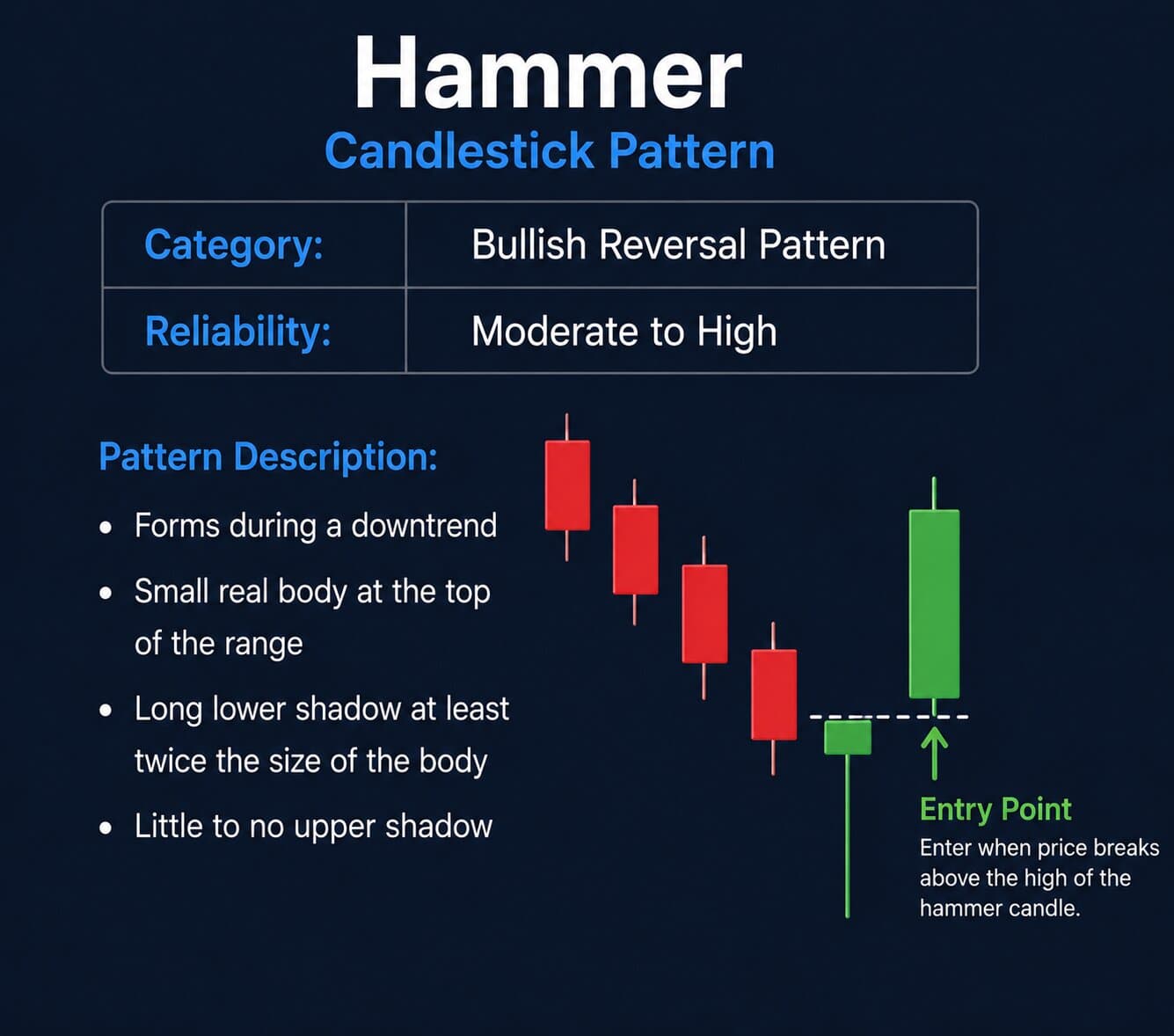
The Hammer pattern forms when buyers strongly reject lower prices after heavy selling pressure. The long lower wick shows buyers regained control, signaling a possible bullish reversal in the market.
What Makes a Hammer?
The Hammer tells a story of rejection. Here's what to look for when the market leaves this footprint.
Small Body at the Top
The body sits near the high of the candle, showing that buyers pushed the price back up by the close. The body color doesn't matter much—what matters is where it sits.
Long Lower Wick
This is the Hammer's signature. The lower wick should be at least twice the body's length—proof that sellers tried and failed to maintain control.
Forms After a Downtrend
Context is everything. A Hammer only carries weight when it appears after prices have been falling. Without a downtrend, it's just another candle.
The Psychology Behind the Hammer
Every candlestick pattern reflects the fight between buyers and sellers, and the Hammer clearly shows a shift in market strength. It forms when sellers push the price sharply lower, but buyers step in strongly and drive the price back up before the session closes.
This pattern usually appears after a strong downtrend when market sentiment is highly bearish. During the trading session, sellers continue the downward move and create panic in the market. However, buyers slowly regain confidence and absorb the selling pressure.
As buying momentum increases, the price starts recovering from the lows. By the end of the session, buyers manage to recover a large part of the decline, showing that sellers are losing control and a potential bullish reversal may be developing.
The Message
That long lower wick is a rejection—a clear statement that the market won't accept those lower prices. Sellers pushed hard and got pushed back even harder.
How to Spot a Valid Hammer
Not every candle with a lower wick is a Hammer. Here's how to separate the real opportunities from the noise:
Confirm the Downtrend
The Hammer must appear after a clear decline. Look for at least 3-5 consecutive lower lows or a well-established bearish trend.
Measure the Wick Ratio
The lower wick should be at least 2x the body length. A 3x ratio is even better—it shows stronger rejection of lower prices.
Check Volume
Higher volume on the Hammer day adds conviction. It means more participants are involved in the rejection, making the signal stronger.
Look for Support
A Hammer that forms at a known support level, moving average, or Fibonacci retracement carries more weight.
Trading the Hammer
Spotting the pattern is only half the battle. Here's how to actually trade it:
Entry Strategy
Wait for confirmation. The Hammer is a warning shot, not a buy signal on its own. Enter when the next candle closes above the Hammer's high—this confirms buyers are following through.
Stop Loss Placement
Place your stop below the Hammer's low. If price breaks below that level, the rejection has failed—sellers have regained control and the trade thesis is invalid.
Target Calculation
Use the pattern's range for targets. Measure from the low to the high of the Hammer. Project that distance upward from the breakout point for your first target. Consider scaling out at 1R and 2R.
Trade Example
A stock has been falling and prints a Hammer with:
- High:
$42.50 - Low:
$40.00
Entry: $42.60 (above high)
Stop: $39.90 (below low) = Risk of $2.70
Target 1: $45.20 (1:1 R/R)
Target 2: $47.80 (1:2 R/R)
Common Mistakes to Avoid
Trading Without Context
A Hammer in an uptrend or sideways market means nothing. Always confirm you're at the end of a real downtrend.
Skipping Confirmation
Jumping in before the next candle confirms the reversal leads to many false starts. Patience pays.
Ignoring Volume
A Hammer on low volume lacks conviction. Strong reversals need strong participation.
Too Tight Stops
Placing stops just below the body instead of the wick's low will get you stopped out on normal volatility.
Hammer vs. Similar Patterns
Hammer
Forms after a downtrend. Long lower wick, small body at top. Signals bullish reversal.
Hanging Man
Identical shape but forms after an uptrend. Same structure, opposite meaning—signals potential bearish reversal.
Inverted Hammer
Also bullish after downtrends, but the long wick is on top. Shows buyers attempted higher prices before the close.
Dragonfly Doji
Similar to Hammer but with virtually no body—open and close at the same price. Even stronger rejection signal.
Frequently Asked Questions
How do I know if a hammer candlestick is valid for a reversal?
A valid hammer appears after a clear downtrend, has a small body at the top, a long lower wick (at least twice the body), and little or no upper wick. The next candle should close higher to confirm the reversal. Volume increasing on the hammer candle adds conviction.
Does the hammer pattern work on all timeframes?
Yes. The hammer can appear on any timeframe—from 1-minute charts for scalping to daily or weekly charts for swing trading. Shorter timeframes tend to produce more noise; many traders find the pattern more reliable on 4-hour or daily charts where context is clearer.
Where should I place my stop loss when trading a hammer?
Place your stop loss just below the low of the hammer’s lower wick. That level represents the point where sellers failed to push price lower. If price breaks below it, the reversal signal is invalidated. Some traders add a small buffer (e.g., a few ticks) to avoid being stopped out by wicks.
What’s the difference between a hammer and a hanging man?
They look the same—small body at the top, long lower wick—but context is everything. A hammer forms after a downtrend and signals a potential bullish reversal. A hanging man forms after an uptrend and warns of a possible bearish reversal. Always check what came before the candle.
Should I wait for confirmation before entering on a hammer?
Yes. Waiting for the next candle to close above the hammer’s open (or above its high) reduces false signals. Entering on the hammer candle itself is riskier because price can still reverse. Confirmation doesn’t guarantee success but improves the odds.