ADX = Average Directional Index
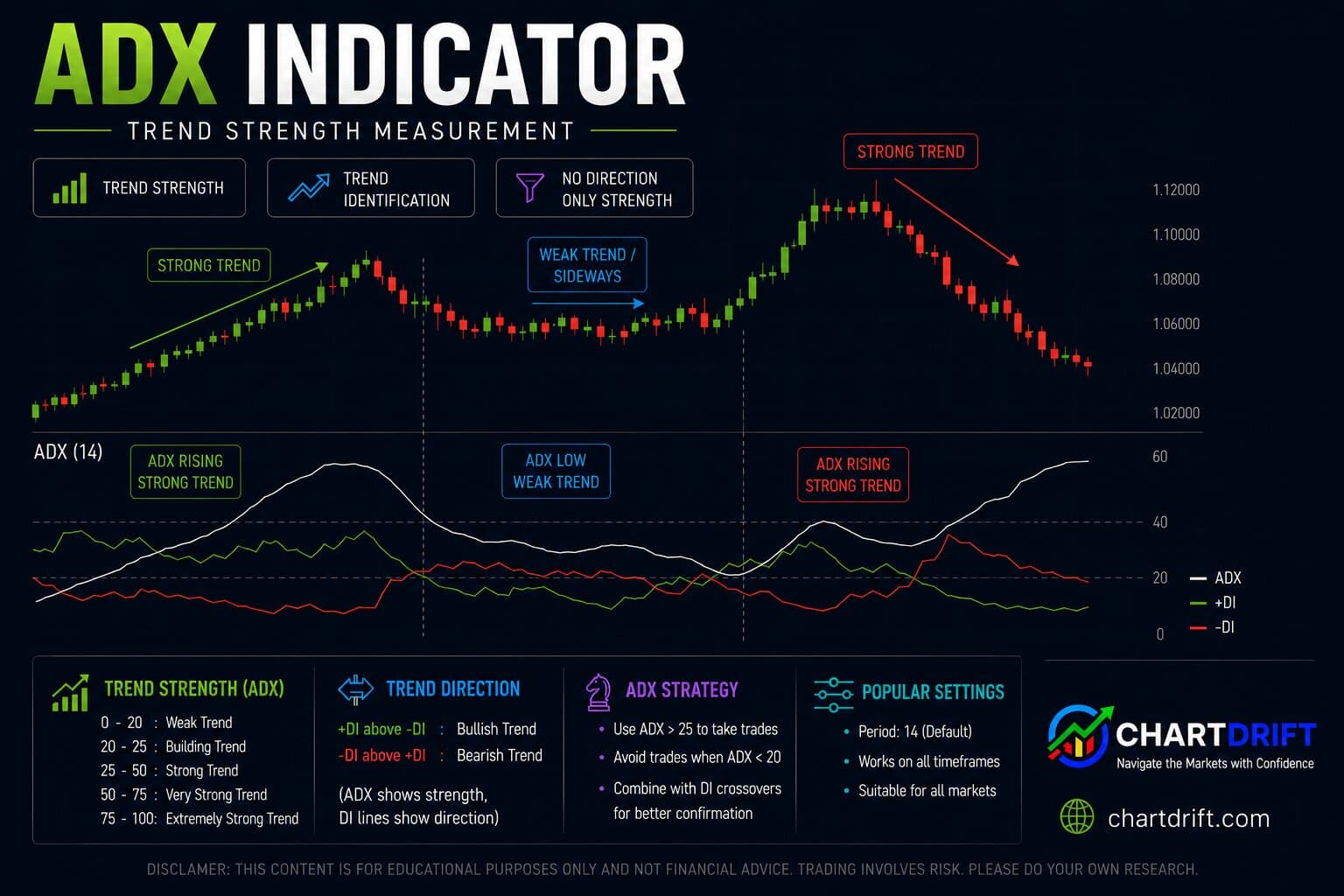
The ADX measures trend strength without indicating direction. It tells you whether a market is trending or ranging, helping you choose the right trading strategy for current conditions.
What is ADX?
Developed by J. Welles Wilder Jr. (who also created RSI), the Average Directional Index measures the strength of a trend on a scale of 0 to 100. It's derived from the Directional Movement Index (DMI) system.
The key insight: ADX tells you HOW STRONG a trend is, not whether it's bullish or bearish. A high ADX means a strong trend (up OR down); a low ADX means weak trend or ranging market.
ADX Components
The complete DMI system consists of three lines: ADX, +DI (positive directional indicator), and -DI (negative directional indicator).
ADX Line
The smoothed average of the directional movement. It only measures strength, rising during strong trends (up or down) and falling during consolidation.
+DI (Plus Directional Indicator)
Measures upward price movement. When +DI is above -DI, buyers are dominant and the trend is bullish.
-DI (Minus Directional Indicator)
Measures downward price movement. When -DI is above +DI, sellers are dominant and the trend is bearish.
Reading ADX Values
| ADX Value | Trend Strength | Trading Implication |
|---|---|---|
| 0-20 | Absent or weak | Range trading strategies work best |
| 20-25 | Emerging trend | Watch for potential breakout |
| 25-50 | Strong trend | Trend-following strategies work best |
| 50-75 | Very strong trend | Stay with the trend, trail stops |
| 75-100 | Extremely strong | Rare; trend may be exhausting |
+DI/-DI Crossovers
Crossovers between +DI and -DI indicate potential trend changes. These signals are most reliable when ADX is above 25, confirming trend strength.
Bullish Crossover
+DI crosses above -DI. Buyers are taking control and an uptrend may be starting.
- • Most reliable when ADX > 25
- • Entry: On crossover confirmation
- • Stop: Below recent swing low
Bearish Crossover
-DI crosses above +DI. Sellers are taking control and a downtrend may be starting.
- • Most reliable when ADX > 25
- • Exit longs, consider shorts
- • Stop: Above recent swing high
Trading Strategies
ADX Trend Filter
Use ADX as a filter for other indicators. Only take trend-following signals when ADX confirms a strong trend.
- • ADX > 25: Use trend strategies (MA crossovers, breakouts)
- • ADX < 20: Use range strategies (support/resistance, oscillators)
- • Combine with MACD or RSI for entry timing
DI Crossover System
A complete trading system using DI crossovers with ADX confirmation.
- • Buy: +DI crosses above -DI AND ADX > 25 (rising)
- • Sell: -DI crosses above +DI AND ADX > 25 (rising)
- • Exit: Opposite crossover OR ADX falls below 20
ADX Peak Strategy
Very high ADX readings (50+) often precede trend exhaustion. Use ADX peaks as a warning to tighten stops or take partial profits.
- • ADX peaks above 50: Trend may be overextended
- • ADX starts falling from peak: Momentum fading
- • Don't fade the trend; just manage risk
Optimal Settings
| Trading Style | ADX Period | Key Level | Notes |
|---|---|---|---|
| Scalping | 7-10 | 20 | Faster signals, more noise |
| Day Trading | 14 | 25 | Default, balanced |
| Swing Trading | 14 | 25 | Works well on daily charts |
| Position Trading | 20-25 | 25 | Smoother, fewer signals |
ADX + Moving Average Combo
Combine ADX with a moving average crossover system. Only take MA crossover signals when ADX is above 25 and rising. This filters out many false signals in ranging markets.
Frequently Asked Questions
What is ADX and what does it measure?
ADX (Average Directional Index) measures trend strength, not direction. It oscillates from 0 to 100. Values above 25 often indicate a present trend; below 20 suggests weak or no trend. Higher ADX means stronger trend.
What do +DI and -DI mean?
+DI (Plus Directional Indicator) measures upward price movement; -DI measures downward movement. When +DI is above -DI, buying pressure is stronger; when -DI is above +DI, selling pressure is stronger. Crossovers can signal trend changes.
Does ADX show trend direction?
No. ADX only shows how strong the trend is. You need +DI/-DI or price to determine direction. A rising ADX with +DI above -DI suggests a strengthening uptrend; with -DI above +DI, a strengthening downtrend.
What ADX level means a strong trend?
Wilder considered ADX above 25 as indicating a trend. Many traders use 25 as a filter—only take trend-following signals when ADX is above 25. ADX above 40 often indicates a very strong trend.
Can ADX be used with other indicators?
Yes. ADX is often used as a filter: take moving average or Parabolic SAR signals only when ADX is above 25. Combining with +DI/-DI crossovers helps confirm entries. Use ADX to avoid trading in ranging markets.