Triple BottomChart Pattern
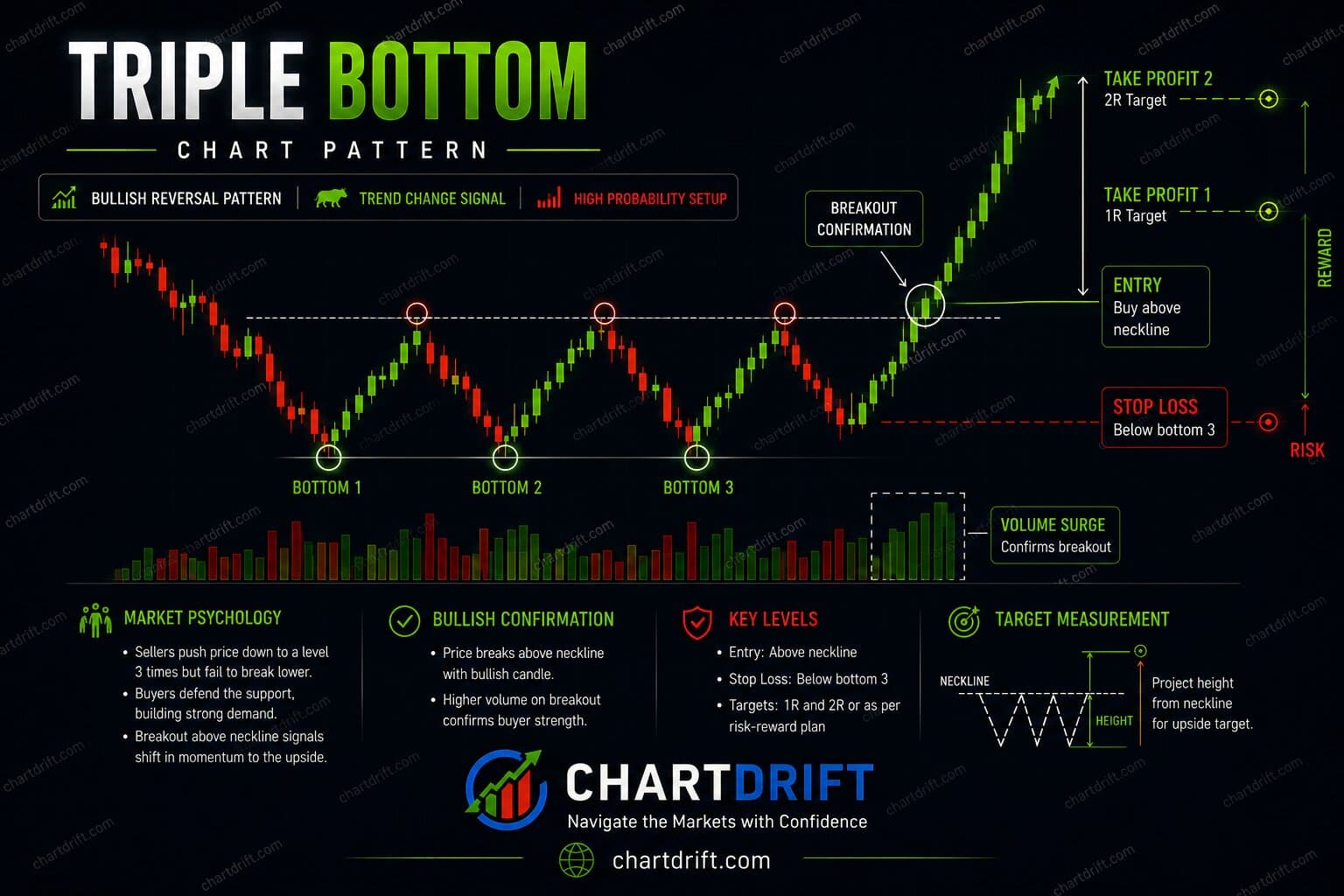
The Triple Bottom is a strong bullish reversal pattern that appears after a downtrend. It forms when the price touches the same support level three different times but fails to move lower. This repeated rejection from support shows that buyers are gaining strength and sellers are losing control.
Key Characteristics
Understanding these essential features will help you spot the Triple Bottom pattern with confidence.
Three Equal Troughs
Price drops to approximately the same low three times, with troughs within 3-5% of each other, showing persistent support.
Strong Resistance Level
Two peaks between the troughs form a resistance level (neckline). A break above confirms the reversal.
Extended Time
Triple Bottoms take longer to form than Double Bottoms, making them less common but often more reliable.
What is the Triple Bottom Pattern?
A Triple Bottom is a bullish chart pattern created when the market tests a support zone three times and bounces back each time. It is considered a more reliable version of the Double Bottom pattern because the support level holds multiple times. This pattern usually signals that the downtrend may be ending and an upward move could begin soon.
Key Insight
Three failed attempts to break support create a powerful accumulation zone. Each failure brings more buyers into the market. When the resistance finally breaks, the accumulated buying pressure creates a powerful upward move.
How to Identify the Pattern
Structure of Triple Bottom
First Trough
Price falls to a low during a downtrend, then bounces. This creates the first trough and initial support level.
Second Trough
Price falls again to approximately the same level, then bounces again. Two troughs confirm the support zone.
Third Trough
Price makes a third attempt at the support but holds once more. Three tests confirm exhausted selling power.
Neckline Break
Connect the two peaks between troughs to form the neckline. A close above with volume confirms the pattern.
Volume Analysis
During Formation
Volume typically decreases with each successive trough, showing diminishing selling pressure with each attempt.
At Breakout
A surge in volume when price breaks the neckline provides strong confirmation of the bullish reversal.
Trading Strategy
Entry Strategy
Entry After Breakout: Enter a long position when the price breaks and closes above the neckline with increased volume. The third trough holding provides extra confirmation.
Setting Stop Loss
Stop Loss Placement: Set your stop loss below the third (most recent) trough. This protects against false breakouts while giving the trade room to work.
Determining Target Price
Measuring Technique: Measure the distance from the troughs to the neckline. Project this same distance upward from the breakout point to find your target.
Example Calculation
If the Triple Bottom has:
- Troughs:
$40 - Neckline:
$60 - Pattern Height:
$20
Height = $60 - $40 = $20
Target = $60 (neckline) + $20 = $80
Risk Management
Risk-Reward Ratio
Aim for at least 1:2. If your stop is $5 below entry (at the troughs), your target should be at least $10 above entry.
Pattern Strength
Triple Bottoms are less common than Double Bottoms but often more reliable. The extra trough confirms the support level's significance.
Tips for Successful Trading
Equal Trough Depths
The three troughs should be at similar levels. Widely varying depths may indicate a different pattern or trend continuation.
Confirm with Indicators
Look for bullish divergence on RSI or MACD during the third trough—momentum strengthening even as price tests lows.
Wait for the Break
Don't buy after the third trough forms. Wait for the neckline to break. Many Triple Bottoms never complete.
Example Trade Setup
Identify the Pattern
Spot three troughs at approximately $40 on a daily chart after a downtrend. Confirm similar depths across all troughs.
Draw the Neckline
Connect the two peaks between the troughs to establish the neckline at $60.
Enter the Trade
When price breaks above the neckline at $60 with strong volume, enter a long position.
Set Stop Loss
Place your stop loss at $38, below the lowest trough.
Determine Target Price
Measure the height ($20) and add to the neckline ($60) to set a target at $80.
Conclusion
The Triple Bottom pattern is a powerful bullish reversal signal. Three failed attempts to break support create significant buying pressure that often leads to substantial upside moves. By following a systematic approach and waiting for proper confirmation, you can trade this pattern with confidence.
Happy trading!
Frequently Asked Questions
What is the triple bottom chart pattern?
The triple bottom is a bullish reversal pattern with three troughs at roughly the same support level, each followed by a bounce. When price breaks above the resistance (the highs between the troughs), it signals a potential trend reversal from down to up. It shows three failed attempts to break lower.
Where should I enter on a triple bottom?
Enter when price breaks above the resistance level (the highs between the three troughs). Many traders wait for a close above resistance or a retest of resistance as support before buying. Avoid entering on the third trough before the break.
How is triple bottom different from double bottom?
Double bottom has two troughs; triple bottom has three. Triple bottom often shows stronger support and can lead to a more decisive break when resistance is finally cleared. The trading approach is the same: wait for the break above resistance.
Where do I place my stop loss on a triple bottom trade?
Place your stop loss below the three troughs (or below the lowest trough). If price breaks below that level, the pattern is invalidated. Some traders use a buffer below the troughs to avoid wicks.
Does the triple bottom work on all timeframes?
Yes. The triple bottom can form on any timeframe. It tends to be more reliable when it appears after a clear downtrend and when the break above resistance is accompanied by higher volume.