Ascending TriangleChart Pattern
A powerful bullish continuation pattern where rising lows meet horizontal resistance. As buyers become more aggressive, pressure builds until a decisive upward breakout occurs.
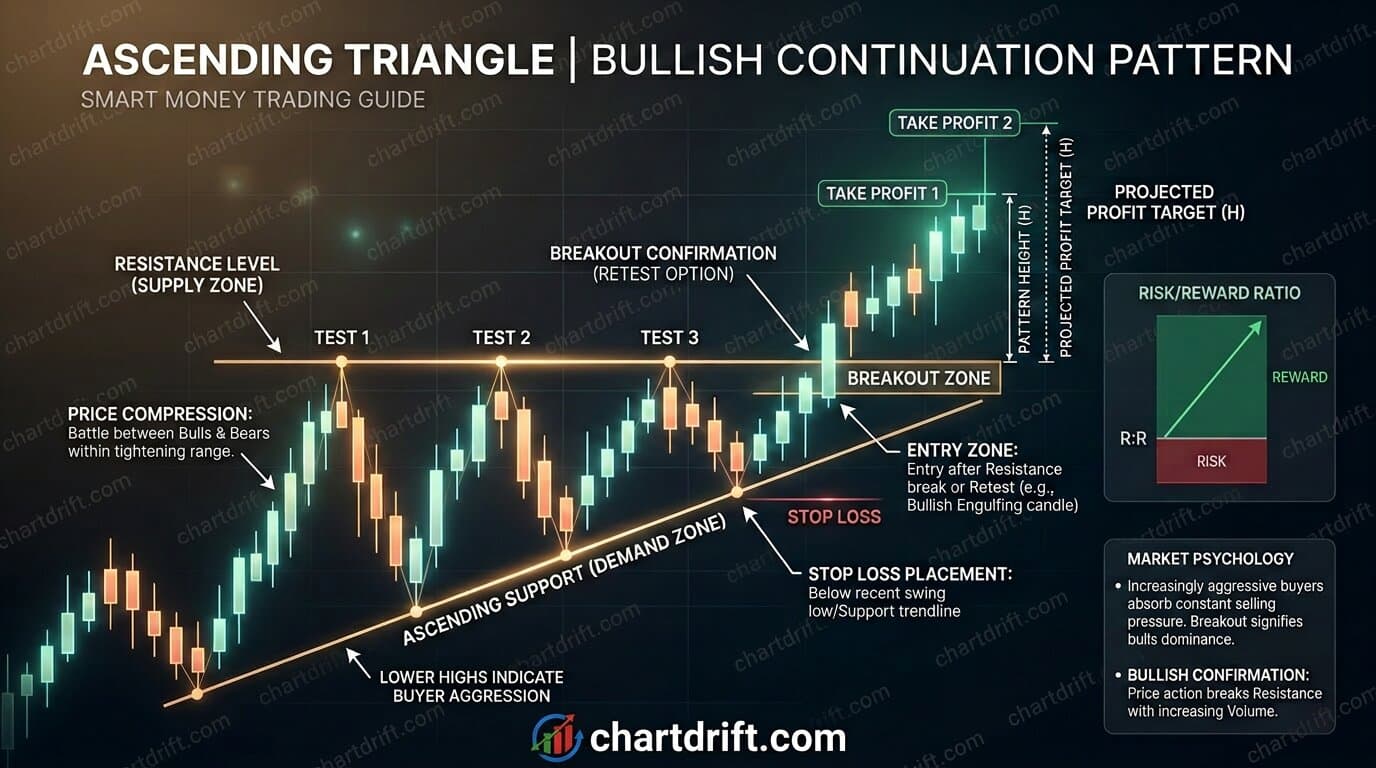
Key Characteristics
Understanding these essential features will help you spot the Ascending Triangle pattern with confidence.
Flat Resistance
A horizontal line connecting two or more highs at approximately the same level. Sellers defend this price zone repeatedly.
Rising Support
An upward-sloping trendline connecting higher lows. Each pullback finds buyers at increasingly higher prices.
Converging Lines
The pattern narrows over time with at least 3+ touches on each line, building pressure before the breakout.
What is the Ascending Triangle Pattern?
The Ascending Triangle is a bullish continuation pattern that forms during an uptrend. It consists of a horizontal resistance line at the top and a rising support line at the bottom, creating a triangle shape that narrows over time until price breaks out.
Key Insight
The Ascending Triangle demonstrates a battle where buyers are gradually gaining the upper hand. Each pullback finds support at a higher level, showing buyers are willing to pay increasingly higher prices. Eventually, sellers run out of supply and the accumulated buying pressure overwhelms them.
How to Identify the Pattern
Structure of Ascending Triangle
Identify the Uptrend
The pattern forms during an existing uptrend. Price consolidates as it encounters resistance, but maintains higher lows.
Draw the Resistance Line
Connect at least two highs at approximately the same level to form the horizontal resistance. This is where sellers repeatedly defend.
Draw the Rising Support
Connect at least two higher lows with an upward-sloping trendline. This shows increasing buyer aggression.
Wait for Breakout
The pattern is confirmed when price closes above the resistance line with strong volume. This typically happens in the final third of the triangle.
Volume Analysis
During Formation
Volume typically decreases as the pattern develops, showing consolidation and decreasing volatility.
At Breakout
A significant surge in volume on the breakout provides strong confirmation. Low volume breakouts are less reliable.
Trading Strategy
Entry Strategy
Breakout Entry: Enter long when price closes above the resistance level with above-average volume. Place your order slightly above the resistance to catch the breakout.
Setting Stop Loss
Stop Loss Placement: Set your stop loss below the most recent swing low inside the triangle, or below the rising support trendline for a wider stop.
Determining Target Price
Measuring Technique: Measure the height of the triangle at its widest point. Project this distance upward from the breakout point to find your target.
Example Calculation
If the Ascending Triangle has:
- Resistance:
$120 - Lowest Support Point:
$100 - Triangle Height:
$20
Height = $120 - $100 = $20
Target = $120 (breakout) + $20 = $140
Risk Management
Risk-Reward Ratio
Aim for at least 1:2. The triangle's height gives you a natural target, so ensure your stop allows for this ratio.
False Breakout Protection
Wait for a confirmed close above resistance—not just a wick. Some traders wait for a pullback and retest of the breakout level.
Tips for Successful Trading
Volume is Critical
A breakout with weak volume often fails. Wait for above-average volume to confirm the move is genuine.
Trade in the Direction of the Trend
Ascending Triangles work best when they form in an existing uptrend. They're continuation patterns, not reversals.
Watch for Failed Breakouts
If price breaks out but quickly reverses back inside the triangle, exit the trade. This is a sign of a false breakout.
Example Trade Setup
Identify the Pattern
Spot an Ascending Triangle forming during an uptrend. Confirm with at least 2 touches on both the resistance and rising support.
Draw Your Trendlines
Mark the horizontal resistance at $120 and the rising support connecting higher lows.
Enter the Trade
When price breaks above $120 with strong volume, enter a long position at $121.
Set Stop Loss
Place your stop loss at $112, below the most recent swing low inside the triangle.
Determine Target Price
With a triangle height of $20, set your target at $140 ($120 + $20).
Conclusion
The Ascending Triangle is one of the most reliable continuation patterns in technical analysis. With about 70% of breakouts occurring upward, it offers excellent risk-reward opportunities. By following a systematic approach—identifying the pattern clearly, waiting for volume-confirmed breakouts, and managing risk properly—you can trade this pattern successfully.
Happy trading!
Frequently Asked Questions
What is the ascending triangle chart pattern?
The ascending triangle is a bullish continuation pattern with a flat resistance line at the top and a rising support line (higher lows). It shows buyers stepping in at higher levels. When price breaks above resistance, it often continues higher. About 70% of breakouts occur upward.
Where should I enter on an ascending triangle?
Enter when price breaks above the horizontal resistance with conviction. Many traders wait for a close above resistance or a retest of resistance as support before buying. Volume often increases on the breakout—look for that confirmation.
How is ascending triangle different from descending triangle?
Ascending triangle has flat resistance and rising support—bullish bias. Descending triangle has flat support and falling resistance—bearish bias. Same structure, flipped. Ascending typically breaks up; descending typically breaks down.
Where do I place my stop loss on an ascending triangle trade?
Place your stop loss below the rising support line (or below the lowest low of the pattern). If price breaks below that level, the continuation setup is invalidated. Some traders use a buffer below the support.
Does the ascending triangle always break upward?
No. Although about 70% of ascending triangles break upward, some break downward. Wait for the actual breakout before entering. A false breakout (break then reversal) can occur—use volume and confirmation to improve odds.