Symmetrical TriangleChart Pattern
A neutral pattern with converging trendlines showing lower highs and higher lows. Can break either direction, typically continuing the prior trend.
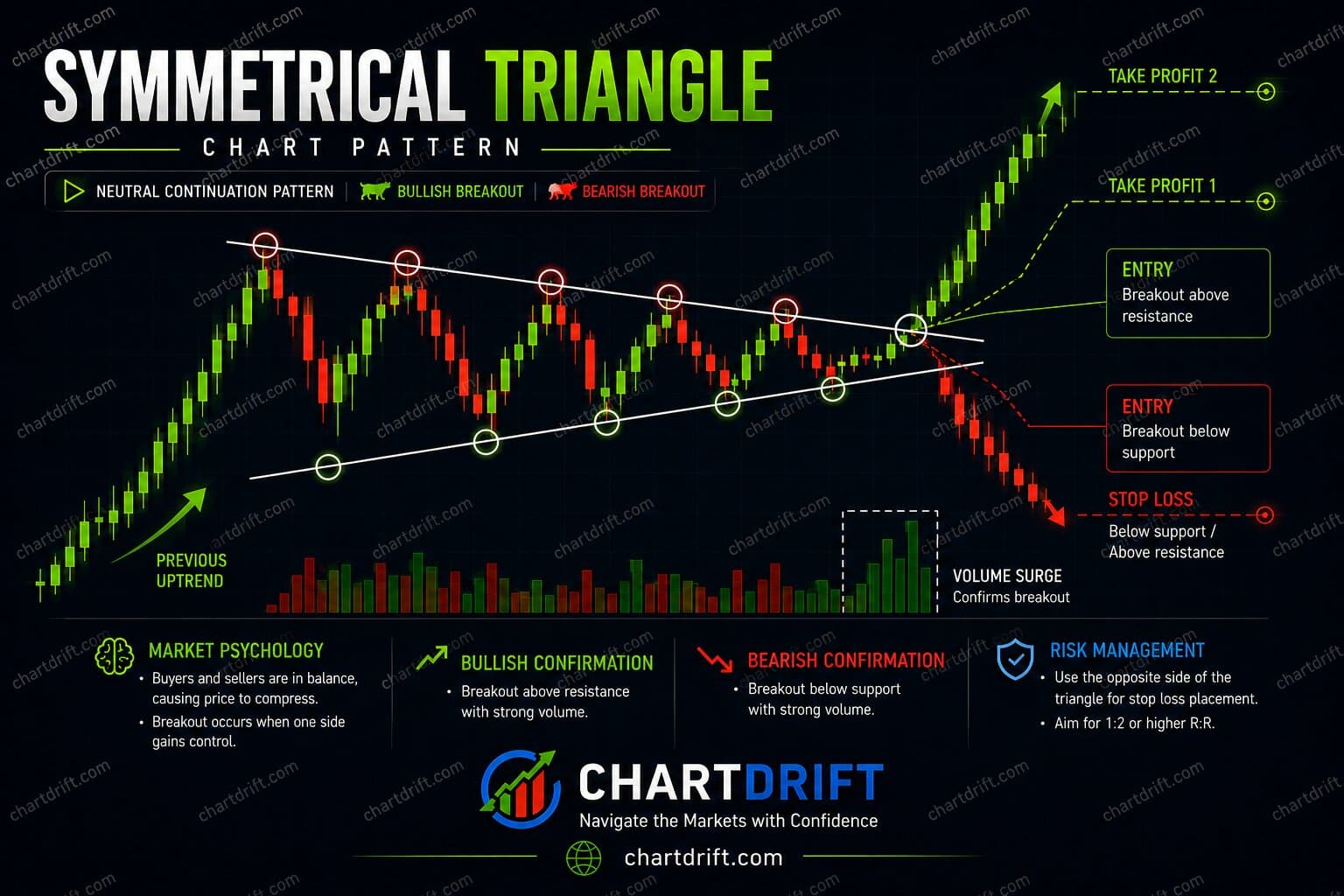
What is a Symmetrical Triangle?
The Symmetrical Triangle is a bilateral pattern that forms when price makes both lower highs and higher lows, creating two converging trendlines that meet at an apex. Unlike ascending or descending triangles, this pattern has no directional bias.
The pattern represents a period of indecision and usually breaks in the direction of the prior trend, making it a continuation pattern about 55-60% of the time.
Market Psychology
This pattern shows a true equilibrium between buyers and sellers. Each rally is met with selling, creating lower highs. Each decline is met with buying, creating higher lows.
As the pattern narrows, volatility contracts and tension builds. Eventually, one side overwhelms the other, leading to a decisive breakout with expanding volatility.
How to Identify
Lower Highs
A downward-sloping resistance line connecting at least two lower highs.
Higher Lows
An upward-sloping support line connecting at least two higher lows.
Converging Apex
Both lines should converge at a point—breakout typically occurs 2/3 to 3/4 to apex.
Trading Strategies
Bullish Breakout
Enter long when price breaks above the upper trendline with volume. Stop-loss below the most recent swing low.
Bearish Breakdown
Enter short when price breaks below the lower trendline with volume. Stop-loss above the most recent swing high.
Real Examples
Symmetrical triangles are common across all markets. They typically take 1-3 months to form and work best when traded in the direction of the prior trend.
Breakouts should occur between 2/3 and 3/4 of the way to the apex. Late breakouts near the apex tend to be less reliable.
Common Mistakes
Guessing Direction
Never anticipate breakout direction—wait for confirmation.
Trade the Breakout
Let price show you the direction with a decisive close outside.
Frequently Asked Questions
What is the symmetrical triangle chart pattern?
The symmetrical triangle has converging trendlines—both support and resistance slope toward each other, with lower highs and higher lows. It shows indecision. The breakout can go either way; many traders wait for a decisive close outside the triangle and trade in that direction.
Does the symmetrical triangle have a bullish or bearish bias?
Neither by itself. The symmetrical triangle is a bilateral pattern—it can break up or down. Context helps: in an uptrend, breakouts often go up; in a downtrend, breakouts often go down. Volume often increases on the breakout; the direction of the break defines the trade.
Where should I enter on a symmetrical triangle?
Enter when price breaks out of the triangle with a decisive close beyond one of the trendlines. Avoid entering before the break. Some traders wait for a retest of the broken trendline before entering. Volume confirmation on the breakout improves odds.
Where do I place my stop loss on a symmetrical triangle trade?
Place your stop loss on the opposite side of the triangle from your entry. For a long (break above), stop below the lower trendline or the low of the pattern. For a short (break below), stop above the upper trendline or the high of the pattern.
How is symmetrical triangle different from ascending and descending?
Ascending triangle has flat resistance and rising support—bullish bias. Descending has flat support and falling resistance—bearish bias. Symmetrical has both lines converging—no bias; breakout direction is unknown until price breaks.