Flag PatternChart Pattern
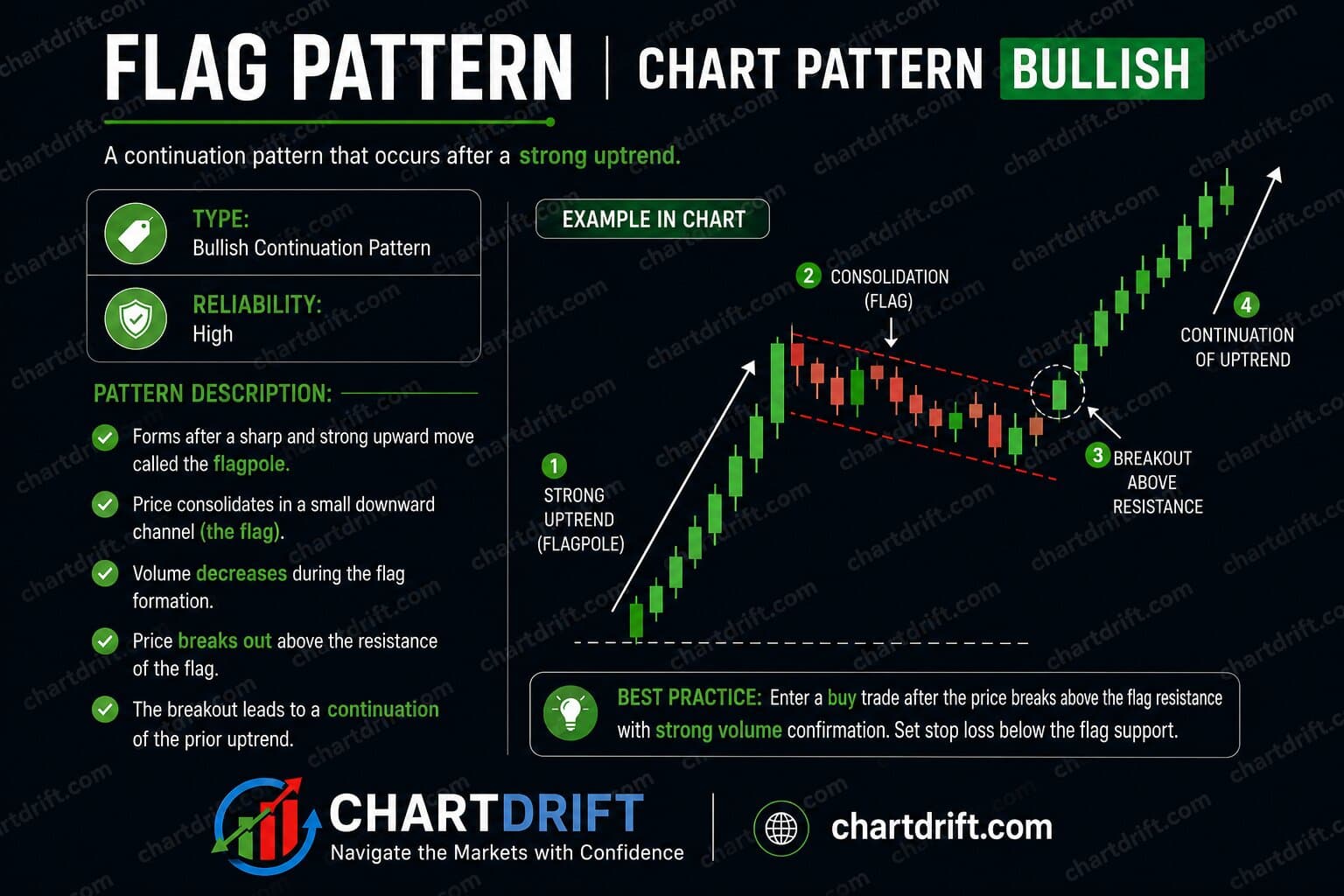
A powerful continuation pattern featuring a sharp move (flagpole) followed by a brief consolidation (flag). When the flag breaks, expect a move equal to the flagpole's length.
Key Characteristics
Understanding these essential features will help you spot the Flag pattern with confidence.
Strong Flagpole
A steep, almost vertical price move on high volume. This represents the initial impulse that precedes the consolidation.
Parallel Channel Flag
A brief consolidation that slopes against the trend, forming a rectangular or parallelogram shape with parallel trendlines.
Volume Pattern
High volume on the flagpole, decreasing during the flag formation, then surging again on breakout.
What is the Flag Pattern?
The Flag pattern is a continuation pattern that consists of two parts: the flagpole and the flag. The flagpole is a sharp, strong move in price, while the flag is a brief consolidation period that slopes in the opposite direction of the trend.
Key Insight
The Flag pattern represents a pause in the trend, not a reversal. After the initial strong move (flagpole), traders take profits causing a brief pullback (flag). Once the consolidation ends, the original trend resumes with similar force, often matching the flagpole's length.
How to Identify the Pattern
Structure of Flag Pattern
Identify the Flagpole
Look for a sharp, almost vertical price move on above-average volume. This is the initial impulse that creates the "pole" of the flag.
Locate the Flag Formation
After the flagpole, price consolidates in a rectangular channel that slopes against the prior trend. Draw parallel trendlines connecting highs and lows.
Confirm Volume Pattern
Volume should be high during the flagpole, decrease during flag formation, then surge on breakout. This volume signature validates the pattern.
Wait for Breakout
The pattern confirms when price breaks out of the flag in the direction of the original trend with strong volume.
Bull Flag vs Bear Flag
Bull Flag
Flagpole moves sharply up, flag slopes down. Breakout occurs above the upper flag trendline, continuing the uptrend.
Bear Flag
Flagpole moves sharply down, flag slopes up. Breakout occurs below the lower flag trendline, continuing the downtrend.
Trading Strategy
Entry Strategy
Breakout Entry: Enter when price breaks out of the flag channel in the direction of the original trend. For bull flags, buy above the upper trendline. For bear flags, sell below the lower trendline.
Setting Stop Loss
Stop Loss Placement: Place your stop loss on the opposite side of the flag. For bull flags, stop below the flag's low. For bear flags, stop above the flag's high.
Determining Target Price
Measured Move Technique: Measure the length of the flagpole. Project this same distance from the breakout point to find your target. The second leg often equals the first.
Example Calculation (Bull Flag)
If the Bull Flag has:
- Flagpole Start:
$80 - Flagpole End:
$100 - Breakout Point:
$98
Flagpole Length = $100 - $80 = $20
Target = $98 (breakout) + $20 = $118
Risk Management
Risk-Reward Ratio
Flag patterns often offer excellent risk-reward. With stops at the flag's extreme and targets based on flagpole length, 1:3 ratios are common.
Time Duration
Flags typically last 1-4 weeks. If consolidation extends beyond this, the pattern may be morphing into something else. Be ready to reassess.
Tips for Successful Trading
Volume is Essential
The flagpole must have high volume. If the initial move lacks conviction, the flag breakout is less likely to succeed.
Shallow Flags Are Better
The best flags retrace only 20-30% of the flagpole. Deep retracements suggest weakening momentum and lower success rates.
Don't Anticipate the Breakout
Wait for the breakout to occur. Trading inside the flag is risky—the pattern could fail and reverse.
Example Trade Setup
Spot the Flagpole
Identify a sharp move from $80 to $100 on high volume—this is your flagpole with a $20 measured move.
Identify the Flag
Price consolidates in a downward-sloping channel between $95 and $100, lasting about 2 weeks.
Enter on Breakout
When price breaks above the upper trendline at $98 with strong volume, enter a long position.
Set Stop Loss
Place your stop loss at $93, below the flag's lowest point.
Set Target Price
Add the flagpole length ($20) to breakout ($98) for a target of $118.
Conclusion
The Flag pattern is a trader's favorite for its clear structure and reliable targets. The measured move technique makes target setting objective, while the flag's boundaries provide natural stop-loss levels. Master this pattern and you'll have a powerful tool for trading trending markets.
Happy trading!
Frequently Asked Questions
What is the flag chart pattern?
The flag is a continuation pattern that appears after a strong move (the pole): a short consolidation (the flag) with parallel or slightly sloping boundaries, then a breakout in the same direction. It represents a brief pause before the trend resumes. Bullish and bearish flags both use the measured move for targets.
Where should I enter on a flag pattern?
Enter when price breaks out of the flag in the direction of the prior trend. For a bullish flag, enter on a break above the flag’s upper boundary. For a bearish flag, enter on a break below the flag’s lower boundary. Volume often increases on the breakout.
How do I set a target using the measured move?
Measure the length of the pole (the initial strong move). Then project that same distance from the breakout point. For a bullish flag, add the pole length to the breakout level. For a bearish flag, subtract it from the breakout level. That gives you a first target.
How is the flag different from the pennant?
The flag has parallel or near-parallel boundaries (a small channel). The pennant has converging boundaries (a small triangle). Both are short consolidations after a strong move and both typically break in the direction of the prior trend. The measured move technique applies to both.
Where do I place my stop loss on a flag trade?
Place your stop loss on the opposite side of the flag from the breakout. For a bullish flag, stop below the flag’s lower boundary. For a bearish flag, stop above the flag’s upper boundary. Some traders use the low or high of the pole for a wider stop.