Spinning Top Pattern
Like a top wobbling before it falls, the Spinning Top shows a market that's losing momentum—volatility without direction.
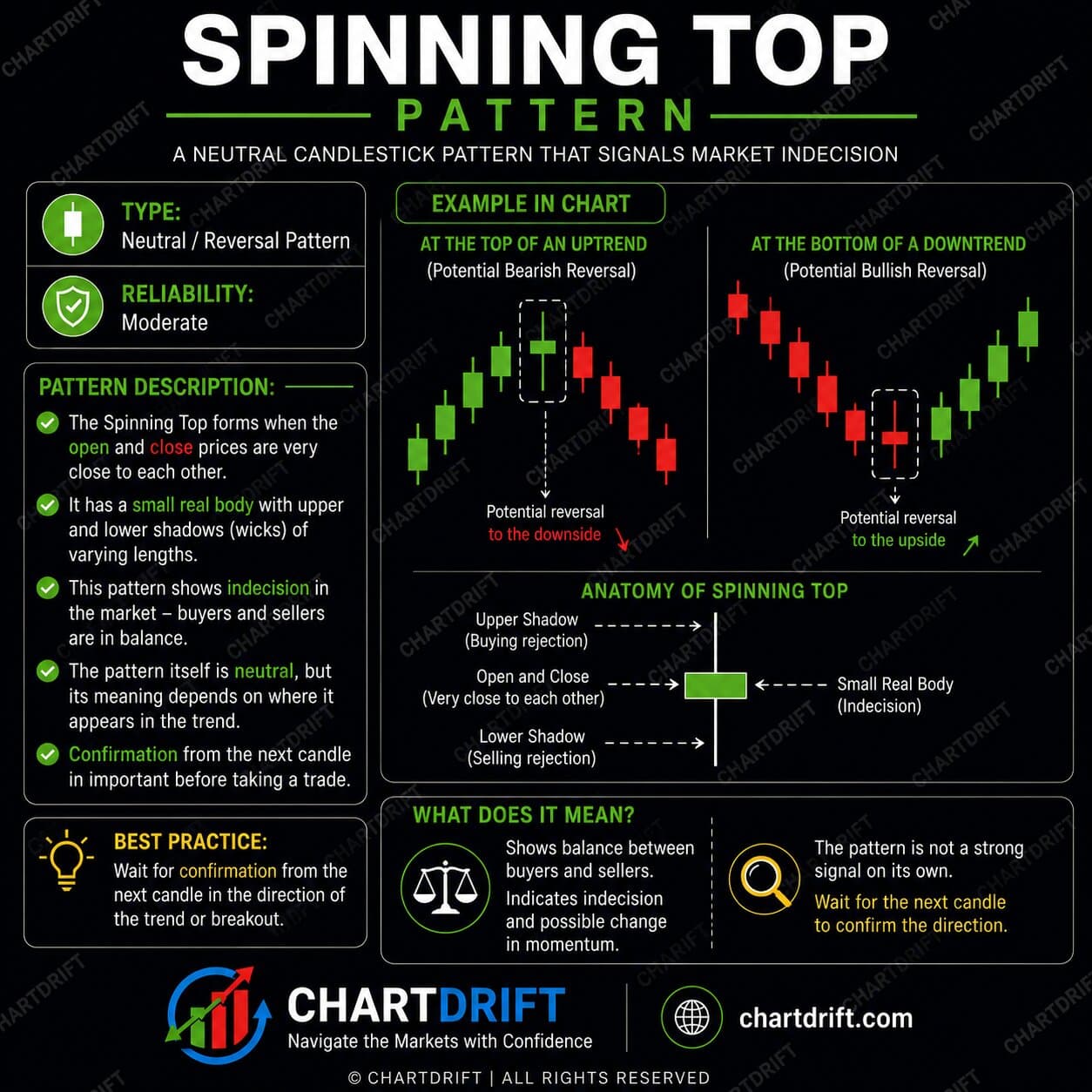
What is a Spinning Top Pattern?
A Spinning Top is a candlestick with a small body positioned in the middle of relatively long upper and lower wicks. Unlike the Doji, which has virtually no body, the Spinning Top has a visible—but small—real body.
The pattern gets its name from the toy that spins until it loses momentum and topples over. In markets, it represents loss of momentum.
Pattern Type
Single-candle indecision
Key Feature
Small body, long wicks
Signal
Momentum exhaustion
The Psychology Behind the Pattern
During the session, price moves significantly in both directions. Bulls push prices up, bears push prices down, but by the close, neither side can claim victory.
In an uptrend: The Spinning Top suggests bulls are losing steam. Sellers are becoming more aggressive.
In a downtrend: Bears are losing control. Buyers are absorbing the selling. A bounce may be coming.
Spinning Top vs Doji
Spinning Top
- • Has a small but visible body
- • Open and close are different
- • More common pattern
- • Weaker indecision signal
Doji
- • Virtually no body (line)
- • Open equals close
- • Less common pattern
- • Stronger indecision signal
Trading Strategy
Key Principle
Never trade a Spinning Top in isolation. Wait for confirmation.
Bullish Reversal Setup
Spinning Top at end of downtrend, followed by bullish confirmation.
- • Entry: Above Spinning Top high
- • Stop: Below Spinning Top low
- • Target: Prior resistance
Bearish Reversal Setup
Spinning Top at end of uptrend, followed by bearish confirmation.
- • Entry: Below Spinning Top low
- • Stop: Above Spinning Top high
- • Target: Prior support
Context Determines Meaning
After Extended Downtrend
Sellers may be exhausted. Watch for bullish confirmation.
After Extended Uptrend
Bulls may be tiring. Watch for bearish confirmation.
In a Trading Range
Less meaningful. Ranges are inherently indecisive.
Common Mistakes to Avoid
Overtrading the Pattern
Spinning Tops are common. Only act when they appear at significant levels.
Not Waiting for Confirmation
The confirmation candle is essential for determining direction.
Frequently Asked Questions
What does a spinning top candlestick mean?
A spinning top has a small body (open and close are close together) with upper and lower wicks of similar length. It shows indecision—buyers and sellers pushed price in both directions during the period but ended near where they started. The small body and balanced wicks reflect uncertainty.
Should I trade on a spinning top alone?
No. A spinning top by itself doesn’t tell you direction—it only shows indecision. You need the next candle (or more context) to confirm whether buyers or sellers will win. Many traders use spinning tops at support or resistance to anticipate a breakout or reversal.
How is a spinning top different from a doji?
A doji has a very small or no body—open and close are the same or nearly the same. A spinning top has a small but visible body. Both show indecision; the doji is often considered a stronger indecision signal because the body is even smaller.
When is a spinning top most useful?
A spinning top is most useful when it appears at a key level—support, resistance, or the end of a strong trend—and is followed by a confirming candle. In the middle of a range with no clear level, it has less predictive value. Context and confirmation matter.
Can a spinning top appear in an uptrend or downtrend?
Yes. A spinning top can appear anywhere. After an uptrend it can warn of a possible bearish reversal if the next candle closes lower. After a downtrend it can hint at a bullish reversal if the next candle closes higher. Always wait for the next candle to confirm direction.