Doji Candlestick Pattern
When buyers and sellers battle to a draw, the Doji emerges—a single candle that captures the moment of perfect balance.
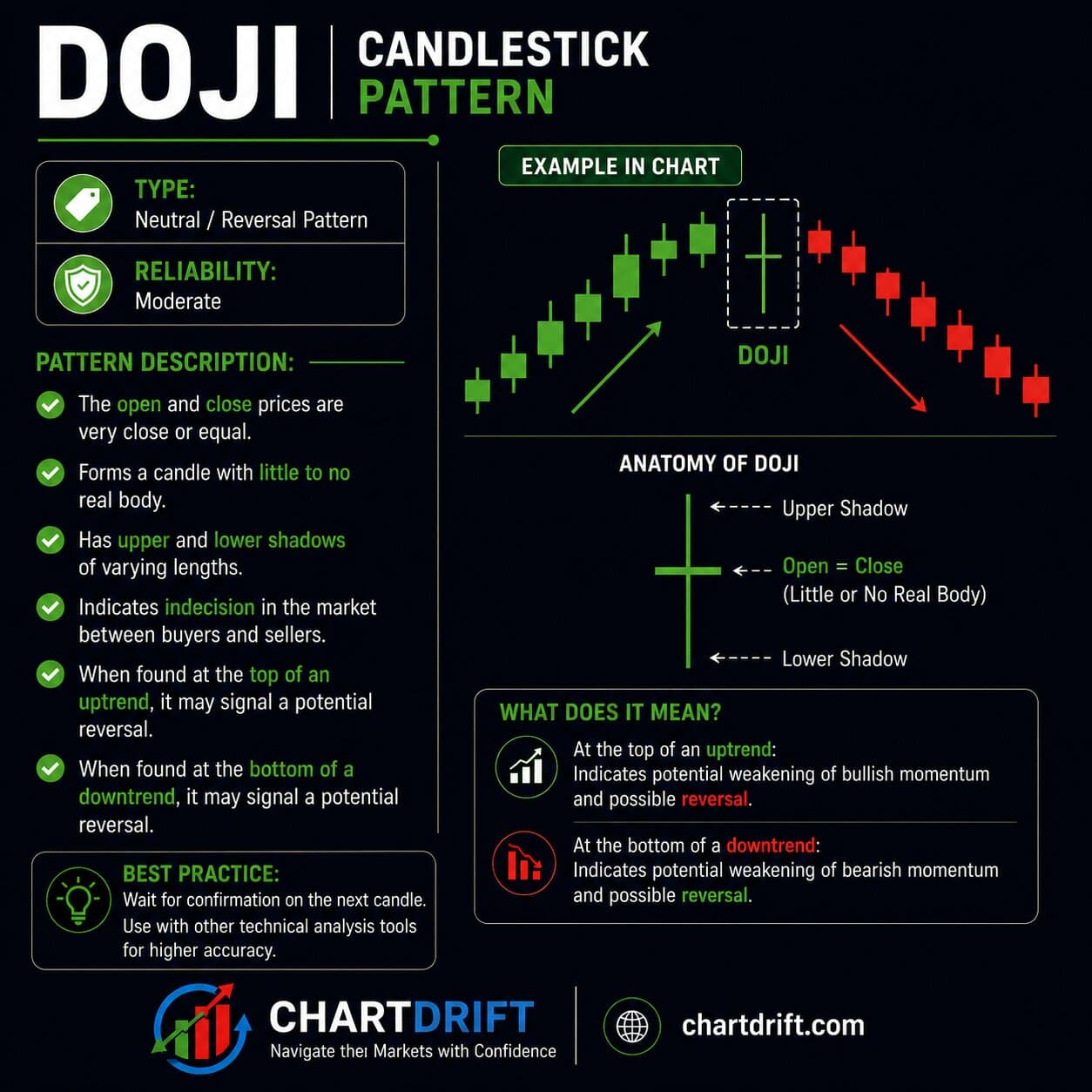
What is a Doji Pattern?
A Doji is a candlestick where the opening and closing prices are virtually identical, creating a candle with little or no body. The wicks show the price range explored during the session.
The Doji represents a tug-of-war between bulls and bears that ended in a stalemate. This equilibrium often precedes significant moves.
Pattern Type
Single-candle indecision
Key Feature
Open ≈ Close
Action
Wait for confirmation
The Psychology Behind the Doji
The Doji captures a moment when conviction evaporates and uncertainty takes over. A Doji at a key level after a strong trend is a potential reversal warning.
Types of Doji Patterns
Standard Doji
Equal upper and lower wicks with open/close in the middle. Pure indecision.
Long-Legged Doji
Extended wicks in both directions. High volatility but no resolution.
Dragonfly Doji
Long lower wick, no upper wick. Bullish after a downtrend.
Gravestone Doji
Long upper wick, no lower wick. Bearish after an uptrend.
Trading Strategy
Critical Rule
Never trade a Doji alone. Always wait for the next candle to confirm direction.
Bullish Setup
Doji after a downtrend, followed by bullish confirmation.
- • Entry: Above Doji high
- • Stop: Below Doji low
- • Target: Prior resistance
Bearish Setup
Doji after an uptrend, followed by bearish confirmation.
- • Entry: Below Doji low
- • Stop: Above Doji high
- • Target: Prior support
Context is Everything
High-Impact Locations
- ✓ At major support/resistance
- ✓ After extended trends
- ✓ At round numbers
Low-Impact Locations
- ✗ Mid-range in sideways markets
- ✗ During low-volume periods
- ✗ Multiple Dojis in a row
Common Mistakes to Avoid
Trading Without Confirmation
Doji shows indecision, not direction. Wait for the next candle.
Ignoring Trend Context
A Doji after 3 candles isn't the same as after a 20-candle rally.
Frequently Asked Questions
Does a doji candle mean the market will reverse?
Not by itself. A doji shows indecision—buyers and sellers ended the period in balance. Reversal potential depends on context: a doji after a long uptrend or downtrend can signal exhaustion, but you need the next candle to confirm direction. Never trade on the doji alone.
What’s the difference between a dragonfly doji and a gravestone doji?
A dragonfly doji has a long lower wick and no upper wick; the open and close are at the high. It often appears at support and can hint at a bullish bounce. A gravestone doji has a long upper wick and no lower wick; open and close are at the low. It often appears at resistance and can hint at a bearish rejection.
When is a doji most useful in trading?
A doji is most useful when it appears at a key level—support, resistance, or the end of a strong trend—and is followed by a confirming candle. In the middle of a range or with no clear trend, a doji has little predictive value. Context and confirmation matter more than the candle shape.
Should I use doji with other indicators?
Yes. Combining a doji with volume (e.g., high volume on the doji), RSI (overbought/oversold), or a clear support/resistance level improves the odds. The doji identifies indecision; other tools help you decide whether a reversal is likely.
Can a doji appear on any timeframe?
Yes. Dojis can form on 1-minute charts as well as weekly charts. On shorter timeframes they’re more common and noisier. Many traders pay closer attention to dojis on 4-hour or daily charts where they tend to carry more weight, especially at important levels.