Shooting Star Candlestick Pattern
A bearish reversal signal appearing after uptrends. Long upper wick with a small body at the bottom—buyers tried to push higher but sellers took control by the close.
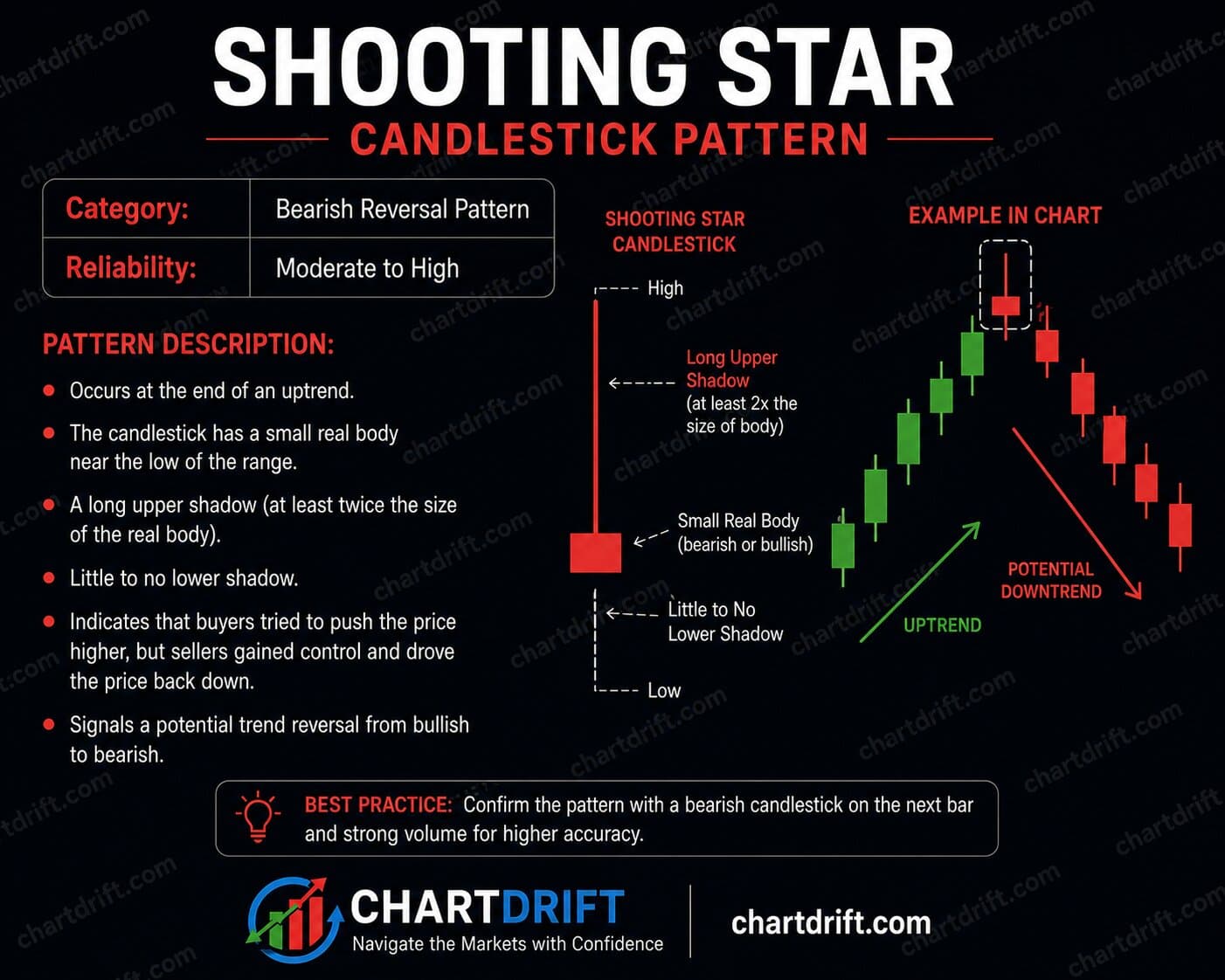
Key Characteristics
The Shooting Star tells a story of rejection at the top. Here's what to look for.
Small Body at Bottom
The body sits near the low of the candle. Buyers pushed up during the session but sellers closed it near the open.
Long Upper Wick
The upper wick should be at least twice the body length—proof that buyers tried and failed to hold higher prices.
Forms After Uptrend
Context is everything. A Shooting Star only carries weight when it appears after prices have been rising.
The Psychology Behind the Shooting Star
The Shooting Star shows a session where buyers pushed prices higher, only to see sellers take control by the close. The long upper wick is a rejection of higher prices—a warning that the uptrend may be ending.
The Message
Buyers tried and failed. Sellers closed the session in control. Wait for confirmation before shorting.
How to Spot a Valid Shooting Star
Confirm the Uptrend
The pattern must appear after a clear advance. Look for at least 3-5 consecutive higher highs.
Measure the Wick
The upper wick should be at least 2x the body length. A 3x ratio shows stronger rejection.
Check Volume
Higher volume on the Shooting Star day adds conviction.
Trading the Shooting Star
Entry Strategy
Wait for confirmation. Enter when the next candle closes below the Shooting Star's low—this confirms sellers are following through.
Stop Loss
Place your stop above the Shooting Star's high. If price breaks above, the rejection has failed.
Target
Use the pattern's range. Measure from low to high and project downward from the breakout point. Consider 1R and 2R targets.
Common Mistakes
Trading Without Context
A Shooting Star in a downtrend or sideways market means nothing.
Skipping Confirmation
Jumping in before the next candle confirms leads to false starts.
Frequently Asked Questions
Why does a shooting star signal a bearish reversal?
The shooting star has a small body at the bottom and a long upper wick. After an uptrend, that long wick shows buyers pushed price higher during the candle, but sellers pushed it back down by the close. That rejection of higher prices often means buying pressure is fading and a bearish reversal may follow.
Do I need to wait for the next candle after a shooting star?
Yes. Waiting for the next candle to close below the shooting star’s body (or low) confirms that sellers are in control. Entering on the shooting star candle itself is riskier because price can still bounce. Confirmation improves your odds and reduces false signals.
What’s the difference between a shooting star and an inverted hammer?
They look the same—small body at the bottom, long upper wick. The difference is context: shooting star forms after an uptrend (bearish signal); inverted hammer forms after a downtrend (bullish signal). Same shape, opposite trend, opposite interpretation.
Where should I place my stop loss on a shooting star trade?
Place your stop loss above the high of the shooting star’s upper wick. That level represents the point where buyers failed to hold price higher. If price breaks above it, the bearish reversal is invalidated. Some traders add a small buffer to avoid wicks.
Can a shooting star appear in a downtrend?
It can appear anywhere, but its meaning changes with context. After an uptrend it’s a bearish reversal signal. After a downtrend, a candle with a long upper wick and small body at the bottom is often called an inverted hammer and can signal a bullish reversal. Always check the trend before the candle.