Hanging Man Pattern
The Hanging Man gets its ominous name from its shape—a body "hanging" above a long lower wick, like a figure on a gallows. When this appears after an uptrend, it's a warning that the rally may be living on borrowed time.
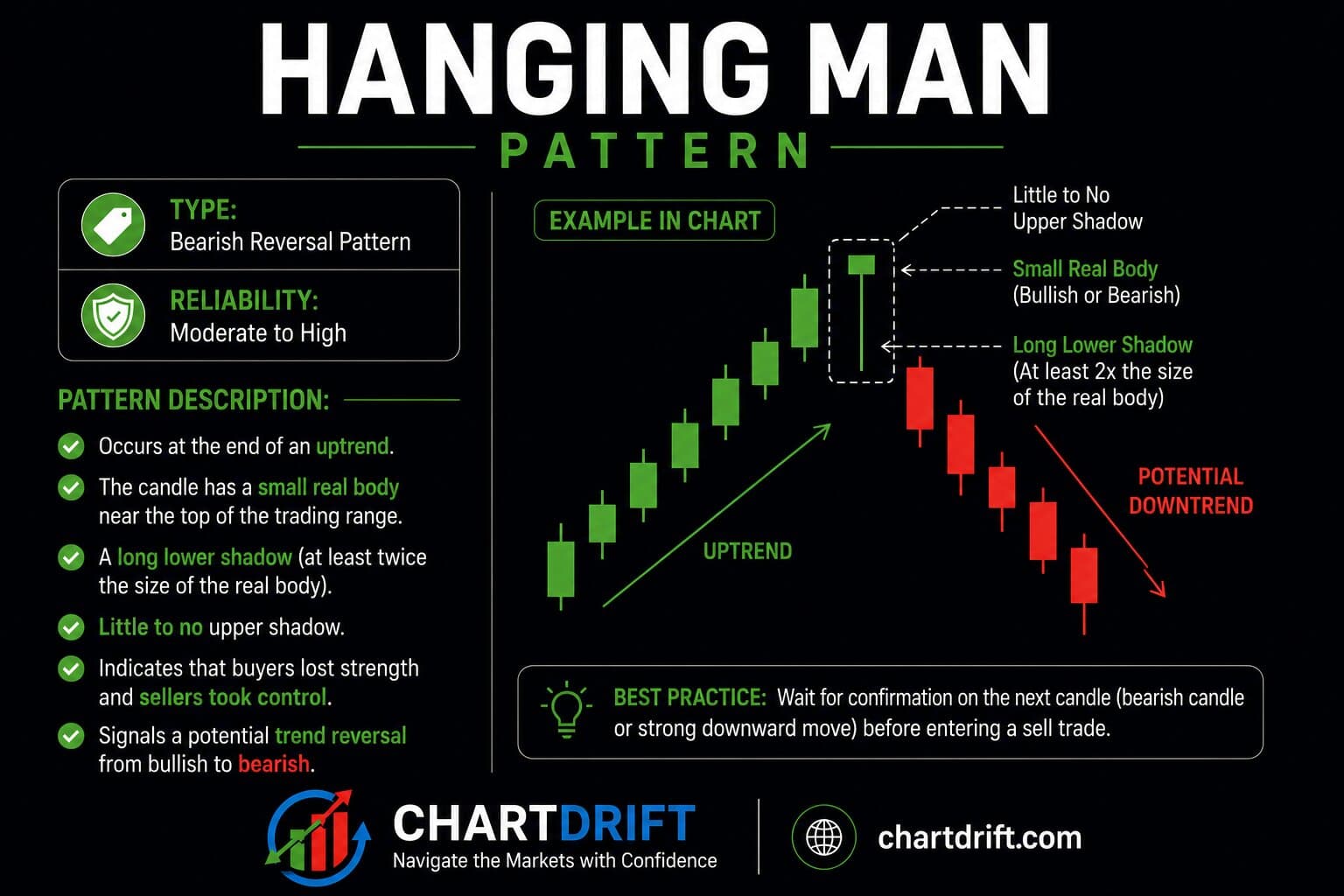
Pattern Anatomy
The Hanging Man is the bearish cousin of the Hammer—same shape, different story.
Small Body at the Top
The body forms near the session's high. Whether the body is bullish or bearish is less important than its position at the top of the trading range.
Long Lower Wick
The lower wick should be at least twice the body length. This represents intraday selling pressure that was ultimately overcome—but sellers showed up.
At the Top of an Uptrend
This is crucial. A Hanging Man only matters when it appears after the market has been rising. It's a potential turning point, not a continuation signal.
Why the Hanging Man Is Dangerous
At first glance, the Hanging Man might seem bullish—after all, the price recovered from the lows and closed near the highs. But context changes everything.
After an uptrend, the market is extended. Longs are comfortable, perhaps complacent. Then comes the Hanging Man session: at some point during the day, sellers pushed the price significantly lower. The market recovered, yes—but that selling pressure was a warning shot.
The long lower wick reveals that sellers are lurking. They tested the bulls' resolve, and while they didn't win this round, they made their presence known. The question becomes: will they come back stronger tomorrow?
The Warning
The Hanging Man is a yellow flag, not a red one. It says "be careful" rather than "sell now." Confirmation is essential before acting.
Getting Confirmation
The Hanging Man requires confirmation more than most patterns. Here's how to wait for the market to show its hand:
Bearish Candle Following
The strongest confirmation is when the next candle opens lower and closes below the Hanging Man's body.
Gap Down
A gap down opening after the Hanging Man significantly increases the reversal probability.
Increased Volume
High volume on the Hanging Man day, followed by another high-volume bearish day, validates the reversal.
Trading Execution
Entry Strategy
Enter short when the next candle breaks below the Hanging Man's low, or when it closes as a bearish candle below the Hanging Man's body.
Stop Loss
Above the Hanging Man's high. This is where the pattern fails. If price exceeds the high, bulls are still in control.
Targets
First target: The start of the uptrend or the nearest support level. Second target: Measure the Hanging Man's range and project downward.
Trade Example
Hanging Man on SPY after a 5-day rally:
- High:
$455 - Low:
$448 - Close:
$454
Next day opens at $452, closes at $447
Entry (Short): $447.90 (below Hanging Man low)
Stop: $455.20 (above high) = Risk $7.30
Target 1: $440.60 (1:1)
Target 2: $433.30 (1:2)
Hanging Man vs. Hammer
Hanging Man
Forms after an uptrend at potential tops. The long lower wick represents selling pressure emerging. Bearish implication.
Hammer
Forms after a downtrend at potential bottoms. The long lower wick represents buyer rejection of lower prices. Bullish implication.
Critical insight: The exact same candle shape has opposite meanings depending on where it appears. Context determines whether you should buy or sell.
Common Errors
Acting Without Confirmation
The Hanging Man is a warning, not a sell signal. Many Hanging Man patterns fail. Wait for follow-through.
Wrong Context
A Hanging Man in a downtrend is just a Hammer—a bullish signal. Always verify the preceding trend.
Ignoring Support Below
If strong support sits right below the Hanging Man, the reversal may stall. Check the bigger picture.
Tight Stops
Placing stops just above the body instead of above the high will get you stopped out prematurely.
Frequently Asked Questions
How do I know if a hanging man is valid for a bearish reversal?
A valid hanging man appears after a clear uptrend, has a small body at the top, a long lower wick (at least twice the body), and little or no upper wick. The next candle should close lower to confirm the reversal. Volume increasing on the hanging man candle adds conviction.
Why does the hanging man look like a hammer but mean the opposite?
They look identical—small body at the top, long lower wick. Context is what changes the meaning: a hammer forms after a downtrend and signals a bullish reversal; a hanging man forms after an uptrend and warns of a possible bearish reversal. Same shape, opposite trend.
Where should I place my stop loss when trading a hanging man?
Place your stop loss above the high of the hanging man’s body (or above the high of the upper wick). If price breaks above that level, the bearish reversal is invalidated. Some traders use the recent swing high for a wider stop.
Should I wait for confirmation after a hanging man?
Yes. Waiting for the next candle to close below the hanging man’s body (or low) confirms that sellers are in control. Entering on the hanging man candle alone is riskier because price can still rise. Confirmation improves your win rate.
Can a hanging man appear in a downtrend?
It can appear anywhere, but its meaning depends on context. After an uptrend it’s a hanging man (bearish signal). After a downtrend, the same shape is a hammer (bullish signal). Always look at the trend before the candle to interpret it correctly.