Evening Star Pattern
As the sun sets on a rally, the Evening Star emerges—a three-candle warning that the uptrend is losing its light.
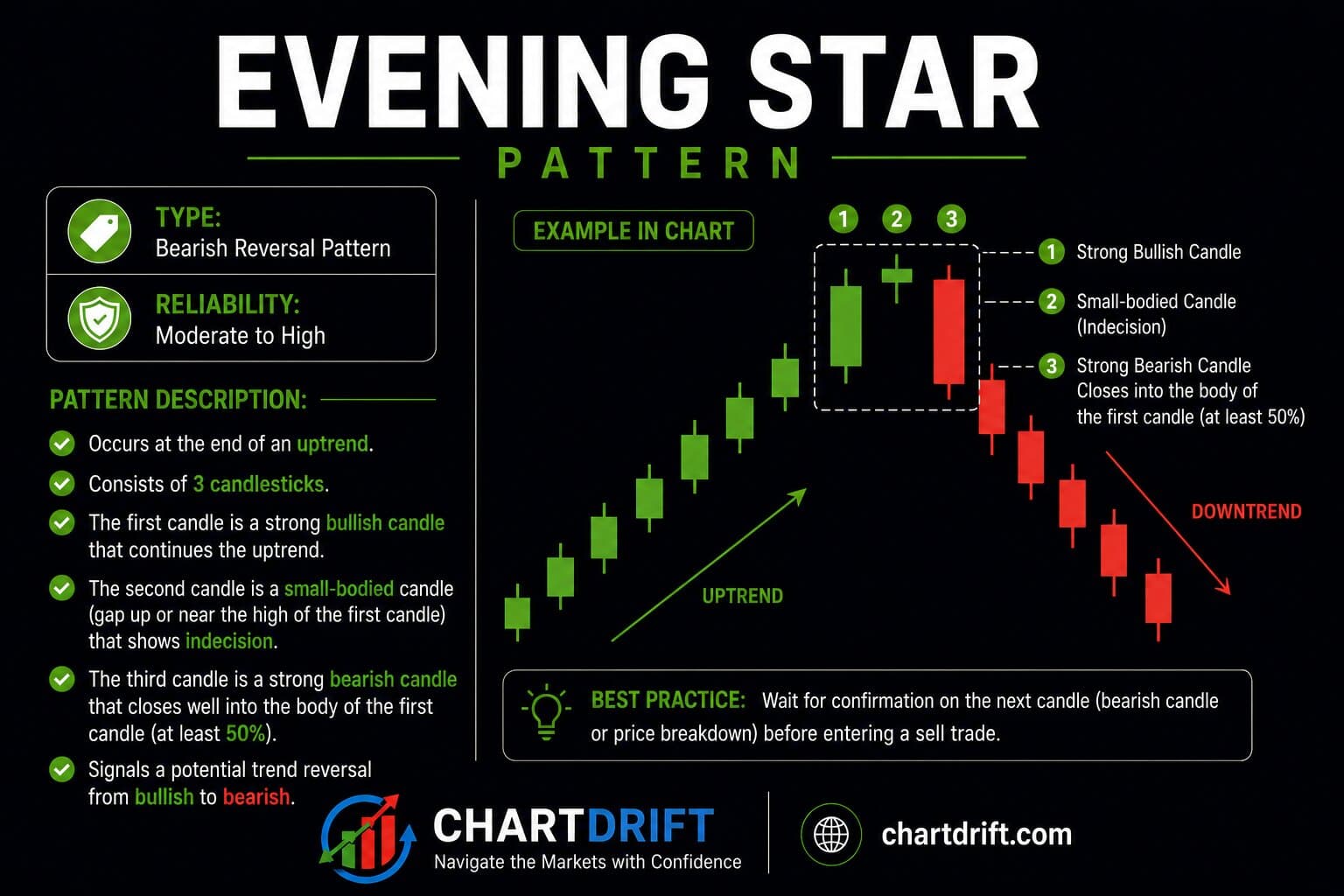
What is the Evening Star Pattern?
The Evening Star is a three-candle bearish reversal pattern that marks the end of an uptrend. Named after Venus—the "evening star" that appears as the sun sets—this pattern signals that the bullish run is fading.
The pattern consists of a large bullish candle, followed by a small-bodied candle (the "star") that gaps up, and finally a large bearish candle that closes deep into the first candle's body.
Pattern Type
Three-candle bearish reversal
Reliability
Very high—classic reversal
Best Timeframe
Daily and weekly charts
The Psychology Behind the Pattern
The Evening Star tells a compelling three-act story about how market sentiment shifts from euphoric to fearful.
Act One: Bulls are in full control. The large bullish candle confirms the uptrend, and optimism runs high.
Act Two: The market gaps up—excitement peaks! But buyers can't push prices much further. The small body reveals indecision.
Act Three: Sellers flood the market, driving prices deep into the first day's gains. The message is clear: the trend has reversed.
How to Identify the Pattern
First Candle: Strong Bullish
A large bullish candle confirming the uptrend is still intact.
Second Candle: The Star
A small-bodied candle that gaps above the first. The gap is key.
Third Candle: Bearish Confirmation
A large bearish candle that closes into the body of the first candle.
Trading Strategy
Entry Point
Enter short when price breaks below the third candle's low.
Stop Loss
Place stop loss above the star's high (second candle).
Targets
First target: Previous support level or 1:1 risk/reward ratio.
Second target: 1:2 risk/reward ratio or next major support.
Pattern Variations
Evening Doji Star
When the middle candle is a doji, the signal is even stronger.
Abandoned Baby
A rare variation where the star gaps completely away from both surrounding candles.
Common Mistakes to Avoid
Not Waiting for Confirmation
The pattern isn't complete until the third candle closes.
Ignoring the Trend Context
This pattern only works after a sustained uptrend.
Frequently Asked Questions
When is an evening star pattern complete?
The evening star is complete when the third candle closes. That candle should be bearish and close well into the body of the first (bullish) candle. Until the third candle closes, the pattern is not confirmed—price can still reverse and invalidate the setup.
How do I trade an evening star pattern?
Wait for the third candle to close, then consider a short entry. Some traders enter on the next candle or when price breaks below the low of the middle candle. Place your stop loss above the high of the first or third candle. Target support or use a risk-reward ratio.
What’s the difference between evening star and shooting star?
The shooting star is a single-candle pattern: small body at the bottom, long upper wick, after an uptrend. The evening star is a three-candle pattern: bullish candle, small body, then strong bearish candle. Both are bearish reversal signals; the evening star is considered stronger because it shows a clearer shift over three periods.
Where should I put my stop loss on an evening star trade?
Place your stop loss above the high of the first candle (the bullish one) or above the high of the third candle. If price breaks above that level, the bearish reversal is invalidated. Some traders use the recent swing high for a wider stop.
Does the evening star work on all timeframes?
Yes. The evening star can form on any timeframe—from 1-minute to weekly. On shorter timeframes you’ll see more patterns but also more noise. Many traders find it more reliable on 4-hour or daily charts where the trend context is clearer.