Chaikin Money Flow
CMF measures buying and selling pressure over a period by analyzing where price closes within its range combined with volume—revealing institutional accumulation and distribution.
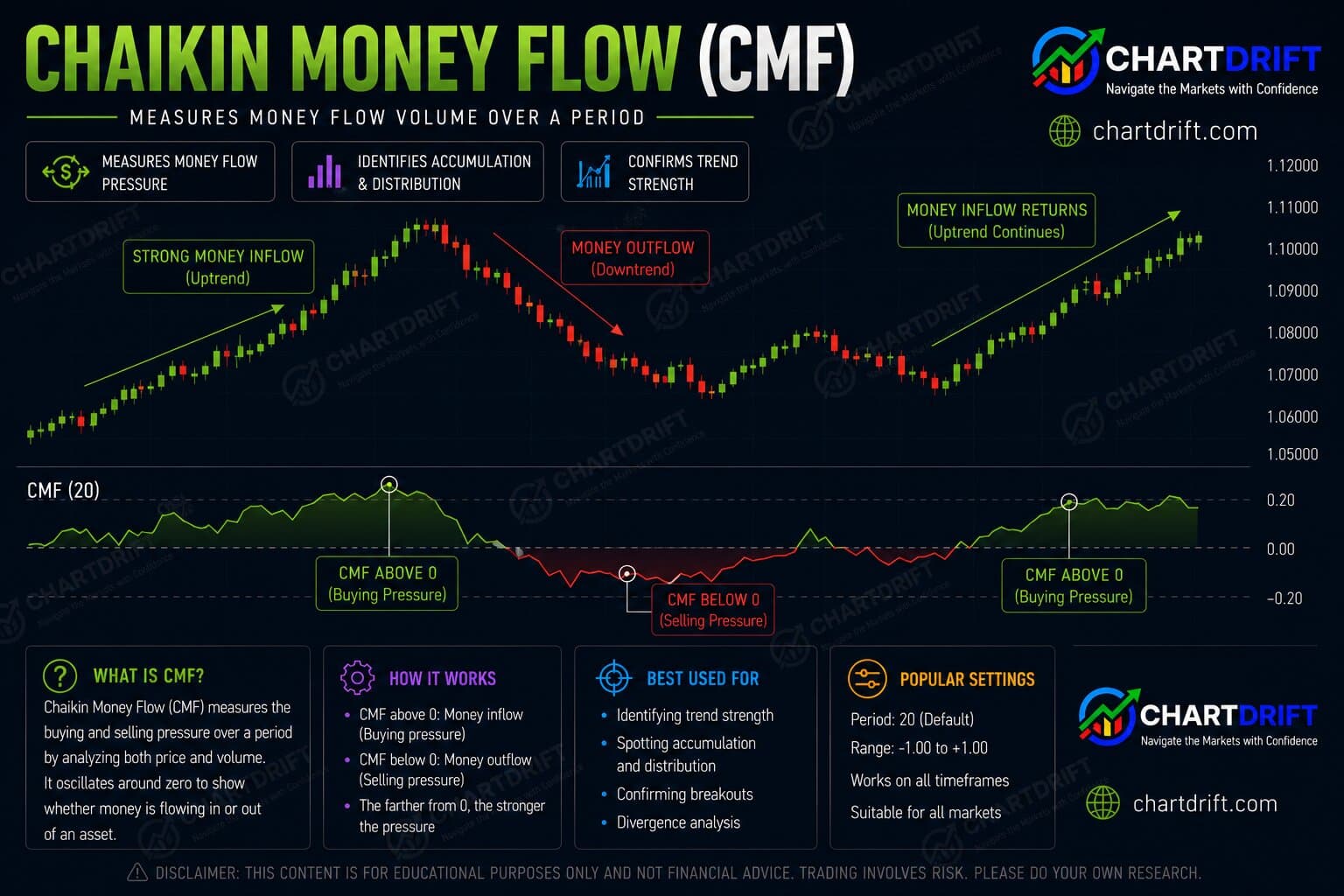
What is Chaikin Money Flow?
Created by Marc Chaikin, the Chaikin Money Flow indicator measures the amount of Money Flow Volume over a specific period. It oscillates between +1 and -1, with values above zero indicating buying pressure and values below zero indicating selling pressure.
The key insight is that if price closes near its high with strong volume, it suggests accumulation. If it closes near its low with volume, it indicates distribution. CMF aggregates this data to reveal the dominant force.
Positive CMF
Values above zero indicate buying pressure dominates—money is flowing into the asset.
Negative CMF
Values below zero indicate selling pressure dominates—money is flowing out.
How It Works
CMF is calculated in three steps: first the Money Flow Multiplier, then Money Flow Volume, and finally the CMF value itself.
Step 1: Money Flow Multiplier
MFM = [(Close - Low) - (High - Close)] / (High - Low)
Step 2: Money Flow Volume
MFV = MFM × Volume
Step 3: CMF (21-period default)
CMF = Sum(MFV, 21) / Sum(Volume, 21)
Reading CMF Values
The strength of CMF readings provides insight into the conviction behind price moves. Extreme readings suggest strong institutional activity.
Strong Buying (> +0.25)
Significant accumulation. Price likely to continue higher.
Neutral (-0.05 to +0.05)
No clear bias. Wait for a breakout in either direction.
Strong Selling (< -0.25)
Significant distribution. Price likely to continue lower.
Trading Strategies
Zero Line Crossover
- Buy when CMF crosses above zero from below
- Sell when CMF crosses below zero from above
- Confirms shift in buying/selling pressure
- Best with trend confirmation from price action
Trend Confirmation
- CMF above zero during uptrends = healthy trend
- CMF below zero during downtrends = trend has conviction
- Use CMF to validate breakout trades
- Declining CMF in uptrend = warning sign
CMF Divergences
Divergences between CMF and price often precede trend reversals. They reveal when price movement lacks volume confirmation.
Bullish Divergence
Price makes lower lows while CMF makes higher lows. Selling pressure is weakening.
Bearish Divergence
Price makes higher highs while CMF makes lower highs. Buying pressure is fading.
Pro Tip
CMF works best on higher timeframes (4H, Daily) where volume data is more reliable. On lower timeframes, noise can create false signals.
Frequently Asked Questions
What is Chaikin Money Flow (CMF)?
Chaikin Money Flow is a volume-based oscillator that measures buying and selling pressure over a set period. It uses the relationship between close price and the high-low range, weighted by volume. Values range from -1 to +1; positive CMF suggests accumulation, negative suggests distribution.
How do I read CMF values?
CMF above zero suggests more buying pressure (accumulation); below zero suggests more selling pressure (distribution). The farther from zero, the stronger the pressure. CMF crossing above or below zero can signal shifts in money flow.
What is CMF divergence?
Bullish divergence: price makes a lower low while CMF makes a higher low—selling pressure may be weakening. Bearish divergence: price makes a higher high while CMF makes a lower high—buying pressure may be fading. Divergence often precedes reversals but should be confirmed.
What period is best for CMF?
The default 20-period works well. Shorter periods (e.g. 10) react faster but are noisier; longer periods (e.g. 21–25) are smoother. CMF is often used on 4H or daily charts where volume data is more meaningful.
How is CMF different from OBV?
OBV (On-Balance Volume) adds or subtracts volume based on close direction; CMF uses the close position within the bar (high-low range) weighted by volume. CMF is bounded (-1 to +1) and can show divergence more clearly; OBV is cumulative and unbounded.