Average True Range (ATR)
Measure market volatility to set smarter stops, size positions correctly, and identify potential breakout opportunities.
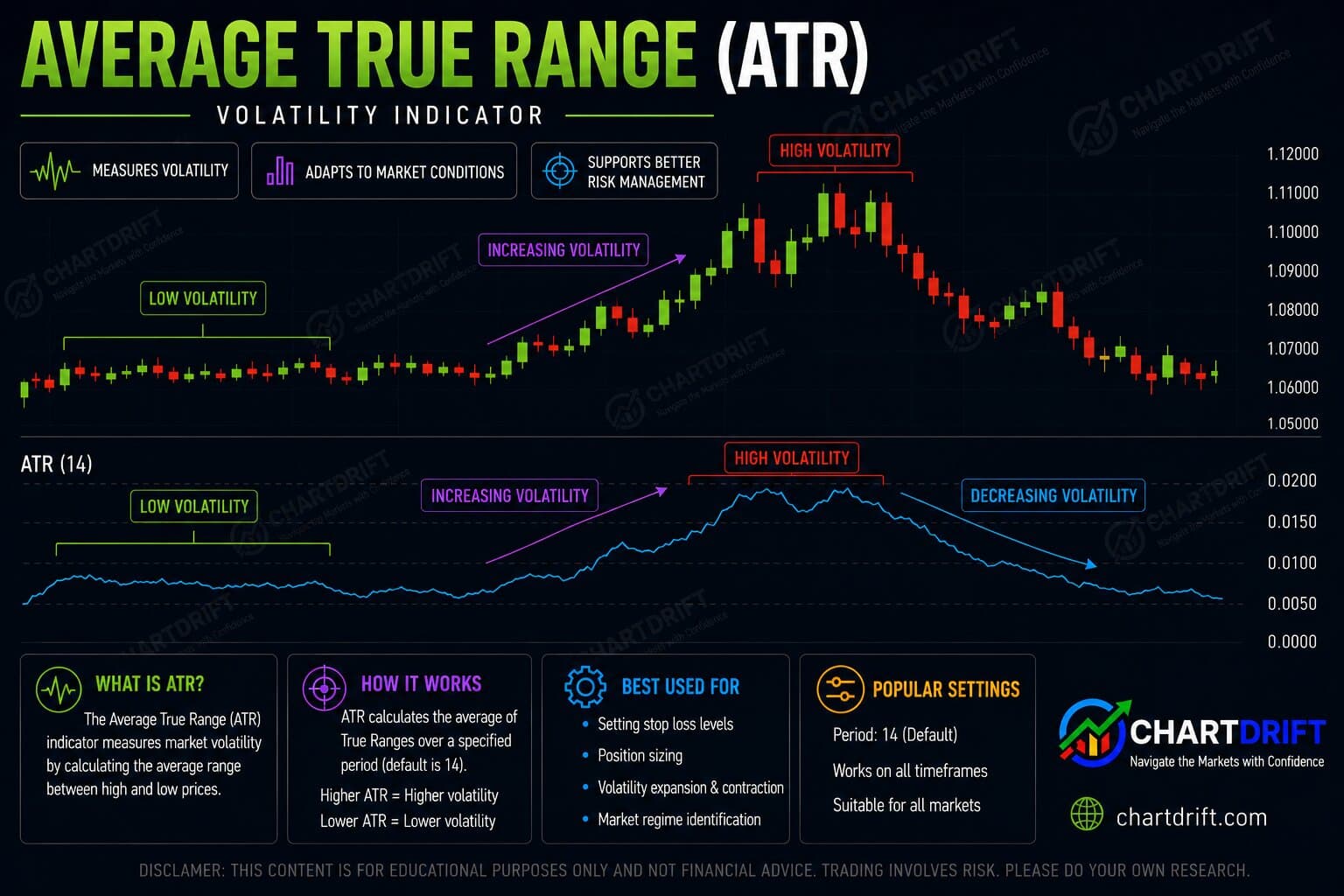
What is ATR?
The Average True Range (ATR) is a volatility indicator developed by J. Welles Wilder Jr. Unlike directional indicators, ATR doesn't tell you where price is going—it tells you how much price typically moves.
High ATR means the market is volatile with large price swings. Low ATR indicates consolidation with smaller moves. This information is invaluable for setting stops, sizing positions, and identifying potential breakouts.
How ATR Works
True Range is calculated as the greatest of three values:
Current High − Current Low|Current High − Previous Close||Current Low − Previous Close|ATR is then the moving average of True Range over a specified period (typically 14 periods). This accounts for gaps and produces a smoothed volatility measure.
Reading ATR Values
High ATR
- • Market is volatile and active
- • Often follows major news or breakouts
- • Wider stops required
- • Consider smaller position sizes
Low ATR
- • Market is consolidating
- • May precede a breakout
- • Tighter stops possible
- • Larger position sizes viable
⚠️ Important Context
ATR values are relative to the asset's price. A $100 stock with ATR of 2 has similar volatility to a $50 stock with ATR of 1 (both are ~2%). Always consider ATR as a percentage of price for comparisons.
ATR-Based Stop Loss
Setting stops based on ATR automatically adapts to current volatility. The most common approach uses ATR multiples:
Example Calculation
Entry: $50.00 | ATR(14): $1.20 | Stop Multiplier: 2×
Stop Loss: $50.00 − ($1.20 × 2) = $47.60
ATR Position Sizing
ATR helps normalize position sizes across different volatility environments. Risk the same dollar amount regardless of market conditions:
Position Size Formula
Position Size = Risk Amount ÷ (ATR × Multiplier)Example
Account: $10,000 | Risk: 1% ($100) | ATR: $2.00 | Multiplier: 2×
Shares: $100 ÷ ($2.00 × 2) = 25 shares
This approach naturally reduces position size in volatile markets and increases it during calm periods—exactly what good risk management requires.
Optimal Settings
| Trading Style | ATR Period | Stop Multiple |
|---|---|---|
| Scalping | 7–10 | 1–1.5× |
| Day Trading | 14 | 1.5–2× |
| Swing Trading | 14–20 | 2–2.5× |
| Position Trading | 20–50 | 2.5–3× |
Pro Tip
Use ATR expansion (rising ATR) as a filter for breakout trades. A breakout accompanied by increasing ATR has higher odds of follow-through than one with flat or declining ATR.
Frequently Asked Questions
What is ATR and what does it measure?
ATR (Average True Range) measures volatility—how much an asset typically moves over a given period. It does not indicate direction. Higher ATR means more volatility; lower ATR means quieter markets. It is often used for stop placement and position sizing.
How do I use ATR for stop loss?
Place stops based on ATR so they adapt to volatility. For example, set a stop 1.5–2× ATR below your entry for a long. In volatile markets the stop is wider; in quiet markets it is tighter. This reduces being stopped out by normal noise.
What ATR period should I use?
The default 14-period works well for many timeframes. Shorter periods (7–10) suit scalping; longer (20–50) suit swing or position trading. Match the period to your holding time.
Can ATR be used for position sizing?
Yes. Risk a fixed amount per trade (e.g. 1% of account). Divide that risk by (ATR × multiplier) to get position size. Higher ATR means smaller position; lower ATR means larger position, keeping risk per trade consistent.
Does ATR indicate trend direction?
No. ATR only measures volatility. Rising ATR often accompanies strong trends or breakouts; falling ATR often accompanies consolidation. Use trend or momentum indicators for direction and ATR for stops and size.