Inverse Head and ShouldersChart Pattern
The mirror image of the classic Head and Shoulders. This powerful pattern forms at market bottoms and signals a bullish reversal when the neckline is broken with conviction.
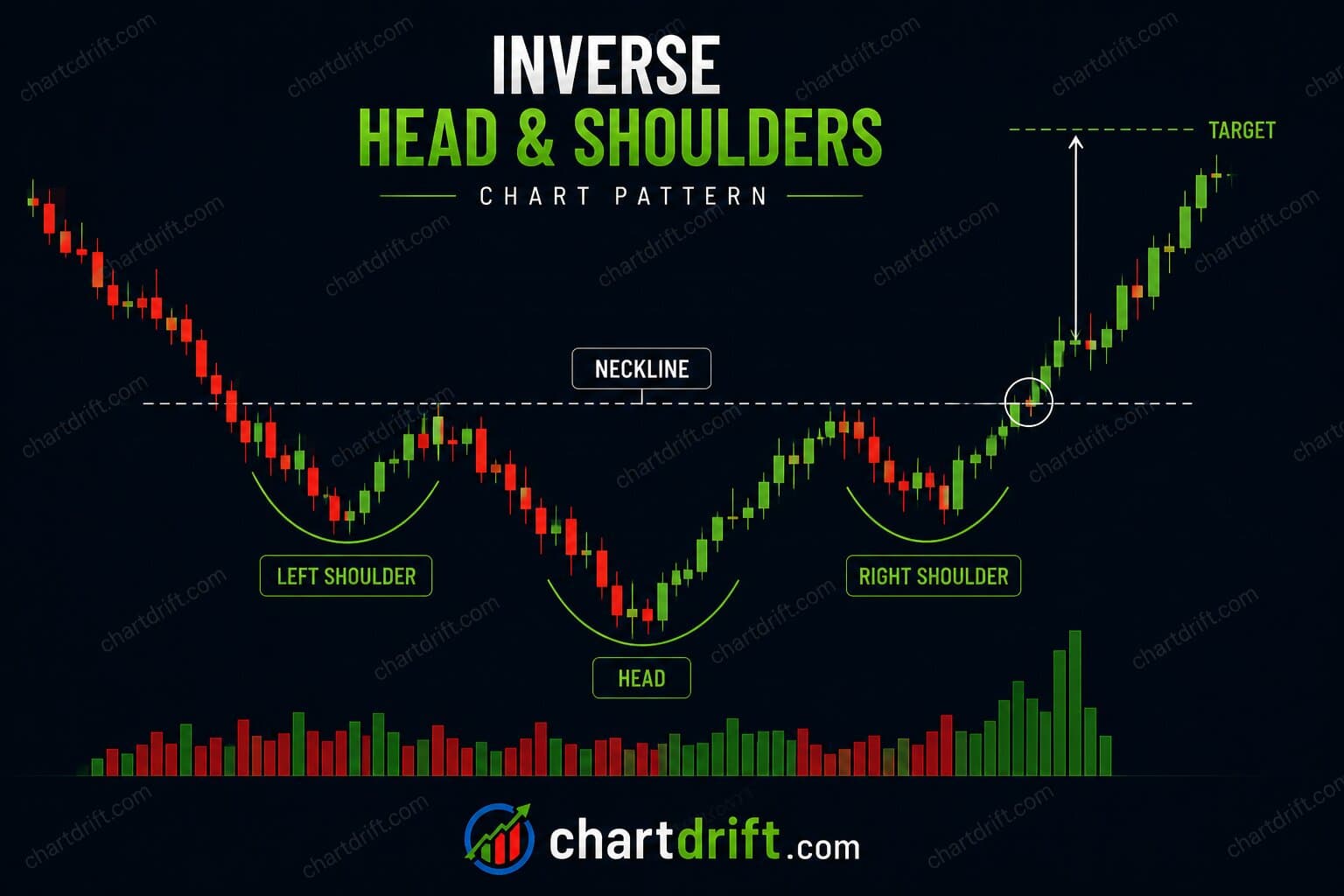
Key Characteristics
Understanding these essential features will help you spot the Inverse Head and Shoulders pattern with confidence.
Three Troughs
The pattern consists of a left shoulder, a deeper head (the lowest trough), and a right shoulder that mirrors the left at similar levels.
Neckline Resistance
Connect the highs between the troughs to form the neckline. A break above this line confirms the bullish reversal.
Downtrend Preceding
The pattern forms after a sustained downtrend, signaling that sellers are exhausted and buyers are stepping in.
What is the Inverse Head and Shoulders Pattern?
The Inverse Head and Shoulders pattern is the bullish counterpart to the classic Head and Shoulders. It typically signals the end of a downtrend and the beginning of an uptrend, making it invaluable for traders looking to catch major bottoms and ride new bullish trends.
Key Insight
The pattern represents capitulation and recovery. The head marks the point of maximum fear, where weak hands sell at the worst prices. The higher right shoulder shows buyers stepping in earlier—a sign of increasing bullish conviction.
How to Identify the Pattern
Structure of Inverse Head and Shoulders
Left Shoulder
Price declines to a trough during a downtrend, then rallies. This creates the first shoulder of the pattern.
Head Formation
Price drops to a deeper low (the head), which is the lowest point of the entire pattern, then rallies again to the neckline area.
Right Shoulder
Price declines again but holds above the head's low. This higher low is a critical sign of diminishing selling pressure.
Neckline Break
Draw a line connecting the highs between shoulders (neckline). A close above this line confirms the bullish reversal.
Volume Analysis
During Formation
Volume often spikes at the head (capitulation selling), then decreases during the right shoulder—showing exhausted selling pressure.
At Breakout
A surge in volume when price breaks the neckline provides strong confirmation of the bullish reversal.
Trading Strategy
Entry Strategy
Entry After Breakout: Enter a long position when the price breaks and closes above the neckline with increased volume. For safer entries, wait for a retest of the neckline as support.
Setting Stop Loss
Stop Loss Placement: Set your stop loss below the right shoulder. For tighter risk, place it just below the neckline after a successful retest.
Determining Target Price
Measuring Technique: Measure the vertical distance from the head to the neckline. Project this same distance upward from the breakout point to find your target.
Example Calculation
If the Inverse Head and Shoulders pattern has:
- Head:
$40 - Neckline:
$50 - Pattern Height:
$10
Height = $50 - $40 = $10
Target = $50 (neckline) + $10 = $60
Risk Management
Risk-Reward Ratio
Aim for at least 1:2. If your stop is $5 below entry (at the right shoulder), your target should be at least $10 above entry.
Position Sizing
Never risk more than 1-2% of your account per trade. The Inverse Head and Shoulders is reliable, but no pattern is perfect. Protect your capital.
Tips for Successful Trading
Confirm with Indicators
Use RSI bullish divergence or MACD crossovers to confirm bullish momentum before entering your trade.
Consider Market Context
Inverse Head and Shoulders works best when the broader market is turning bullish. Check higher timeframes for context.
Wait for the Neckline Break
Patience is key. Many traders enter too early and get stopped out. Wait for a confirmed close above the neckline with volume.
Example Trade Setup
Identify the Pattern
Look for the formation of an Inverse Head and Shoulders on a daily chart after a sustained downtrend.
Draw the Neckline
Connect the highs of the rallies following the left shoulder and head to establish the neckline at $50.
Enter the Trade
Once the price breaks above the neckline at $50 with strong volume, enter a long position.
Set Stop Loss
Place your stop loss at $45, below the right shoulder low.
Determine Target Price
Measure the height ($10) and add to the neckline ($50) to set a target at $60.
Conclusion
The Inverse Head and Shoulders pattern is a powerful signal for traders looking to capitalize on trend reversals from bearish to bullish. By following a systematic approach—identifying the pattern clearly, waiting for neckline confirmation, managing risk properly, and using volume as confirmation—you can significantly improve your trading results.
Happy trading!
Frequently Asked Questions
What is the inverse head and shoulders pattern?
The inverse head and shoulders is a bullish reversal pattern with three troughs: a left shoulder, a deeper head, and a right shoulder at about the same depth as the left. A neckline connects the two peaks. When price breaks above the neckline, it signals a potential trend reversal from down to up.
Where should I enter on an inverse head and shoulders?
Enter when price breaks above the neckline with conviction—many traders wait for a close above the neckline or a retest of the neckline as support before buying. Avoid entering on the right shoulder before the break.
Where do I place my stop loss on an inverse head and shoulders trade?
Place your stop loss below the right shoulder (or below the head for a wider stop). If price breaks below that level, the pattern is invalidated. Some traders use the neckline after the break as a trailing reference.
How is inverse head and shoulders different from regular head and shoulders?
The regular head and shoulders is bearish: three peaks with a higher middle one, break below neckline. The inverse is bullish: three troughs with a deeper middle one, break above neckline. Same structure, flipped upside down.
Does volume matter for the inverse head and shoulders?
Yes. Volume often decreases on the right shoulder and increases on the neckline break. Higher volume on the break adds conviction that buyers are in control. Low volume on the break can mean a weaker or false signal.