Falling Three Methods Pattern
When a downtrend pauses for a brief bounce, this pattern tells you it's just a trap for hopeful bulls—the bears are still in control.
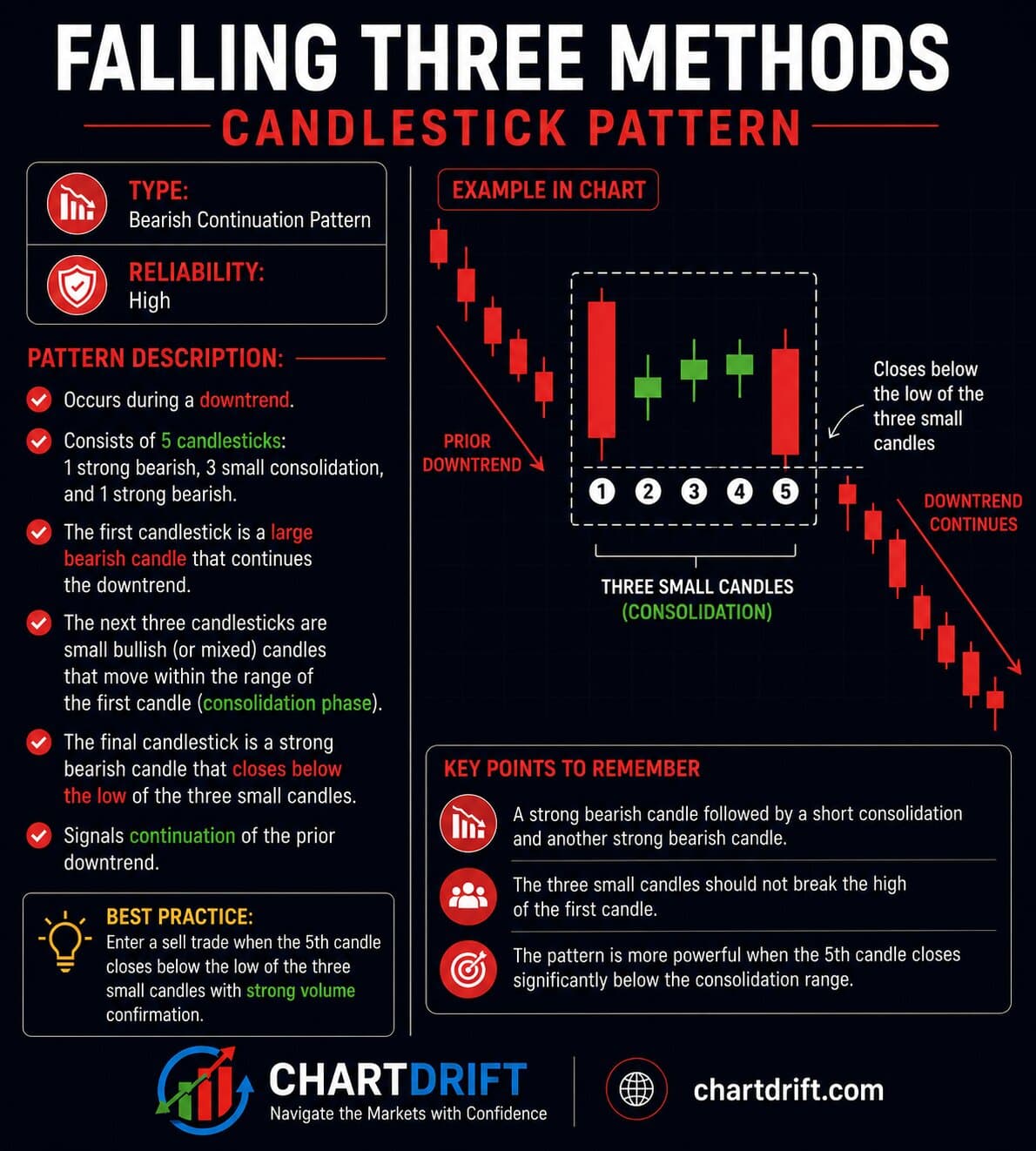
What is the Falling Three Methods Pattern?
The Falling Three Methods is a five-candle bearish continuation pattern that appears during downtrends. It's the mirror image of the Rising Three Methods, consisting of a long bearish candle, followed by small bullish candles within its range, and a bearish breakdown candle.
The pattern captures dead cat bounces. After a sharp decline, some traders try to "buy the dip." But the bounce is weak and contained.
Pattern Type
Five-candle bearish continuation
Reliability
High—confirms trend strength
Signal
Bounce failed, trend continues
The Psychology Behind the Pattern
Day One: Sellers dominate, creating a substantial decline. Some traders see "value."
Days 2-4: Bargain hunters step in. Price bounces. But look closely—the bounce can't reclaim the first candle's high.
Day Five: The trap snaps shut. Sellers return, driving prices through support to new lows.
How to Identify the Pattern
Existing Downtrend
The pattern only works in a downtrend context.
First Candle: Long Bearish
A decisive bearish candle that establishes containment range.
Middle Candles: Small Bullish, Contained
2-4 small bullish candles that stay within the first candle's range.
Final Candle: Bearish Breakdown
A long bearish candle that closes below the first candle's low.
Trading Strategy
Entry Point
Enter short when price breaks below the fifth candle's low.
Stop Loss
Place stop above the first candle's high.
Targets
First target: Previous support level or 1:1 risk/reward ratio.
Second target: 1:2 risk/reward ratio or next major support.
Falling vs Rising Three Methods
Falling Three Methods
- • Appears in downtrends
- • First & last candles bearish
- • Middle candles bullish (failed bounce)
- • Trade: Short positions
Rising Three Methods
- • Appears in uptrends
- • First & last candles bullish
- • Middle candles bearish (healthy pullback)
- • Trade: Long positions
Common Mistakes to Avoid
Bounce Breaks Containment
If any bullish candle closes above the first candle's high, the pattern is invalidated.
Shorting Near Major Support
Even valid patterns can fail at major support zones.
Frequently Asked Questions
What is the falling three methods candlestick pattern?
The falling three methods is a five-candle continuation pattern in a downtrend. The first candle is a strong bearish candle; the next three candles are small bullish (or doji) candles that stay within the range of the first candle; the fifth candle is a strong bearish candle that closes below the first candle’s low. It signals that the downtrend is resuming.
Do the three middle candles have to stay inside the first candle?
Yes. The three middle candles should stay within the range (high to low) of the first candle. If any of the three closes above the first candle’s high, the pattern is invalidated. The pullback should be contained, showing that sellers are still in control.
Where should I place my stop loss on falling three methods?
Place your stop loss above the high of the first candle (the strong bearish one) or above the high of the three middle candles. If price breaks above that level, the continuation setup is invalidated. Some traders use the recent swing high for a wider stop.
How is falling three methods different from rising three methods?
Falling three methods is a bearish continuation pattern: strong bearish candle, three small rally candles, then another strong bearish candle. Rising three methods is a bullish continuation pattern: strong bullish candle, three small pullback candles, then another strong bullish candle. Same structure, opposite direction.
Should I short before or after the fifth candle closes?
Wait for the fifth candle to close below the low of the first candle. The pattern is only complete at that point. Entering before the fifth candle closes can lead to false signals if the fifth candle reverses. Many traders enter on the next candle or when price breaks below the fifth candle’s low.